


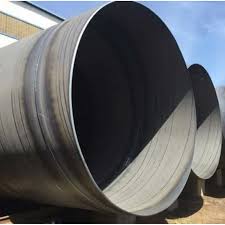
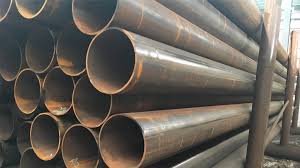
EN 10217-2 P265GH is a standard and widely used material specification for manufacturing Spiral Submerged Arc Welded (SSAW) steel pipes [citation:1, citation:3, citation:4]. This combination is a common product offered by numerous global manufacturers for high-temperature pressure applications such as boilers, heat exchangers, superheaters, and industrial process piping requiring elevated temperature properties [citation:3, citation:6, citation:9].
The designation "EN 10217-2 P265GH Spiral Submerged Arc Pipe" combines a higher-strength high-temperature pressure grade (P265GH) from the European pressure pipe standard with the spiral welding process for large-diameter, pressure-rated piping solutions requiring guaranteed elevated temperature performance and PED compliance [citation:3, citation:9].
📋 Key Specifications for EN 10217-2 P265GH SSAW Pipe
The table below summarizes the primary specifications for this product, based on comprehensive industry data [citation:2, citation:3, citation:4, citation:5, citation:6, citation:8, citation:9].
| Attribute | Description |
|---|---|
| Standard | EN 10217-2: "Welded steel tubes for pressure purposes - Technical delivery conditions - Part 2: Electric welded non-alloy and alloy steel tubes with specified elevated temperature properties" [citation:3, citation:8, citation:9]. |
| Steel Grade | P265GH: A higher-strength high-temperature pressure grade. "P" indicates pressure purpose, "265" indicates minimum yield strength in MPa, and "GH" stands for "Gases" and "High" temperature, indicating suitability for elevated temperature service [citation:2, citation:5, citation:9]. |
| Material Number | 1.0425 [citation:2, citation:5, citation:8]. |
| Manufacturing Process | Spiral Submerged Arc Welding (SSAW/HSAW/SAWH) : Formed from hot-rolled steel coil, with the weld seam running continuously in a spiral along the pipe's length. EN 10217-2 permits both longitudinal (SAWL) and helical (SAWH) seam welding [citation:1, citation:3, citation:4]. |
| Chemical Composition (max %) [citation:2, citation:5, citation:8, citation:9] | Carbon (C): 0.20% max Silicon (Si): 0.40% max Manganese (Mn): 1.40% max Phosphorus (P): 0.025% max Sulfur (S): 0.020% max Aluminum (Al tot): ≥ 0.020% min (mandatory for GH grades) Cr+Cu+Mo+Ni: 0.70% max total residual elements CEV: ≤ 0.43% max [citation:3, citation:5] |
| Mechanical Properties at Room Temperature [citation:2, citation:5, citation:8, citation:9] | Yield Strength (t ≤ 16mm): 265 MPa minimum Yield Strength (16 < t ≤ 40mm): 255 MPa minimum Tensile Strength: 410-570 MPa Elongation (longitudinal): ≥ 23% Elongation (transverse): ≥ 21% |
| Elevated Temperature Yield Strength (Rp0.2 min, MPa) [citation:3, citation:5, citation:8] | 100°C: 226 MPa 150°C: 213 MPa 200°C: 192 MPa 250°C: 171 MPa 300°C: 154 MPa 350°C: 141 MPa 400°C: 134 MPa |
| Impact Properties [citation:2, citation:5, citation:8, citation:9] | Charpy V-notch Impact: 40 J minimum at 0°C (longitudinal) 28 J minimum at -10°C (longitudinal, Option 5) 27 J minimum at 0°C (transverse) |
| Typical Size Range [citation:3, citation:4, citation:6] | Outside Diameter: 219 mm to 4064 mm (approx. 8" to 160") for SSAW [citation:3, citation:6] Wall Thickness: 5 mm to 60 mm (common range 6-32 mm) [citation:3, citation:5] Length: 3 m to 18 m standard; up to 25 m available |
| Key Testing Requirements [citation:3, citation:5, citation:8, citation:9] | Chemical Analysis: Per cast Tensile Test: At room temperature (per batch) Elevated Temperature Tensile: When specified Impact Test: Mandatory Charpy V-notch at 0°C (40J longitudinal) Bend Test: For weld integrity Flattening Test: For ductility Hydrostatic Test: 100% of pipes; ≥ 1.5 × design pressure for ≥ 10 seconds; max 7 MPa [citation:8, citation:9] NDT of Weld: 100% ultrasonic or radiographic inspection of entire weld seam [citation:3, citation:5, citation:8] Visual Inspection: 100% of pipes |
| Test Categories [citation:3, citation:5, citation:8] | TC1: Standard test category for non-alloy steel tubes, including mandatory impact testing and NDT of weld seam TC2: Enhanced test category with additional NDT of the pipe body; mandatory for alloy steel tubes |
| Temperature Range | Designed for elevated temperature service up to 400°C with guaranteed yield strength properties [citation:2, citation:5, citation:8, citation:9]. |
| PED Compliance | EN 10217-2 is harmonized with the EU Pressure Equipment Directive 2014/68/EU. Pipes manufactured to this standard with EN 10204 Type 3.1 certification are suitable for CE-marked pressure equipment [citation:3, citation:8, citation:9]. |
| Common Applications [citation:3, citation:6, citation:9] | Boiler tubes; superheater tubes; heat exchangers; feedwater lines in power plants; steam piping; industrial process piping at elevated temperatures (up to 400°C); chemical plant piping; pressure vessels; district heating systems. |
| Certification | Mill Test Certificate to EN 10204 Type 3.1 (or Type 3.2 for independent verification) with full test results, traceability records, and PED documentation [citation:3, citation:5, citation:8]. |
📊 EN 10217-2 Grade Comparison
P265GH is the higher-strength grade in the EN 10217-2 specification, offering superior performance for more demanding pressure applications. The table below shows its position relative to other grades [citation:2, citation:5, citation:8, citation:9]:
| Grade | Minimum Yield Strength (MPa) | Tensile Strength (MPa) | Impact Testing (0°C) | Key Feature | Typical Application |
|---|---|---|---|---|---|
| P195GH | 195 | 320-440 | 40J | Entry-level high-temperature | Low-pressure boilers, heat exchangers |
| P235GH | 235 | 360-500 | 40J | Medium strength | General boiler applications, power plant piping |
| P265GH | 265 | 410-570 | 40J | Higher strength - MOST WIDELY USED | High-pressure boiler tubes, superheater components, steam piping |
| 16Mo3 | 280 | 450-600 | 40J (20°C) | Cr-Mo alloy steel | High-temperature service up to 500°C |
📏 Dimensional Tolerances
EN 10217-2 specifies the following typical tolerances for SSAW pipes [citation:3, citation:5, citation:8]:
| Parameter | Tolerance |
|---|---|
| Outside Diameter (D ≤ 219.1mm) | ±1% or ±0.5mm (whichever is greater) |
| Outside Diameter (D > 219.1mm) | ±0.75% of specified diameter |
| Wall Thickness (T ≤ 5mm) | ±10% or ±0.3mm (whichever is greater) |
| Wall Thickness (T > 5mm) | ±8% |
| Straightness | ≤ 0.0015 × L (max 3mm per meter) [citation:4, citation:7, citation:8] |
| Length (L ≤ 6000mm) | 0 – +10 mm (D < 406.4mm); 0 – +25 mm (D ≥ 406.4mm) |
| Length (6000 < L ≤ 12000mm) | 0 – +15 mm (D < 406.4mm); 0 – +50 mm (D ≥ 406.4mm) |
| Out-of-Roundness (D > 406.4mm, D/T ≤ 100) | ≤ 2% |
🔍 Key Points to Understand
What "EN 10217-2 P265GH" Means: This is the European standard for welded pressure pipes with specified elevated temperature properties. P265GH is a higher-strength grade, with minimum yield strength of 265 MPa at room temperature. The "GH" suffix indicates suitability for Gases and High temperature service, with guaranteed properties up to 400°C [citation:2, citation:5, citation:9]. Pipes to this standard are designed to meet the essential safety requirements of the EU Pressure Equipment Directive (PED) 2014/68/EU [citation:3, citation:8].
Elevated Temperature Capability: The key feature of P265GH is its guaranteed strength at elevated temperatures up to 400°C. The yield strength decreases with temperature, as shown in the table above [citation:3, citation:5, citation:8]. This allows designers to calculate allowable stresses for high-temperature applications using the provided Rp0.2 values.
Mandatory Impact Properties: GH grades require mandatory Charpy impact testing at 0°C (40J longitudinal minimum), ensuring toughness for safety-critical pressure applications [citation:2, citation:5, citation:8].
Aluminum Requirement: P265GH requires minimum aluminum content of 0.020% for grain refinement, ensuring fine-grain structure and enhanced mechanical properties, which is a key requirement for PED compliance [citation:2, citation:5, citation:8].
PED Compliance: EN 10217-2 is harmonized with the EU Pressure Equipment Directive 2014/68/EU. Pipes manufactured to this standard with EN 10204 Type 3.1 certification are presumed to conform to the essential safety requirements of the PED and can be CE marked [citation:3, citation:8, citation:9].
Test Categories [citation:3, citation:5, citation:8]:
TC1: Standard test category for non-alloy steel tubes, including chemical analysis, tensile testing, flattening test, mandatory impact testing, and NDT of the weld seam
TC2: Enhanced test category with additional NDT of the pipe body; mandatory for alloy steel tubes (e.g., 16Mo3)
Multi-Certification: Many manufacturers offer P265GH pipes that are multi-certified to cover other standards. For example, Tata Steel's Inline™ 265 is certified to EN 10217-2 P265GH, API 5L Grade B, API 5L X42, EN 10217-1 P265TR1/TR2, and EN 10219 S275J2H, offering flexibility for projects with multiple requirements .
SSAW Advantages for P265GH: The spiral welding process offers specific benefits for large-diameter, PED-compliant pipes [citation:3, citation:4, citation:6]:
Large Diameter Capability: Can economically produce pipes up to 160" diameter
PED Compliance: EN 10217-2 explicitly permits SAWH (helical submerged arc welding) for pressure applications
Long Lengths: Up to 25m lengths reduce field joints
100% NDT: Mandatory ultrasonic or radiographic inspection ensures weld quality [citation:3, citation:5, citation:8]
🔧 Manufacturing Process for EN 10217-2 P265GH SSAW Pipe
The manufacturing process follows enhanced quality controls suitable for GH certification and PED compliance [citation:3, citation:5, citation:8]:
| Step | Description |
|---|---|
| 1. Raw Material Preparation | Hot-rolled steel coils meeting P265GH chemistry requirements (fully killed, fine grain steel with Al ≥ 0.020%) are leveled, inspected, and edge-milled [citation:3, citation:5, citation:8]. |
| 2. Spiral Forming | The steel strip is continuously formed into a cylindrical shape at a specific helix angle at room temperature using JCOE or similar forming technology [citation:3, citation:4]. |
| 3. Submerged Arc Welding | Double-sided automatic submerged arc welding (inside and outside) creates the spiral seam with full penetration. SAW tubes can be manufactured with longitudinal (SAWL) or helical (SAWH) seams [citation:1, citation:3, citation:4]. |
| 4. Non-Destructive Testing | 100% ultrasonic (UT) or radiographic (RT) inspection of the entire weld seam is mandatory per EN 10217-2 requirements [citation:3, citation:5, citation:8]. For TC2, additional NDT of the pipe body is required . |
| 5. Hydrostatic Testing | Each pipe individually tested to verify pressure integrity (≥ 1.5 × design pressure, ≥ 10 seconds; max 7 MPa) [citation:8, citation:9]. |
| 6. Mechanical Testing | Tensile tests (room temperature and optionally elevated temperature), flattening tests, bend tests, and mandatory Charpy impact testing at 0°C to verify properties [citation:2, citation:5, citation:8]. |
| 7. Dimensional Inspection | 100% verification of dimensions, straightness, and end squareness per EN 10217-2 tolerances . |
| 8. End Finishing | Ends prepared (plain or beveled) for field welding; beveled ends for wall thickness > 4mm typically [citation:3, citation:5]. |
| 9. Certification | EN 10204 Type 3.1 or 3.2 inspection certificate with full traceability, chemical analysis, mechanical properties, NDT results, and PED documentation [citation:3, citation:5, citation:8]. |
🏭 Applications
EN 10217-2 P265GH SSAW pipes are widely used in demanding high-temperature pressure applications [citation:3, citation:6, citation:9]:
| Application | Temperature Range | Why P265GH is Chosen |
|---|---|---|
| Boiler Tubes | Up to 400°C | Guaranteed elevated temperature strength; higher strength than P235GH for higher pressures [citation:3, citation:9] |
| Superheater Tubes | Up to 400°C | Excellent high-temperature creep resistance; mandatory impact properties |
| Heat Exchangers | Up to 400°C | Good weldability; certified pressure rating; PED compliance |
| Steam Piping | Up to 400°C | Reliable performance; full traceability; CE marked [citation:3, citation:9] |
| Power Plant Piping | Up to 400°C | Higher strength allows reduced wall thickness [citation:3, citation:6] |
| Industrial Process Piping | Up to 400°C | European standard compliance; suitable for high-temperature fluids |
| Pressure Vessels | Up to 400°C | PED Category II, III, IV applications with specific inspection |
| Feedwater Lines | Up to 300°C | Excellent performance in power plant systems |
📝 Important Considerations
PED Compliance: EN 10217-2 is harmonized with the EU Pressure Equipment Directive 2014/68/EU. Pipes to this standard with EN 10204 Type 3.1 certification are suitable for CE-marked pressure equipment [citation:3, citation:8, citation:9].
Test Category Selection: For critical applications, specify TC2 test category which includes additional NDT of the pipe body and is mandatory for alloy steel tubes [citation:3, citation:5, citation:8].
Supplementary Options :
Option 4: Impact testing at specified temperature (e.g., -20°C)
Option 5: Additional longitudinal impact test at -10°C (28J minimum)
Option 2: Tighter limits on copper content for improved formability
Temperature Derating: Design must account for the reduction in yield strength at elevated temperatures. Use the provided Rp0.2 values for accurate allowable stress calculations at the design temperature [citation:3, citation:5, citation:8].
International Equivalents [citation:5, citation:10]:
ASTM A106 Grade C (seamless, similar strength)
DIN 17177 St42.8 (German equivalent)
JIS G 3456 STPT480 (Japanese equivalent)
ISO 9330-2 PH26
GB/T 5310 20G (Chinese standard for boiler tubes)
Weldability: P265GH has good weldability with carbon equivalent (CEV ≤ 0.43). For pressure vessel applications, welding procedures should be qualified in accordance with relevant codes [citation:3, citation:5].
Complete Specification: When ordering, specify [citation:3, citation:5, citation:8]:
EN 10217-2, Grade P265GH, Test Category [TC1 or TC2], SAWH (spiral welded), Size (OD x WT), Length, End Finish
Standard version: [e.g., EN 10217-2:2019]
Coating requirements: [e.g., bare, varnish, FBE, 3LPE]
Any supplementary options (Option 4, Option 5) if required
Certification: EN 10204 Type 3.1 (or Type 3.2)
📝 Summary
EN 10217-2 P265GH Spiral Submerged Arc Welded pipes are a premium, PED-compliant, and widely used choice for elevated temperature pressure applications under the European pressure pipe standard [citation:3, citation:6, citation:9, citation:10]. With minimum room temperature yield strength of 265 MPa and guaranteed elevated temperature properties up to 400°C, these pipes offer a reliable, cost-effective solution for boiler tubes, superheaters, heat exchangers, steam piping, and other demanding high-temperature applications [citation:3, citation:9].
The P265GH grade provides essential features including:
Guaranteed elevated temperature strength with documented Rp0.2 values up to 400°C [citation:3, citation:5, citation:8]
Mandatory Charpy impact testing at 0°C (40J minimum) ensuring toughness for safety-critical pressure applications [citation:2, citation:5, citation:8]
Minimum aluminum content (≥0.020%) for grain refinement and enhanced properties [citation:2, citation:5, citation:8]
PED 2014/68/EU compliance for CE-marked pressure equipment [citation:3, citation:8, citation:9]
Two test categories (TC1 and TC2) allowing selection of appropriate quality level based on application criticality [citation:3, citation:5, citation:8]
Available in diameters from 219mm to over 4000mm with wall thicknesses to 60mm and lengths up to 25m, these pipes are produced using the cost-effective SSAW manufacturing process while meeting the rigorous requirements of the EN 10217-2 specification [citation:3, citation:4, citation:6].
P265GH is the most widely used high-temperature grade in the EN 10217-2 family for higher-pressure boiler and superheater applications. For service above 400°C up to 500°C, specify the alloy steel grade 16Mo3 [citation:8, citation:9].
When ordering, ensure you clearly indicate the complete standard with grade, test category (TC1 or TC2), manufacturing process (SAWH), required dimensions, and any coating or supplementary requirements based on your specific application and PED requirements [citation:3, citation:5, citation:8].


