


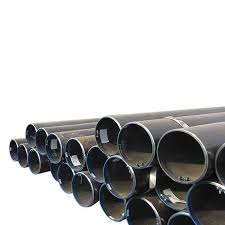
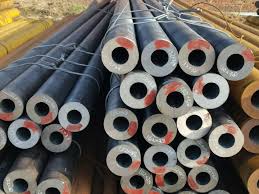
What is EN10210?
EN 10210 is a European Standard that specifies the technical delivery requirements for non-alloy and fine grain steel structural hollow sections (like pipes and tubes) used for construction purposes. The key points are:
Scope: It covers seamless (Part 1) and hot-finished welded (Part 2) steel hollow sections.
Purpose: These sections are primarily intended for use in load-bearing structures, such as buildings, bridges, and other construction projects.
Process: The standard covers pipes that are either seamless (SMLS) or hot-finished welded (HFW). The hot-finishing process refines the weld and grain structure, making it comparable in strength to seamless pipe.
Key Parts of the Standard
EN 10210-1:2006 - Technical delivery conditions for non-alloy and fine grain steel tubes. This part covers the general requirements, testing, inspection, and documentation.
EN 10210-2:2006 - Technical delivery conditions for non-alloy and fine grain steel hollow sections. This part specifies the dimensions and sectional properties.
Common Steel Grades
EN10210 pipes are made from several steel grades, which define their mechanical properties (like yield strength and tensile strength). The most common grades are:
S235JRH (Replaced the older S235JR grade):
Minimum Yield Strength: 235 MPa
Good ductility and impact resistance.
A general-purpose structural steel, commonly used for less demanding applications.
S275JOH (Replaced the older S275JO grade):
Minimum Yield Strength: 275 MPa
Improved impact resistance compared to S235.
Very popular for a wide range of structural applications.
S355J2H (The most common high-strength grade):
Minimum Yield Strength: 355 MPa
Excellent strength and good toughness at lower temperatures.
The go-to choice for highly stressed components, large structures, and dynamic loading situations.
S355K2H:
Similar to S355J2H but with specified elevated temperature properties.
Used in applications where the steel might be exposed to higher temperatures.
Note on the "H" suffix: The "H" at the end of the grade (e.g., J2H) indicates that the material properties are specified for hollow sections.
Key Characteristics & Advantages
High Strength-to-Weight Ratio: The hollow section is an efficient shape, providing high strength and stiffness without excessive weight, leading to material and cost savings.
Excellent Weldability and Formability: The fine-grain steel chemistry makes these pipes easy to weld, cut, and form without compromising their structural integrity.
Aesthetically Pleasing: The clean, consistent appearance of structural hollow sections is often preferred in modern architectural designs.
Consistent Mechanical Properties: The hot-finished process ensures a homogeneous structure with consistent properties throughout the pipe's cross-section.
Durability: When properly protected (e.g., by painting or galvanizing), they offer long service life.
Typical Applications
EN10210 carbon steel pipes are fundamental to modern construction:
Building Frames and Structures: Columns, beams, and trusses in commercial, industrial, and residential buildings.
Bridges: As primary structural members in footbridges, road bridges, and complex architectural bridges.
Architectural and Decorative Applications: Staircases, balustrades, canopies, and sculptural elements.
Mechanical and Plant Structures: Support frames for heavy machinery, conveyor systems, and industrial platforms.
Agricultural and Infrastructure Projects: Gates, fencing, and support structures.
Comparison with Other Standards
It's helpful to compare EN10210 with other common standards:
| Feature | EN 10210 | EN 10219 (Cold-Formed) | ASTM A500 (USA) |
|---|---|---|---|
| Process | Hot-Finished (Seamless or Welded) | Cold-Formed (Welded) | Cold-Formed (Welded - Grade A, B, C) or Hot-Formed (Grade D) |
| Tolerances | Less strict on dimensional tolerances | Tighter dimensional tolerances | Similar to EN10219 for cold-formed |
| Surface Finish | Slight mill scale | Cleaner, smoother finish | Varies |
| Corner Radii | Larger, more rounded corners | Smaller, sharper corners | Smaller, sharper corners |
| Key Advantage | Superior structural properties, better for welding and dynamic loads | Cost-effective, excellent for precise fabrication | Common in the American market |
Key Takeaway: EN10210 hot-finished sections are generally preferred for primary, highly stressed structural members due to their superior mechanical properties, while EN10219 cold-formed sections are often used for secondary structures where precise dimensions and a cleaner finish are more important.
Summary
EN10210 Carbon Steel Pipe represents a high-quality, reliable product for structural engineering. Its specification ensures the material has the strength, ductility, and weldability required for safe and durable construction. When you see "EN10210 S355J2H" on a material certificate, you can be confident you have a high-strength, fine-grain steel pipe suitable for demanding structural applications.


