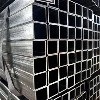
E355 honed tube is an EN 10305-1 precision tube steel - material number 1.0580 - supplied with an ISO H8 bore, a Ra 0.2–0.4 µm cross-hatch finish, bores from 32 mm to 500 mm and lengths up to 12 m. The strength to design against is ReH ≥450 MPa, because barrel tube ships in the stress-relieved (+SR) condition; the 355 MPa that fills online datasheets is the normalized (+N) figure and understates the steel by about a quarter. What buyers actually have to decide is not the grade but three things around it: the delivery condition, the bore tolerance class, and whether their size still sits inside the standard at all.
GNEE supplies E355 honed tube in ID 32–500 mm, wall 4–50 mm and lengths up to 12 m, in +SR and +N, with EN 10204 3.1 mill certificates. Send your bore, wall and delivery condition for a quotation.
Specifications
| Item | Range |
|---|---|
| Bore (ID) | 32–500 mm; imperial bores from 1.5" to 20" |
| Wall thickness | 4–50 mm |
| Length | Up to 12 m; cut to length on request |
| Bore tolerance | H8 standard, H7, H9 and H10 on request |
| Bore roughness | Ra 0.2–0.4 µm honed; Ra 0.05–0.2 µm skived and roller burnished |
| Cross-hatch angle | 30–45° |
| Straightness | ≤0.5 mm/m local deviation |
| Wall tolerance | ±10 %, or ±0.1 mm, whichever is greater |
| Delivery condition | +SR (BKS) standard; +N (NBK) and +C (BK) available |
| Certificate | EN 10204 3.1 |
Bore tolerance classes, and when to use each
| Class | What it costs you | Reasonable when |
|---|---|---|
| H8 | Standard for barrel tube; no premium at most sizes | Piston seals running directly on the bore - the normal case |
| H9 | Slightly cheaper, wider band | Bore will be finish-machined after welding, or a liner or sleeve is fitted |
| H7 | Costs yield, because more stock is honed away and the rejection rate rises | Interference fits or precision guide bores where the seal package is dimensionally critical |
| H10 | Cheapest honed class | Non-sealing cylinders, telescopic stages with separate wear rings |
Decide the class before the tube is drawn. Reaching H7 usually means starting from a thicker wall and removing more material on the bore, and a size already drawn for H9 cannot simply be honed further into H7 without accepting a larger bore than ordered.
Chemical Composition
| C | Si | Mn | P | S | Al total |
|---|---|---|---|---|---|
| 0.22 | 0.55 | 1.60 | 0.025 | 0.025 | 0.020 min |
How an E355 Honed Tube Is Made
Steelmaking. Fully killed, aluminium-treated carbon-manganese steel, cast and rolled to a hot-finished seamless hollow.
Cold drawing. The hollow is drawn over a mandrel through a die to the ordered outside diameter and wall, which sets the dimensional accuracy and the wall thickness tolerance.
Stress relief. Controlled-atmosphere heat treatment to +SR, removing drawing stress while retaining part of the cold work - this is where the 450 MPa comes from.
Straightening. Roller straightening to the ordered straightness, usually ≤0.5 mm/m local deviation.
Boring, where required. Large-bore sizes are pre-bored to leave a uniform honing allowance; smaller sizes go straight to honing.
Honing. Rotating and reciprocating abrasive stones under controlled pressure cut the bore to size and leave the 30–45° cross-hatch. Honing is a low-force cutting process, so it corrects taper, ovality and waviness rather than copying them.
Inspection and protection. Bore gauging at several positions, roughness and straightness checks, oiling, deburring and end caps.
Skiving and roller burnishing is the alternative finishing route for the same mother tube, reaching Ra 0.05–0.2 µm at a much higher metal-removal rate.
Quality Control and Testing
EN 10305-1 requires tensile testing per batch and leaves impact testing, hardness limits and non-destructive testing to agreement. That means the inspection you get is largely the inspection you asked for.
| Check | What it proves |
|---|---|
| Cast analysis against Table 2 | The grade, and the Al / Nb / Ti clause |
| Tensile test on a sample from the batch | That the delivery condition was actually applied. A +SR tube tested at 355 MPa is a +N tube |
| Bore gauging at three or more positions along the length | Diameter, taper and ovality - the three things a single measurement at the end misses |
| Roughness check on the bore | Ra, and whether the cross-hatch is uniform along the tube rather than only at the ends |
| Straightness and wall thickness | That the tube will fit the cylinder's guide and seal geometry |
| Visual and dimensional inspection of ends | No rolled-in scale, no handling damage at the bore lip, deburred and capped |
| Ultrasonic or eddy current, when ordered | Internal soundness - not required by the standard for this product |
Hardness is worth a note. EN 10305-1 sets no Brinell requirement for E355 in the stress-relieved condition, so the figures that appear on honed tube datasheets - around 190 HB in BK+S - are mill commitments, not standard values. They are useful for tracking consistency between deliveries, not as a basis for a design calculation.
Test and inspection


Packaging and shipping


Send your bore, wall thickness, length and delivery condition and we will quote against the correct EN 10305-1 line and confirm which of your sizes sit inside the standard. Samples and third-party inspection available before a production order.
Why Source from GNEE
The grade data is stated per condition. Quotations and certificates identify the delivery condition and give the matching yield - so a +SR tube is never quoted at 355 MPa and a +N tube is never priced as a barrel grade.
Both routes in one place. Cold-drawn EN 10305-1 sizes and the larger bored-and-honed sizes, so a project with several bore sizes does not end up split across two suppliers with two sets of certificates.
Certificate-first documentation. EN 10204 3.1 with heat number, cast analysis, tensile result and condition, plus dimensional and bore inspection records.
Third-party inspection welcome. SGS, BV and TÜV inspections are arranged on request, and we will supply samples ahead of a production order.
Optional finishes and cut lengths. Honed or skived and roller burnished bores, cut to length, deburred, oiled and end-capped for shipment.
FAQ
What is E355 honed tube?
A cold-drawn seamless precision tube in grade E355 (steel number 1.0580) to EN 10305-1, supplied stress relieved (+SR) with the bore honed to ISO H8 and Ra 0.2–0.4 µm. It is used as cylinder barrel stock, so the piston and seals run directly on the delivered bore with no further machining.
Is E355 the same as ST 52.3?
Yes. They share the material number 1.0580 and describe the same steel; St 52-3 was the DIN 2391 designation, E355 is the EN 10305-1 name that replaced it. A page that presents them as two grades of different strength is comparing two delivery conditions, not two steels.
Why does E355 show both 355 MPa and 450 MPa?
Because there are five delivery conditions in EN 10305-1 and each has its own minimum. 355 MPa is the normalized (+N) value; 450 MPa is the stress-relieved (+SR) value that honed barrel tube is actually supplied in, dropping to 420 MPa above 160 mm outside diameter. Design to the condition you are buying, not to the one in the first table you find.
What does +SR mean, and do I need it?
+SR means the tube was stress relieved in a controlled atmosphere after the final cold-drawing pass, which raises yield to at least 450 MPa, holds residual stress down and keeps bore distortion to a minimum during welding. Order it for any welded barrel. Do not order it if the tube will be flared or bent after honing, because elongation is only 10 %; use +N instead.
Should I specify H8 or H9?
H8 if the piston seals will run directly on the delivered bore - that is the normal barrel case. H9 if the bore will be finish-machined after welding or a liner will be fitted. Both are honed bores; the difference is how much material is removed and how much of the batch gets rejected reaching the tighter band.
Can E355 honed tube be welded?
Yes, and it is welded every day into cylinder barrels. EN 10305-1 sets no carbon equivalent limit, so ask for the CEV of the heat: a heat at the composition ceiling reaches about 0.49, where preheat of 100–150 °C is usual for walls over 25 mm. Control heat input near the finished bore, because local heating releases residual stress unevenly and the bore moves.
Can I get a 400 mm bore E355 honed tube to EN 10305-1?
No. EN 10305-1 covers outside diameters up to 380 mm and walls up to 25 mm. A 400 mm bore comes from the EN 10297-1 mechanical tube route, bored and honed to size, and its yield is graded by wall thickness rather than fixed. Ask which route your size takes, because the certificate and the grade reference change with it.
How much pressure can an E355 barrel take?
It depends on the ratio of outside to inside diameter, not on the wall thickness alone. At ReH 450 MPa and a 4:1 design factor, a 100 mm bore with a 20 mm wall works to about 365 bar, while a 250 mm bore with a 25 mm wall works to about 200 bar. Give us both the bore and the wall and we will confirm the figure against your own design factor.
Summary
E355 is the default cylinder barrel grade in Europe for a reason: an unalloyed carbon-manganese steel with enough strength for most hydraulic duty, weldable without elaborate procedure, and available in a dimensional accuracy that lets the bore be used as delivered. The two things that trip buyers up are not the grade. The first is the delivery condition - 355 MPa is the normalized value, and a honed barrel is stress relieved at 450 MPa. The second is the size envelope - beyond 380 mm outside diameter the tube is no longer an EN 10305-1 product, and the grade reference has to change with it. Get those two right and the order writes itself.