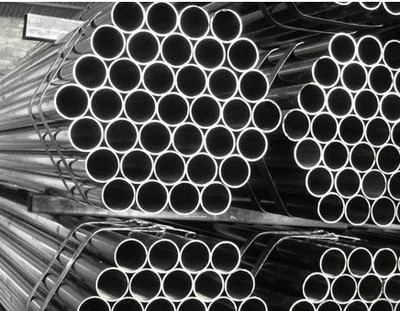
1. Material & Metallurgical Focus
Q: How do material grades and processing differ?
A:
Standard Pipes (e.g., ASTM A53/A106):
Grades: Carbon steel (C ≤0.3%, Mn ≤1.2%).
Process: Hot-rolled or welded (ERW/HFW), minimal post-treatment.
Honed Tubes (e.g., EN 10305-1):
Grades: Fine-grained steels (E355, CK45) with controlled S/P ≤0.025%.
Process: Cold-drawn + annealing + honing for microstructure uniformity.
Key Point: Honed tubes undergo secondary refining (e.g., vacuum degassing) to eliminate inclusions.
2. Dimensional Precision
Q: What tolerance gaps exist between these pipes?
A:
| Parameter | Standard Pipes | Honed Tubes |
|---|---|---|
| OD Tolerance | ±0.75% (ASTM A530) | ±0.01% (ISO 3304) |
| Wall Variation | ≤10% | ≤2% (≤1% for precision honing) |
| Surface Finish | Ra ≤3.2 µm (as-rolled) | Ra ≤0.4 µm (mirror finish) |
Impact: Standard pipes suit structural uses; honed tubes are for精密 motion systems.
3. Surface Treatment & Functionality
Q: How do surface requirements vary?
A:
Standard Pipes:
Coating: Basic anti-rust oil or galvanizing (optional).
Internal: No finishing (Ra ≥6.3 µm).
Honed Tubes:
Coating: Hard chrome plating (20–50 µm) or phosphate.
Internal: Honed (Ra ≤0.4 µm) for seal/piston compatibility.
2025 Trend: Diamond-like carbon (DLC) coatings emerging for honed tubes in aerospace.
4. Manufacturing Complexity & Cost
Q: Why are honed tubes more expensive?
A:
Standard Pipes:
Steps: Forming → Welding → Sizing → Cutting.
Cost: $600–900/ton.
Honed Tubes:
Steps: Cold drawing → Annealing → Honing → QC (100% NDT).
Cost: $2,500–4,500/ton (3–5x premium).
Note: Honing alone removes 0.1–0.3 mm material, increasing waste.
5. Quality Control & Certifications
Q: What tests validate each type?
A:
Standard Pipes:
Tests: Hydrostatic (batch), visual inspection.
Certs: ASTM A53, ISO 9001.
Honed Tubes:
Tests: Eddy current, ultrasonic, roundness mapping.
Certs: ISO 10763 (hydraulic), DIN 2391.