



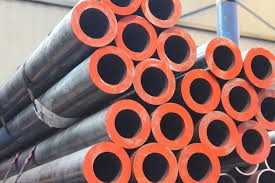
Quick Summary
ASTM A519: This is the standard that specifies the requirements for seamless carbon and alloy steel mechanical tubing. It focuses on the mechanical properties (like tensile strength and hardness) and the chemical composition.
SAE 4140: This is the specific grade of alloy steel defined by the Society of Automotive Engineers. It is a chromium-molybdenum steel known for its high strength, good toughness, and excellent wear resistance.
Seamless: The pipe is formed by piercing a solid billet, creating a tube without any welded seam. This makes it stronger and more reliable for high-pressure applications.
Therefore, ASTM A519 4140 Seamless Steel Pipe is a seamless mechanical tubing made from 4140 alloy steel, manufactured to meet the chemical and mechanical properties outlined in the ASTM A519 standard.
Key Characteristics of SAE 4140 Steel
The properties of the pipe come directly from the 4140 grade composition.
Chemistry:
Carbon (C): ~0.40% - Provides high strength and hardness through heat treatment.
Chromium (Cr): ~0.80-1.10% - Increases hardenability, improves corrosion resistance, and enhances wear resistance.
Molybdenum (Mo): ~0.15-0.25% - Enhances strength at high temperatures and increases hardenability.
Key Properties:
High Strength: Can be heat treated to very high strength levels.
Good Toughness: Maintains good impact resistance even at high strength.
Excellent Wear Resistance: Ideal for parts subject to friction and abrasion.
Good Fatigue Strength: Resists failure under cyclic loading.
Mechanical Properties per ASTM A519
ASTM A519 specifies minimum mechanical properties based on the heat treatment condition. The values for 4140 can vary significantly depending on whether it is annealed, normalized and tempered, or quenched and tempered.
The most common condition for high-strength applications is Quenched and Tempered (Q&T).
Typical Mechanical Properties for 4140 Q&T:
| Property | Typical Value (Q&T) | Notes |
|---|---|---|
| Tensile Strength | 95,000 - 120,000 psi (655 - 827 MPa) | Can be adjusted via tempering temperature. |
| Yield Strength | 60,000 - 100,000 psi (414 - 690 MPa) | Must be at least 60,000 psi (414 MPa) per standard. |
| Elongation (in 2") | 15% - 20% | Measure of ductility. |
| Hardness | 197 - 302 Brinell (HB) | Approx. 90 - 32 HRC. Widely variable. |
Other Conditions:
Annealed: Softer, easier to machine. Lower strength (~60-80 ksi Tensile) and higher ductility.
Normalized & Tempered: A balance of strength and machinability.
Common Applications
This material is chosen for applications requiring a combination of high strength, durability, and a seamless structure.
Hydraulic Cylinder Tubes: The most common application. Used for high-pressure hydraulic rams in construction equipment (excavators, bulldozers), manufacturing machinery, and aerospace.
Power Transmission Shafting: Used for drive shafts, gear shafts, and axles where high torsional strength is needed.
Machine Components: For gears, spindles, bolts, and other critical parts that undergo high stress and wear.
Oil & Gas Industry: Downhole tubing, mandrels, and other components in wellhead equipment.
Automotive Racing: For high-performance suspension components, roll cages, and drive train parts.
Advantages of Using ASTM A519 4140 Seamless Pipe
No Weld Seam: Eliminates the potential for weld defects, making it superior for high-pressure and high-stress applications.
High Strength-to-Weight Ratio: Allows for the design of lighter, stronger components.
Excellent Machinability (in annealed condition): Can be easily machined to precise tolerances before a final heat treatment.
Predictable Properties: The ASTM standard ensures consistent chemical and mechanical properties.
Important Considerations
Heat Treatment: The final properties are achieved through heat treatment (quenching and tempering). The condition you order (e.g., annealed vs. Q&T) depends on your manufacturing process and end-use requirements.
Machining: 4140 is tough to machine in its fully hardened state. It is typically machined in an annealed condition and then heat-treated to achieve its final strength.
Weldability: 4140 has fair weldability but requires pre-heating and post-weld heat treatment (PWHT) to avoid cracking and to restore mechanical properties in the heat-affected zone (HAZ). It is not typically chosen for fabrication that involves extensive welding.
Corrosion Resistance: Like most carbon and alloy steels, it is susceptible to corrosion and will require a protective coating (paint, plating, etc.) if used in corrosive environments.
Related Standards
ASTM A106: Standard for seamless carbon steel pipe for high-temperature service. This is for pressure piping, while A519 is for mechanical tubing.
SAE J412: Another standard that defines 4140 steel grade.
AMS 6380 / AMS 6381: Aerospace Material Specifications for 4140 steel seamless tubing.
In summary, ASTM A519 4140 Seamless Steel Pipe is a premium-grade material selected for demanding mechanical applications where failure is not an option. Its seamless nature and the high performance of 4140 alloy make it a reliable choice for critical components across many industries.


