


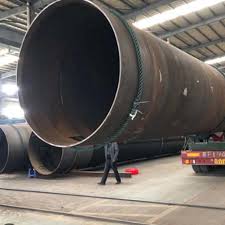

ASTM A672: Standard Specification for Electric-Fusion-Welded Steel Pipe for High-Pressure Service at Moderate Temperatures
This is the definitive specification for factory-made, longitudinally welded steel pipe using the Submerged Arc Welding (SAW) process for pressurized systems. Unlike general structural or piling standards, ASTM A672 is explicitly engineered for high-pressure service in moderate-temperature environments, such as in power generation, petrochemical, and industrial plants.
Core Concept: Grade and Class System
The specification's power lies in its dual classification system, allowing precise selection for design conditions:
GRADE (e.g., A55, B60, C65, E70): Defined by chemical composition and minimum specified tensile strength (the number indicates the tensile strength in ksi).
CLASS (e.g., Class 13, 23, 33): Defined by the heat treatment condition and the corresponding minimum specified yield strength.
This creates a precise call-out: ASTM A672 B60 Class 13, which translates to a carbon-molybdenum steel pipe with a minimum tensile strength of 60 ksi, supplied in the normalized condition.
Technical Specification Tables
Table 1: Common Grades and Their Applications
| Grade | Typical Chemistry | Key Characteristics & Common Applications |
|---|---|---|
| A55 | C-Mn Steel | Basic carbon steel for lower pressure/temperature water and steam lines. |
| B60 | C-½Mo Steel | Carbon steel with 0.5% Molybdenum for improved creep strength. Used for high-temperature steam lines and process piping. |
| C65 | 1¼Cr-½Mo Steel | Low-alloy chromium-molybdenum steel for higher temperature service (e.g., power plant steam lines). |
| E70 | 2¼Cr-1Mo Steel | Higher-strength Cr-Mo alloy for elevated temperature and pressure hydrogen service (e.g., refinery hydrocracker lines). Complies with plate specification ASTM A387 Gr22. |
| L80 | Type 304L Stainless | Austenitic stainless steel for corrosive services or high-purity applications. |
Table 2: Typical Mechanical Properties by Class (Illustrative Examples)
| Grade Class Combination | Typical Min Yield Strength (psi / MPa) | Typical Min Tensile Strength (psi / MPa) | Typical Heat Treatment Condition |
|---|---|---|---|
| A55 Class 13 | 30,000 / 205 | 55,000 / 380 | Normalized |
| B60 Class 13 | 30,000 / 205 | 60,000 / 415 | Normalized |
| B60 Class 23 | 35,000 / 240 | 60,000 / 415 | Normalized and Tempered |
| C65 Class 13 | 30,000 / 205 | 65,000 / 450 | Normalized |
| E70 Class 13 | 40,000 / 275 | 70,000 / 485 | Normalized |
| E70 Class 23 | 45,000 / 310 | 70,000 / 485 | Normalized and Tempered |
Note: Exact values must be taken from the standard's mandatory tables for each Grade and Class.
Table 3: Mandatory Manufacturing & Quality Control Sequence
| Step | Requirement | Purpose & Standard |
|---|---|---|
| 1. Plate/Coil | Must conform to a referenced plate spec (e.g., A285, A515, A387). | Provides traceable base material quality. |
| 2. Forming & Welding | Longitudinal SAW (Single or Double). Weld procedure must be qualified. | Creates the pressure-containing seam. |
| 3. Nondestructive Examination (NDE) | 100% of weld length by Radiography (RT) or Ultrasonic Testing (UT). | Ensures internal weld integrity. No cracks or lack of fusion allowed. |
| 4. Heat Treatment | Mandatory Post Weld Heat Treatment (PWHT) for almost all pipes. Time-Temperature per Grade/Class. | Relieves stresses, improves weld zone toughness. |
| 5. Hydrostatic Test | Every pipe tested. Stress ≥ 75% of SMYS (can be specified up to 95%). Hold ≥ 10 sec. | Proof tests the entire pipe under pressure. |
| 6. Supplementary Tests | Flattening/Bend Test (per lot), Transverse Weld Tension Tests. | Verifies weld ductility and strength. |
Procurement Specification Example
A complete material requisition would specify:
Pipe to ASTM A672 B60 Class 13.
Size: NPS 20", Schedule 80
Process: Double Submerged Arc Welded (DSAW)
Heat Treatment: Full PWHT after welding
Examination: 100% Radiographic Testing of weld seam
Hydrotest: 90% of Specified Minimum Yield Strength (SMYS)
Ends: Beveled ends for welding
Key Distinctions from Other SAW Pipe Standards
vs. API 5L SAW: API 5L is for oil and gas transmission. A672 is for fixed plant piping systems. A672 always requires PWHT and has a different chemical/strength classification system.
vs. ASTM A139 (SAW): A139 is for general fusion-welded pipe, often for lower-pressure conduit or piling. It lacks the mandatory PWHT and strict Grade/Class system of A672.
vs. ASTM A106 (Seamless): A672 is the welded alternative to seamless high-temperature pipe (A106) for larger diameters where seamless is impractical or costly.
In summary, ASTM A672 defines high-integrity, longitudinally SAW pipe for critical pressure applications. Its rigorous linkage of material chemistry (Grade), heat treatment (Class), and mandatory fabrication controls (100% NDE, PWHT) ensures predictable performance in demanding industrial service.


