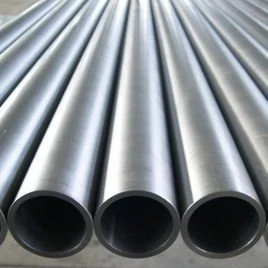
1. What are the basic properties of ASTM A572 Grade 65 steel pipe?
ASTM A572 Grade 65 is an ultra-high-strength low-alloy structural steel in the American Standard (ASTM), representing the highest strength grade in the current A572 series. The "65" designation indicates a minimum yield strength of 65 ksi (approximately 450 MPa), achieved through advanced microalloying (composite additions of Nb, V, and Ti) and a controlled rolling and controlled cooling (TMCP) process. Its core features are:
Ultimate strength: Yield strength ≥ 450 MPa, tensile strength ≥ 550 MPa, and yield strength ratio ≤ 0.85 (ensuring seismic ductility).
Lightweight advantage: Over 30% lighter than Q355 steel, making it particularly suitable for long-span and super-high-rise structures.
Stringent quality control: Must meet additional requirements such as Charpy impact testing and ultrasonic flaw detection.
2. What are the special features of its chemical composition and strengthening mechanism? Alloy Formula Highlights:
Low Carbon, High Manganese: C ≤ 0.23% + Mn ≤ 1.60% base, ensuring weldability
Triple Microalloying: Synergistic Effect of Nb (0.02-0.05%) + V (0.05-0.15%) + Ti (0.01-0.03%)
Purity Control: S ≤ 0.008%, P ≤ 0.020% (Ultra-low Impurity Version Available)
Strengthening Mechanisms:
Grain Refinement (Nb inhibits austenite growth)
Precipitation Strengthening (V/Ti carbonitride dispersion)
Phase Transformation Strengthening (controlled cooling to achieve bainite + acicular ferrite)
3. In which cutting-edge engineering fields is it irreplaceable? Grade 65 is the material of choice for major projects:
Super-high-rise buildings: Massive support columns for skyscrapers over 600 meters (e.g., the core of the Kingdom Tower in Saudi Arabia); Cross-sea bridges: Main saddle structures for suspension bridges and deep-water jacket nodes; Energy equipment: Pressure vessel penetrations for fourth-generation nuclear fast reactors; National defense technology: Track support structures for electromagnetic catapults on aircraft carriers; Transportation innovation: 600 km/h maglev rail beams; 4. How to achieve the performance boundary with Grade 60/Grade 70? Key Comparison Dimensions:
Strength Gradient: Grade 60 (415 MPa) → Grade 65 (450 MPa) → Grade 70 (485 MPa)
Toughness Tradeoff: Grade 65's impact energy at -40°C is approximately 15% lower than Grade 60 (requires specific evaluation).
Cost Difference: Grade 65's unit price is 20-25% higher than Grade 60, but it can reduce material usage by 15%.
Selection Decision Principles:
Grade 65 is mandatory when the design stress is ≥430 MPa or when the weight reduction benefit exceeds the cost increase.
Buildings in seismic zones require additional verification of Grade 65's cyclic loading performance.
Welding Procedure Qualification (PQR) must include Z-axis performance testing (for lamellar tearing resistance).
5. What are the disruptive technical requirements for full-process applications? Key Technical Points for the Full Lifecycle:
Manufacturing:
Online composition analysis using an optical emission spectrometer (OES)
JCOE forming process simulation is mandatory (to avoid cold bending cracks)
Steel annealing (SR) treatment (stress relief annealing) is required on the pipe ends
Construction:
Welding should use metal-cored wire (such as E121T1-K6), preheating to 180-230°C
Flame correction for deformation is prohibited (hydraulic shaping is required)
HV10.9 grade high-strength bolts are required for bolted connections
Operation and Maintenance:
Phase-controlled ultrasonic testing (PAUT) is performed every three years
Fiber Bragg grating sensors are required in stress corrosion-sensitive areas
Carbon arc gouging is prohibited during maintenance (laser root cleaning is recommended)