


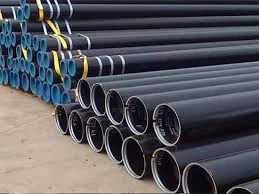

Overview & Common Applications
ASTM A53 is a standard specification for pipe that is suitable for mechanical and pressure applications and is also acceptable for ordinary uses in steam, water, gas, and air lines. It is a general-purpose steel pipe.
Typical Applications Include:
Structural Applications: Fencing, handrails, scaffolding, and structural supports.
Low-Pressure Conveyance: Plumbing, HVAC systems, compressed air lines, and natural gas distribution.
Industrial Use: Process piping in various industrial settings.
Key Specifications & Properties
1. Grades and Types
ASTM A53 covers three types and two grades:
Grade A: Lower strength, better weldability.
Grade B: Higher strength (more common for pressure applications).
Type F: Furnace-Butt Welded (continuous weld). Note: Grade A only.
Type E: Electric-Resistance Welded (ERW).
Type S: Seamless.
2. Chemical Composition (Grade A)
The chemical composition is a key factor in the material's properties, especially weldability.
| Element | Composition (%) |
|---|---|
| Carbon, max | 0.25 |
| Manganese, max | 0.95 |
| Phosphorus, max | 0.05 |
| Sulfur, max | 0.045 |
| Copper, min (when required) | 0.20 |
| Nickel, min (when required) | 0.20 |
| Chromium, min (when required) | 0.20 |
| Molybdenum, min (when required) | 0.08 |
Note: The "copper-bearing" requirement is for enhanced atmospheric corrosion resistance.
3. Mechanical Properties (Grade A)
These are the strength and ductility values.
| Property | Requirement |
|---|---|
| Tensile Strength, min | 330 MPa (48,000 psi) |
| Yield Strength, min | 205 MPa (30,000 psi) |
| Elongation, min | Varies based on wall thickness and specimen type (see table in spec). |
4. Dimensions and Tolerances
Size Range: NPS 1/8" to NPS 26" (Nominal Pipe Size).
Wall Thickness: Governed by "Schedule" numbers (e.g., Sch 40, Sch 80, STD, XS) or by specified wall thickness.
The standard provides detailed tables for outside diameter, wall thickness, and weight tolerances.
Types of A53 Pipe: A Closer Look
Type S - Seamless
Manufacturing: Made by piercing a solid billet of steel to form a hollow shell without any seams.
Advantages:
No weld seam, making it stronger and more uniform.
Preferred for high-pressure applications and critical services.
Better for bending and flaring.
Disadvantage: Generally more expensive than welded types.
Type E - Electric-Resistance Welded (ERW)
Manufacturing: Formed from skelp (rolled steel strip) and the longitudinal seam is welded by applying electric resistance heat and pressure.
Advantages:
Cost-effective.
Excellent for many low to medium-pressure applications.
Disadvantage: The weld seam can be a potential point of failure if not manufactured correctly.
Type F - Furnace-Butt Welded
Manufacturing: Low-cost process where the skelp is heated in a furnace and then mechanically rolled to force the edges together to form a weld. This type is not permitted for flanging or bending.
Common Use: Typically used for non-critical, low-pressure applications like fencing and structural posts.
Surface Conditions & Coatings
Black Pipe: The pipe is supplied with a dark iron oxide scale on the surface from the manufacturing process. It is not corrosion-resistant and will rust if exposed to moisture.
Galvanized Pipe: The pipe is coated with a layer of zinc (hot-dip galvanizing) to provide corrosion resistance. ASTM A53 explicitly covers hot-dip galvanizing.
A53 Grade A vs. Grade B - Quick Comparison
| Feature | Grade A | Grade B |
|---|---|---|
| Tensile Strength | 48,000 psi (min) | 60,000 psi (min) |
| Yield Strength | 30,000 psi (min) | 35,000 psi (min) |
| Carbon Content | 0.25% (max) | 0.30% (max) |
| Primary Use | Structural, low-pressure | Pressure applications (more common) |
| Weldability | Slightly better | Good |
Rule of Thumb: For pressure-containing applications, Grade B is almost always specified due to its higher strength. Grade A is perfectly suitable for structural and low-pressure uses where its lower strength is adequate.
Important Distinctions
ASTM A53 vs. ASTM A106: A106 is specifically for seamless pipe intended for high-temperature service (e.g., in power plants and refineries). A53 is more general-purpose.
ASTM A53 vs. API 5L: API 5L is a line pipe specification for the transportation of oil, gas, and water in the pipeline industry. While there is overlap (API 5L Gr B is similar to A53 Gr B), API 5L has more stringent testing for its specific application.
Summary
ASTM A53 Grade A is a versatile, general-purpose carbon steel pipe available in seamless and welded forms. It offers good weldability and formability with moderate strength, making it a cost-effective choice for a wide range of structural and low to medium-pressure plumbing and industrial applications. When selecting it, always confirm the Type (S, E, or F) and the surface condition (black or galvanized) to ensure it meets your project's specific requirements.


