


ASTM A252 Grade 2 is a specification defined by ASTM International (formerly known as American Society for Testing and Materials) for welded and seamless steel pipe piles.
ASTM A252: This standard covers nominal (average) wall thickness pipe piles of cylindrical shape, produced in seamless, welded (longitudinal or spiral), or electric-resistance-welded (ERW) forms. It applies to pipe piles used in construction and engineering projects for deep foundation applications.
Grade 2: This is one of the grades specified within ASTM A252, which defines the mechanical properties and chemical composition requirements for the steel.
What is the yield of ASTM A252 Grade 2?
Mechanical Properties:
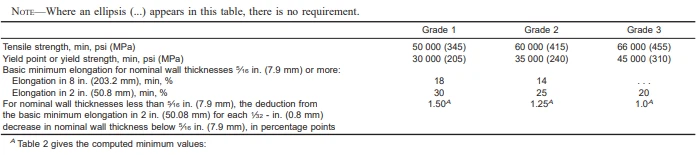
Tensile Strength: The minimum tensile strength for Grade 2 is generally around 448 MPa (65,000 psi).
Yield Strength: The minimum yield strength is approximately 310 MPa (45,000 psi).
Elongation: The standard also specifies elongation requirements to ensure ductility.
What is the equivalent material of astm a252 grade 2
Domestic Materials
Q235B (in some cases)
Similarities: Q235B is a common carbon structural steel in China, possessing certain strength and good plasticity and weldability. In applications such as pile foundations where strength requirements are not particularly high, its performance characteristics are similar to A252 GR2, meeting similar functional needs for foundation support.
Differences: The chemical composition and some performance indicators of the two may have slight differences, and they adhere to different standards. Q235B follows Chinese national standards, while A252 GR2 follows American ASTM standards.
International Materials
S235JR (European Standard)
Similarities: S235JR is a non-alloy structural steel in the European standard EN 10025. Its mechanical properties, such as yield strength and tensile strength, are quite similar to A252 GR2, making both suitable for the manufacture of structural components. It can be used as a similar material choice in some bridge, building, and other foundation engineering projects.
Differences: Testing methods and some quality requirements may differ under different standards. In specific applications, evaluation is required based on engineering standards and requirements.
Tensile Requirements
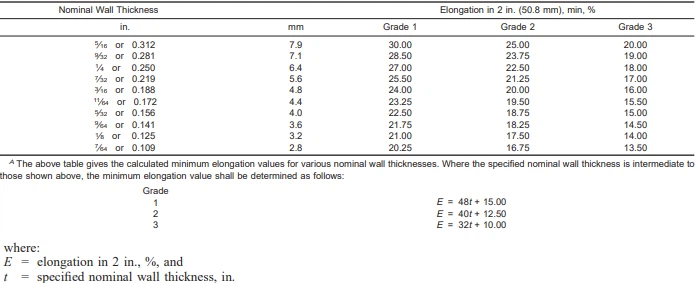
Calculated Minimum Elongation ValuesA
A252 GR2 Pipe pile Anti-Corrosion Process Workflow
| Process Step | Technical Details | Function |
|---|---|---|
| 1. Surface Pre-treatment | - Grit blasting derusting: Sa 2.5 grade (ISO 8501), surface roughness 40-80μm - Solvent cleaning: Remove oil, salt, and contaminants |
Ensure coating adhesion, prevent delamination |
| 2. Anti-Corrosion Coating Application | Options: | |
| a) Epoxy Powder Coating (FBE) | - Thickness: 300-400μm - Curing: 200°C thermal curing to form dense film |
Base corrosion resistance, chemical/electrolyte protection |
| b) 3PE Composite Coating | - Structure: FBE + Adhesive layer + Polyethylene (PE) - Total thickness ≥2.5mm |
Enhanced impact resistance (for rocky/offshore environments) |
| c) Hot-Dip Galvanizing | - Zinc layer ≥85μm (ISO 1461) - Full coverage including welds |
Cost-effective protection (mild environments) |
| 3. Weld Treatment | - Epoxy resin touch-up on weld zones - NDT (UT/RT) to eliminate pores/slag |
Eliminate weak points |
| 4. Cathodic Protection | - Impressed Current: Anode bed installation (-0.85~-1.2V vs CSE) - Sacrificial Anodes: Attach Al/Zn alloy blocks |
Electrochemical protection (>50-year service life) |
| 5. Quality Inspection | - Coating tests: Spark test (≥5kV), thickness gauge - Adhesion test: Cross-cut (ASTM D3359) |
Verify coating integrity |


