


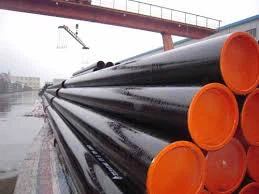
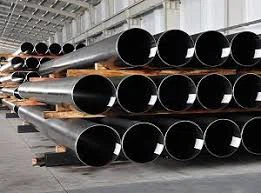
At a Glance: API 5L X80 PSL1
Application: High-pressure transmission pipelines for oil and natural gas.
Key Characteristic: Very high yield strength, allowing for thinner pipe walls and reduced material costs for the same pressure rating.
Standard: Governed by the API 5L Specification, which sets the minimum requirements for manufacture.
Grade: X80 indicates a Minimum Yield Strength of 80,000 psi (551 MPa).
PSL: PSL1 (Product Specification Level 1) is the standard level with basic requirements.
Detailed Breakdown of the Specification
1. API 5L (American Petroleum Institute Specification 5L)
This is the foundational standard that defines the manufacturing, chemical, and mechanical properties for line pipe used in pipeline transportation systems in the petroleum and natural gas industries.
2. Grade: X80
The "X" stands for "Line Pipe" and the number refers to the Minimum Specified Yield Strength (SMYS) in thousands of pounds per square inch (psi).
X80 means:
Minimum Yield Strength: 80,000 psi (551 MPa)
Minimum Tensile Strength: 90,000 psi (621 MPa) for PSL1
This high strength allows for the design of pipelines that can operate at much higher pressures than those made with lower grades like X42 or X65.
3. PSL: Product Specification Level 1 (PSL1)
API 5L defines two PSLs. PSL1 is the more common and standard grade with less stringent requirements compared to PSL2.
Key characteristics of PSL1:
Chemical Composition: The chemical requirements (e.g., Carbon, Manganese) are defined as a maximum percentage, but there are no mandatory limits on Carbon Equivalent (CE) for weldability. The manufacturer controls this based on the required mechanical properties.
Mechanical Properties: Testing is generally done on a lot basis.
Toughness: There are no mandatory Charpy V-Notch (CVN) impact toughness requirements. This is a critical difference from PSL2. The pipe is suitable for environments where low-temperature brittleness is not a primary concern.
Dimensional Tolerances: Slightly more lenient than PSL2.
Testing: Less extensive non-destructive testing (NDT) requirements.
Typical Chemical Composition (PSL1 X80)
While API 5L does not mandate a specific chemistry for PSL1 (it's performance-based), X80 is a micro-alloyed steel. A typical chemistry range for a modern X80 pipe would be:
| Element | Typical Range (Weight %) | Purpose |
|---|---|---|
| Carbon (C) | 0.04 - 0.10% | Increases strength but reduces weldability. Kept low in modern steels. |
| Manganese (Mn) | 1.50 - 1.90% | Primary strengthening element, improves toughness. |
| Niobium (Nb) | 0.04 - 0.08% | Micro-alloying element that provides grain refinement and precipitation strengthening. |
| Vanadium (V) | 0.02 - 0.06% | Micro-alloying element for precipitation strengthening. |
| Titanium (Ti) | 0.005 - 0.025% | Controls grain growth during welding. |
| Silicon (Si) | 0.10 - 0.35% | Deoxidizer and solid solution strengthener. |
| Carbon Equivalent (CE/Pcm) | ~0.20 - 0.23 | A calculated value to predict weldability (lower is better). |
Note: The actual chemistry is carefully balanced by the steelmaker to achieve the high strength and good weldability required.
Manufacturing Processes
API 5L X80 PSL1 pipe can be manufactured using two primary methods:
Seamless (SMLS): Made by piercing a solid billet. No seam weld, ideal for high-pressure, critical applications.
Welded (ERW, SAW):
Electric Resistance Welded (ERW): Formed from a coil and the seam is welded using electric resistance.
Submerged Arc Welded (SAW): Formed from a steel plate and the seam is welded internally and externally under a flux layer. This is very common for large-diameter transmission pipelines.
The steel is typically thermo-mechanically controlled processed (TMCP) to achieve the fine-grained, high-strength microstructure of X80.
Advantages and Applications
Advantages:
High Pressure Capability: Enables the economic transport of gas over long distances without numerous compressor stations.
Cost-Effective: Thinner walls mean less steel weight per meter, reducing material and transportation costs.
Efficiency: Higher strength allows for smaller diameters to transport the same volume at the same pressure, further reducing costs.
Applications:
Onshore and Offshore Natural Gas Transmission Pipelines
High-Pressure Crude Oil Transmission Lines
Arctic Pipeline Applications (though PSL2 is often preferred here due to its toughness requirements)
Gathering lines in high-pressure fields
PSL1 vs. PSL2 for X80 Pipe
This is a critical distinction for engineers and purchasers.
| Feature | PSL1 | PSL2 |
|---|---|---|
| Mandatory Toughness | No Charpy Impact Test requirement | Yes, strict CVN requirements at specified temperatures |
| Chemical Composition | Max limits for C, Mn, P, S, etc. | Stricter limits, including max CE for weldability |
| Strength Properties | Defined for pipe body | Defined for pipe body, weld seam, and heat-affected zone (HAZ) |
| Dimensional Tolerances | Standard | Stricter |
| NDT & Inspection | Standard | More extensive (e.g., hydrostatic test on every length) |
| Cost | Lower | Higher |
| Typical Use | Standard duty, non-critical environments | Critical, sour service, low-temperature, offshore, seismic zones |
Summary
API 5L X80 PSL1 is a workhorse grade for high-strength pipeline projects where the operating environment does not demand guaranteed impact toughness. Its high strength-to-weight ratio makes it a cost-effective choice for modern, high-pressure oil and gas transmission. However, for projects in cold climates or demanding conditions, API 5L X80 PSL2 is the mandatory and safer choice due to its guaranteed fracture toughness.


