


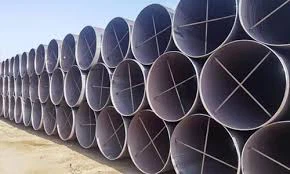

At a Glance: What is it?
API 5L X65 PSL2 is a specific grade and specification for steel pipe used primarily in the transportation of oil, gas, and other hydrocarbons in high-pressure pipeline systems.
API 5L: This is the standard set by the American Petroleum Institute (API) that governs the manufacture of "Line Pipe" used in pipeline transportation systems.
X65: This is the Grade, indicating the Minimum Yield Strength of the steel. "X65" means the steel has a minimum yield strength of 65,000 psi (448 MPa). Yield strength is the stress at which the material begins to deform plastically.
PSL2: This stands for Product Specification Level 2. It is a more stringent set of requirements compared to PSL1, demanding higher quality control, tougher material, and more comprehensive testing.
Key Characteristics & Requirements (PSL2 vs. PSL1)
The PSL2 designation is what sets this pipe apart for critical, high-performance applications. Here's a comparison:
| Feature | API 5L X65 PSL1 | API 5L X65 PSL2 |
|---|---|---|
| Chemical Composition | Less restrictive. Focus on carbon, manganese, and a few other elements. | More controlled and restrictive. Limits on Carbon Equivalent (CE) to improve weldability. Tighter controls on sulfur and phosphorus for better toughness. |
| Toughness | Not a mandatory requirement. | Mandatory impact testing (Charpy V-Notch). Must meet minimum absorbed energy values at a specified temperature to prevent brittle fracture. |
| Strength | Minimum Yield and Tensile Strength. | Same minimums, but with additional Maximum Yield Strength and Maximum Tensile Strength limits to ensure consistency and over-strength control. |
| Hydrostatic Test | Required, but test pressure and duration may be lower. | Required at a higher pressure and for a longer duration to ensure integrity. |
| Non-Destructive Testing (NDT) | Required for the pipe body on seamless and most welded pipes. | More comprehensive. Requires NDT on the entire pipe body and the weld seam for welded pipes (e.g., using Ultrasonic Testing). |
| Dimensions & Weight | Standard tolerances. | Tighter tolerances on dimensions (OD, WT) and weight. |
Manufacturing Processes
API 5L X65 PSL2 pipe can be manufactured in two main ways:
Seamless (SMLS): Made by piercing a solid billet of steel. It has no longitudinal weld seam, making it inherently strong and uniform. Often used for smaller diameters or highest-pressure applications.
Welded (EW / SAW):
Electric Resistance Welded (ERW): Formed from a steel coil and the seam is welded using electrical resistance.
Submerged Arc Welded (SAW): Formed from steel plate and the longitudinal (LSAW) or spiral (HSAW) seam is welded under a blanket of flux. LSAW is very common for large-diameter, high-pressure transmission pipelines.
Mechanical Properties (Typical for PSL2)
Yield Strength (Min.): 65,000 psi (448 MPa)
Yield Strength (Max.): 87,000 psi (600 MPa) - This max limit is a key PSL2 requirement.
Tensile Strength (Min.): 77,000 psi (531 MPa)
Tensile-to-Yield Ratio (Max.): Typically limited to 0.93 for sizes below 20 inches, to ensure strain capacity during installation (e.g., in bending).
Chemical Composition (Typical for PSL2)
PSL2 has strict limits, especially on Carbon Equivalent (CE) to ensure good weldability. A typical composition might look like this (values are maximums or ranges):
Carbon (C): 0.12% max
Manganese (Mn): 1.60% max
Sulfur (S): 0.015% max (very low for better toughness)
Phosphorus (P): 0.025% max (very low for better toughness)
Carbon Equivalent (CEpcm): ~0.23% max (Commonly used formula: C + Mn/6 + (Cr+Mo+V)/5 + (Ni+Cu)/15)
Common Applications
API 5L X65 PSL2 is the workhorse grade for major pipeline projects due to its excellent balance of high strength, good weldability, and proven toughness.
High-Pressure Natural Gas Transmission Pipelines
Crude Oil Transmission Pipelines
Product Pipelines (e.g., diesel, gasoline)
CO2 Injection Lines for Enhanced Oil Recovery (EOR)
Offshore Pipelines (both subsea flowlines and export lines)
Slurry Pipelines in mining operations
Why Choose X65 PSL2?
High Strength: Allows for the use of thinner pipe walls to transport fluids at higher pressures, reducing material and construction costs.
Proven Toughness: The mandatory Charpy impact testing ensures the pipe can withstand sudden shocks and resist crack propagation, even in cold environments.
Excellent Weldability: The controlled chemistry, particularly the low Carbon Equivalent, makes it easier and safer to weld in the field.
High Integrity: The comprehensive NDT and stricter hydrostatic testing provide a high level of confidence in the pipe's quality and reliability.
In summary, API 5L X65 PSL2 represents a premium category of line pipe designed for safety, reliability, and performance in the most demanding onshore and offshore pipeline applications.


