


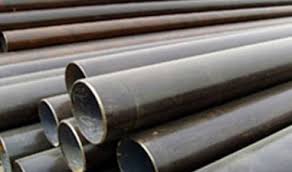
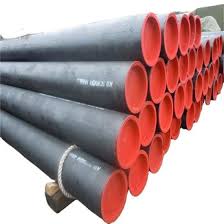
API 5L X60 Electric Resistance Welded (ERW) Pipe
Basic Overview
A standard specification for electric resistance welded steel line pipe under the API 5L specification. Grade X60 is a high-strength pipeline steel widely used in oil and gas transmission systems, with a minimum yield strength of 60,000 psi (415 MPa) .
Name Explanation
| Part | Meaning |
|---|---|
| API | American Petroleum Institute |
| 5L | Specification for line pipe |
| X60 | Grade designation – X = pipeline grade, 60 = minimum yield strength in ksi (60,000 psi) |
| Electric Resistance Welded | Manufacturing process – pipe formed from coil and welded longitudinally |
Key Features of X60 ERW Pipe
| Feature | Description |
|---|---|
| Material Type | Carbon Steel (micro-alloyed) |
| Manufacturing | Electric Resistance Welded (ERW) – longitudinal weld seam present |
| Product Spec Levels | PSL1 or PSL2 (PSL2 has tighter chemistry, mandatory impact testing) |
| Key Property | Excellent balance of high strength, toughness, and weldability |
| Typical Diameters | 21.3mm to 660mm (1/2" to 26") – ERW |
| Typical Wall Thickness | 1.8mm to 22.2mm |
Chemical Composition (Maximum %)
| Element | PSL1 (Seamless) | PSL1 (Welded) | PSL2 (Welded) |
|---|---|---|---|
| Carbon (C) | 0.28 | 0.26 | 0.22 |
| Manganese (Mn) | 1.40 | 1.40 | 1.40 |
| Phosphorus (P) | 0.030 | 0.030 | 0.025 |
| Sulfur (S) | 0.030 | 0.030 | 0.015 |
| Vanadium (V) | 0.15 max | 0.15 max | As agreed |
| Niobium (Nb) | 0.05 max | 0.05 max | As agreed |
| Titanium (Ti) | 0.04 max | 0.04 max | 0.04 max |
Sources:
Note: For each reduction of 0.01% below the specified maximum carbon content, an increase of 0.05% above the specified maximum manganese content is permissible, up to 1.50% for X60 .
Mechanical Properties
| Property | Requirement |
|---|---|
| Yield Strength (Min) | 415 MPa (60,000 psi) |
| Tensile Strength (Min) | 520 MPa (75,000 psi) |
| Elongation | Varies by wall thickness (minimum ~28%) |
Sources:
Comparison Table: X60 vs. Adjacent Line Pipe Grades
| Grade | Yield Strength Min (MPa/ksi) | Tensile Strength Min (MPa/ksi) | Position |
|---|---|---|---|
| X52 | 360 / 52 | 460 / 67 | Lower strength |
| X56 | 390 / 56 | 490 / 71 | Intermediate |
| X60 | 415 / 60 | 520 / 75 | High strength |
| X65 | 450 / 65 | 535 / 77 | Higher strength |
| X70 | 485 / 70 | 570 / 82 | Ultra-high strength |
Source:
Common Applications
| Application Area | Specific Uses |
|---|---|
| Oil & Gas | Long-distance oil and gas transmission pipelines |
| Transportation | Natural gas gathering and distribution lines |
| Fluid Handling | Water, slurry, and steam transport |
| Industrial | Petrochemical plant piping |
| Offshore | Subsea pipelines and marine applications |
| Structural | Mechanical and structural applications (furniture, building, bridge) |
ERW Manufacturing Process
ERW pipes are manufactured by:
Forming: Steel coil is cold-formed into a cylindrical shape.
Welding: The edges are heated by high-frequency electrical resistance and forged together under pressure .
Heat Treatment: The weld seam and heat-affected zone are heat-treated to simulate a normalizing heat treatment .
NDT: The weld seam is 100% non-destructively tested (ultrasonic or eddy current) .
Advantages of ERW:
Lower cost than seamless pipe
Excellent dimensional accuracy (precise OD and wall thickness)
Long lengths available (up to 18m)
High production efficiency
Size Availability
| Manufacturing Method | Size Range | Notes |
|---|---|---|
| ERW | 21.3mm to 660mm (1/2" to 26") | Most common for X60 up to 24-26" |
| Seamless | 1" to 14" (typical) | For comparison |
| LSAW | 14" to 60" (typical) | For larger diameters |
Sources:
PSL1 vs. PSL2 for X60
| Aspect | PSL1 | PSL2 |
|---|---|---|
| Chemistry | Standard limits | Tighter controls (lower C, P, S) |
| Strength | Min only specified | Min and Max specified |
| Impact Testing | Not required | Mandatory (specified temperature) |
| Carbon Equivalent | Not required | Calculated and controlled |
| Typical Use | General service | Critical service, sour service, low temperature |
Coating & Protection Options
X60 ERW pipe is commonly supplied with:
| Coating Type | Application |
|---|---|
| Black (bare mill finish) | Standard indoor/above ground |
| 3LPE (3-layer polyethylene) | Most common for buried pipelines |
| FBE (Fusion Bonded Epoxy) | Corrosion protection |
| Coal Tar Epoxy | Heavy-duty protection |
| Varnish coating / Anti-rust oil | Temporary protection |
| Bitumen coating | Buried service |
International Standard Equivalents
| Standard | Grade Equivalent |
|---|---|
| API 5L | X60 |
| ISO 3183 | L415 |
| DNV OS-F101 | Grade 450 |
| CSA Z245 | Grade 415 |
| GB/T 9711 | L415 |
Industry Role & Selection Logic
X60 represents the "high-strength" category in the line pipe family:
| Strength Level | Grades | Typical Use |
|---|---|---|
| Low | A, B | Low-pressure, non-critical |
| Medium | X42, X46, X52 | General transmission |
| High | X60, X65 | High-pressure transmission, offshore |
| Ultra-High | X70, X80 | Deepwater, arctic, high-efficiency |
When to Choose X60:
For high-pressure oil and gas transmission pipelines
When design pressure exceeds X52 capabilities
For offshore and subsea applications
For sour service applications (when specified as PSL2 with additional testing)
When higher strength-to-weight ratio is needed to reduce material costs
Fabrication & Weldability
| Aspect | Requirement |
|---|---|
| Weldability | Excellent due to controlled chemistry and low carbon equivalent |
| Field Welding | Qualified procedures required, especially for PSL2 |
| Preheat | May be required for thicker walls depending on carbon equivalent |
| Bending | Can be cold-field bent within specified limits |
| Heat Treatment | X60 may be normalized, quenched, and tempered as required |
Testing & Certification
X60 ERW pipe typically undergoes:
| Test Type | Purpose |
|---|---|
| Chemical Analysis | Verify composition meets specifications |
| Tensile Test | Confirm yield and tensile strength |
| Flattening Test | Check ductility |
| Bend Test | Verify weld integrity |
| Impact Test | Charpy V-notch (required for PSL2) |
| Hydrostatic Test | Verify pressure containment |
| NDT (Ultrasonic/Eddy Current) | Detect weld defects |
| Hardness Test | When specified for sour service |
Mill Test Certificate: EN 10204/3.1B typically provided
Final Takeaway: API 5L X60 ERW Pipe is a high-strength welded line pipe designed for demanding oil and gas transmission applications. With a minimum yield strength of 60,000 psi (415 MPa) , it offers enhanced strength for high-pressure pipelines, offshore installations, and critical service conditions where X52 is insufficient. Available in both PSL1 and PSL2 quality levels, it provides an excellent balance of strength, toughness, and weldability for modern pipeline systems .


