


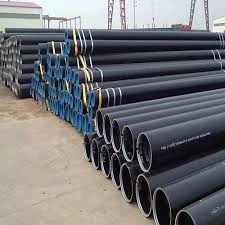

API 5L X56 ERW Pipe
Basic Overview
API 5L X56 ERW (Electric Resistance Welded) pipe is a medium-to-high strength carbon steel line pipe positioned between X52 and X60 in the API 5L grade ladder [citation:1, citation:3]. The "X56" designation indicates a minimum yield strength of 56,000 psi (386-390 MPa) , offering approximately 8% higher strength than X52 [citation:3, citation:6]. This grade is commonly specified for higher-pressure transmission applications where X52 strength is insufficient but X60 may be over-specified .
Name Explanation
| Part | Meaning |
|---|---|
| API | American Petroleum Institute |
| 5L | Specification for line pipe used in pipeline transportation systems |
| X56 | Grade designation – "X" indicates pipeline grade, "56" represents minimum yield strength in ksi (56,000 psi / 386-390 MPa) [citation:3, citation:4] |
| ERW | Electric Resistance Welded – pipe formed from steel coil and welded longitudinally without filler metal |
Key Features
| Feature | Description |
|---|---|
| Yield Strength (min) | 386-390 MPa (56,000-56,600 psi) [citation:3, citation:6] |
| Tensile Strength (min) | 490-500 MPa (71,100-72,500 psi) [citation:3, citation:6] |
| Manufacturing | Electric Resistance Welded (ERW) – high-frequency welding process [citation:1, citation:3] |
| Size Range (ERW) | 21.3 mm to 610 mm (1/2" to 24") OD; up to 610 mm (24") typical for ERW [citation:1, citation:2, citation:7] |
| Wall Thickness | 1.8 mm to 19.1 mm (max 18 mm for X56) [citation:1, citation:2] |
| Length | 3 m to 18 m (customizable) [citation:2, citation:7] |
| Product Specification Levels | PSL1 (standard) and PSL2 (enhanced) [citation:3, citation:4] |
Chemical Composition
PSL1 (max %) [citation:3, citation:10]
| Element | Specification | Notes |
|---|---|---|
| Carbon (C) | 0.26-0.28% max | Provides strength |
| Manganese (Mn) | 1.40% max | Enhances strength and hardenability |
| Silicon (Si) | 0.40% max | Deoxidizer |
| Phosphorus (P) | 0.030% max | Controlled for weldability |
| Sulfur (S) | 0.030% max | Controlled for toughness |
PSL2 (max %) [citation:3, citation:6, citation:10]
| Element | Specification | Significance |
|---|---|---|
| Carbon (C) | 0.24% max | Better weldability than PSL1 |
| Manganese (Mn) | 1.40% max | |
| Silicon (Si) | 0.40-0.45% max | |
| Phosphorus (P) | 0.025% max | Stricter than PSL1 |
| Sulfur (S) | 0.015% max | 50% reduction from PSL1; critical for toughness |
| Vanadium (V) | 0.10% max | Micro-alloying for grain refinement |
| Niobium (Nb) | 0.05% max | Micro-alloying for strength |
| Titanium (Ti) | 0.04% max | Micro-alloying for grain refinement |
*Note: The total content of micro-alloying elements (Nb+V+Ti) does not exceed 0.15% .*
Mechanical Properties
| Property | PSL1 Requirement | PSL2 Requirement |
|---|---|---|
| Yield Strength (min) | 390 MPa (56,600 psi) | 390 MPa (56,600 psi) |
| Yield Strength (max) | Not specified | 545 MPa (79,000 psi) |
| Tensile Strength (min) | 490 MPa (71,100 psi) | 490 MPa (71,100 psi) |
| Tensile Strength (max) | Not specified | 760 MPa (110,000 psi) |
| Yield-to-Tensile Ratio | Not specified | 0.93 max |
| Elongation | Per API 5L table | Per API 5L table |
Grade Comparison
| Grade | Yield Strength (min) | Tensile Strength (min) | Relative Strength vs. X52 | Typical Application |
|---|---|---|---|---|
| X42 | 290 MPa (42 ksi) | 415 MPa (60 ksi) | -19% | Gathering lines, distribution |
| X46 | 320 MPa (46 ksi) | 435 MPa (63 ksi) | -11% | Medium-pressure gathering |
| X52 | 359-360 MPa (52 ksi) | 455-460 MPa (66 ksi) | Baseline | General transmission |
| X56 | 386-390 MPa (56 ksi) | 490-500 MPa (71 ksi) | +8% yield | Higher-pressure transmission |
| X60 | 414-415 MPa (60 ksi) | 517-520 MPa (75 ksi) | +15% yield | High-pressure transmission |
*X56 offers approximately 8% higher yield strength than X52 and serves as a cost-effective intermediate option when X52 is under-strength but X60 would be over-specified .*
Dimensional Tolerances
| Parameter | Size Range | Tolerance | Source |
|---|---|---|---|
| Outside Diameter (OD 219.1-273.1mm) | - | +1.6mm, -0.4mm | |
| Outside Diameter (OD 274-320mm) | - | +2.4mm, -0.8mm | |
| Outside Diameter (OD 323.9-457mm) | - | +2.4mm, -0.8mm | |
| Outside Diameter (OD 508-610mm) | - | +2.4mm, -0.8mm | |
| Wall Thickness (OD 508-610mm) | - | +19.5%, -8% |
Size Availability: ERW process typically produces X56 pipes up to 24-26 inches (610 mm) OD [citation:1, citation:2, citation:7]. Larger diameters require LSAW or SSAW manufacturing.
Testing Requirements
| Test Type | Purpose | Applicability |
|---|---|---|
| Chemical Analysis | Verify composition per API 5L limits | Per heat |
| Tensile Test | Confirm yield and tensile strength | Per lot |
| Flattening Test | Check ductility | Required |
| Bend Test | Verify weld integrity | Required |
| Hydrostatic Test | Pressure integrity verification | Each pipe |
| NDT (Ultrasonic/Eddy Current) | Weld seam inspection | Standard practice |
| Impact Test (Charpy V-notch) | Low-temperature toughness | PSL2 only [citation:3, citation:4] |
| Hardness Testing | Sour service verification | PSL2 (sour service) |
Common Applications
| Application | Description |
|---|---|
| Oil and Gas Transmission | Medium-to-high pressure pipelines for crude oil and natural gas |
| Natural Gas Gathering Lines | Connecting wells to processing facilities |
| Water Transmission Mains | Large-diameter municipal and industrial water pipelines |
| Industrial Process Piping | Refineries, chemical plants, power generation |
| Gathering and Flow Lines | Upstream oil and gas operations |
| Structural Applications | Furniture, window frames, door frames, building, bridge, mechanical |
PSL1 vs. PSL2: Key Differences for X56
| Feature | PSL1 | PSL2 | Significance |
|---|---|---|---|
| Carbon (C) max | 0.26-0.28% | 0.24% | Better weldability, lower HAZ hardness |
| Sulfur (S) max | 0.030% | 0.015% | 50% reduction – critical for toughness and HIC resistance |
| Yield Strength | Min only | Min and Max (390-545 MPa) | Prevents over-strength materials |
| Tensile Strength | Min only | Min and Max (490-760 MPa) | Ensures consistent mechanical properties |
| Yield Ratio (Y/T) | Not specified | ≤ 0.93 | Ensures adequate ductility |
| Impact Testing | Not required | Mandatory | Guarantees low-temperature toughness |
| NDT Requirements | Standard | More stringent | Better defect detection |
| Typical Use | General service | Critical service, sour service, low temperature |
Key Advantages
| Advantage | Description |
|---|---|
| Higher Strength than X52 | 8% higher yield strength allows higher operating pressures or reduced wall thickness |
| Cost-Effective Intermediate Grade | Economical alternative when X52 is under-strength but X60 would be over-specified |
| Excellent Weldability | Controlled chemistry ensures good field weldability |
| Wide Availability | Produced by major manufacturers including Baosteel |
| PSL2 Option | Available for critical service requiring guaranteed low-temperature toughness and sour service resistance |
Important Considerations
1. Size Limitations
ERW manufacturing for X56 is typically limited to 24-26 inches (610 mm) OD [citation:1, citation:2]
Larger diameters require LSAW or SSAW manufacturing
2. PSL1 vs. PSL2 Selection
PSL1: Suitable for general service, water lines, non-critical applications
PSL2: Required for low-temperature service, sour service (H₂S environments), regulated pipelines (FERC, DOT), and critical applications
3. Equivalent Grades
ISO 3183: L390
GB/T 9711: L390
4. Coating Options
Black (bare): Standard mill finish
FBE (Fusion Bonded Epoxy): Corrosion protection
3LPE (3-layer polyethylene): Buried pipelines
Coal Tar Epoxy: Heavy-duty protection
Varnish Coating / Anti-rust oil: Temporary protection
5. Mill Test Certificate
Typically provided as EN 10204 Type 3.1B with full test results
Third-party inspection by SGS, BV, Lloyds available
Summary
API 5L X56 ERW pipe is a medium-to-high strength line pipe that fills the gap between X52 and X60 in the API 5L grade ladder. With minimum yield strength of 56,000 psi (390 MPa) – approximately 8% higher than X52 – it offers an excellent intermediate option for higher-pressure transmission applications where X52 is under-strength but X60 would be over-specified .
Available in diameters from 21.3 mm to 610 mm (1/2" to 24") with wall thicknesses from 1.8 mm to 19.1 mm [citation:1, citation:2], X56 ERW pipes are produced using high-frequency welding processes that ensure consistent quality and dimensional accuracy.
The specification offers two quality levels:
PSL1: Standard quality for general pipeline service with basic chemical and mechanical requirements
PSL2: Enhanced quality with mandatory impact testing, tighter chemistry controls (S ≤ 0.015%, P ≤ 0.025%), and maximum strength limits for critical applications requiring low-temperature toughness or sour service resistance [citation:3, citation:10]
Common applications include medium-to-high pressure oil and gas transmission, natural gas gathering, water transmission mains, and industrial process piping .
When ordering, specify: API 5L, Grade X56, [PSL1 or PSL2], ERW, Size (OD x WT), Length, End Finish.


