


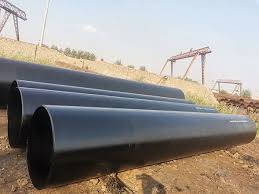
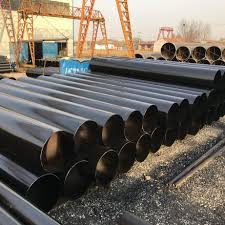
API 5L X46 Longitudinal Submerged Arc Welding (LSAW) Pipe
Basic Overview
A standard specification for longitudinally submerged-arc welded steel line pipe under the API 5L specification. Grade X46 is a medium-strength pipeline steel positioned between X42 and X52, with a minimum yield strength of 46,000 psi (317 MPa) . It offers a balanced combination of strength and weldability for moderate-pressure oil and gas transmission applications .
Name Explanation
| Part | Meaning |
|---|---|
| API | American Petroleum Institute |
| 5L | Specification for line pipe |
| X46 | Grade designation – X = pipeline grade, 46 = minimum yield strength in ksi (46,000 psi) |
| Longitudinal Submerged Arc Welding (LSAW) | Manufacturing process – steel plates are formed and welded along a single straight longitudinal seam using submerged arc welding with filler metal added |
Key Features of API 5L X46 LSAW Pipe
| Feature | Description |
|---|---|
| Material Type | Micro-alloyed carbon steel – may contain small additions of niobium, vanadium, or titanium for grain refinement and strength |
| Manufacturing | LSAW (Longitudinal Submerged Arc Welding) – plates formed by UOE, JCOE, or RBE processes, then welded with submerged arc on inside and outside |
| Product Spec Levels | PSL1 or PSL2 (PSL2 requires mandatory impact testing and tighter chemistry controls) |
| Yield Strength | 317 MPa (46,000 psi) minimum |
| Tensile Strength | 434 MPa (63,000 psi) minimum |
| Key Advantage | Higher strength than X42 (317 MPa vs. 290 MPa) while maintaining excellent weldability |
| Typical Diameters | 219 mm to 1820 mm (8" to 72") – LSAW process enables large diameters |
| Typical Wall Thickness | 5.0 mm to 60 mm (up to 80 mm available from some manufacturers) |
| Length | 6 m to 18 m standard; typical 6-12.3 m |
Chemical Composition (API 5L X46)
| Element | PSL1 (max %) | PSL2 (max %) | Notes |
|---|---|---|---|
| Carbon (C) | 0.26 | 0.22 | PSL2 has tighter control for weldability |
| Manganese (Mn) | 1.40 | 1.30-1.40 | PSL2 may have lower limits |
| Phosphorus (P) | 0.030 | 0.025 | Stricter in PSL2 |
| Sulfur (S) | 0.030 | 0.015 | Significantly tighter in PSL2 for toughness |
| Silicon (Si) | - | 0.45 max | Specified in PSL2 |
Note: For each reduction of 0.01% below the specified maximum carbon content, an increase of 0.05% above the specified maximum manganese content is permissible, up to 1.65% for grades ≥ X52 .
Mechanical Properties
| Property | PSL1 | PSL2 |
|---|---|---|
| Yield Strength (min) | 317 MPa | 317 MPa |
| Yield Strength (max) | Not specified | 495 MPa (for certain sizes) |
| Tensile Strength (min) | 434 MPa | 434 MPa |
| Tensile Strength (max) | Not specified | 758 MPa |
| Elongation | 21-27% (varies by wall thickness) | 21-27% |
| Impact Energy (Charpy V-notch) | Not required | 41 J (27 ft-lbf) average at specified temperature |
Note: X46 provides approximately 9% higher yield strength than X42 (290 MPa vs. 317 MPa) .
PSL1 vs. PSL2 for X46 LSAW Pipe
| Aspect | PSL1 | PSL2 |
|---|---|---|
| Chemistry | Standard limits (C ≤ 0.26%, S ≤ 0.030%) | Tighter controls (C ≤ 0.22%, S ≤ 0.015%) |
| Strength | Min only specified | Min and Max specified (prevents over-strength) |
| Impact Testing | Not required | Mandatory at specified temperature |
| Carbon Equivalent | Not required | Calculated and controlled |
| NDT Requirements | Standard | More stringent |
| Typical Use | General service, water lines | Critical service, sour service, low temperature |
LSAW Manufacturing Process
Forming Methods
| Method | Description | Typical Diameters |
|---|---|---|
| UOE / UOE | Plate pressed into U-shape, then O-shape, expanded after welding | 508-1118 mm (20"-44") |
| JCOE / JCOE | Progressive J-C-O forming steps (J-shape → C-shape → O-shape), expanded after welding | 406-1626 mm (16"-64") |
| RBE / RBE | Roll bending process | Various |
Process Steps
Plate Preparation: Hot-rolled steel plates undergo incoming inspection (ultrasonic testing for laminations), edge milling for precise bevels
Plate Crimping: Both edges of plate are pre-bent to curvature close to finished pipe (crimping press)
Forming: Progressive hydraulic pressing (JCO or UOE) creates uniform roundness
Pre-Welding (Tack Welding): Secures seam temporarily
Submerged Arc Welding: Multi-wire SAW applies internal weld, then external weld for full penetration under flux. For small pipes, inner single wire + outer double wire may be used
Mechanical Expanding: Pipe expanded to precise dimensions (for UOE/JCOE processes) to achieve tight tolerances. This step also reduces residual stress and improves yield strength
NDT & Testing: 100% ultrasonic testing of weld seam, radiographic examination when specified, hydrostatic testing
Finishing: End beveling (per ANSI B16.25), coating application as specified
Size Availability
| Parameter | Range | Notes |
|---|---|---|
| Outside Diameter | 219 mm to 1820 mm (8" to 72") | Available up to 2134 mm (84") from some manufacturers |
| Wall Thickness | 5.0 mm to 60 mm | Up to 80 mm available from some manufacturers |
| Length | 6 m to 12.3 m standard; up to 18 m available | JCOE process typically 8-12.2 m |
| End Finish | Plain ends, beveled ends per ANSI B16.25 | Beveled for welding standard |
Typical Wall Thickness Availability by Diameter (X46)
| OD (inch) | OD (mm) | Wall Thickness Range (mm) |
|---|---|---|
| 16" | 406 | 6.0 - 13.0 |
| 20" | 508 | 6.0 - 15.0 |
| 24" | 610 | 6.0 - 17.0 |
| 30" | 762 | 7.0 - 20.0 |
| 36" | 914 | 8.0 - 23.0 |
| 40" | 1016 | 8.0 - 25.0 |
| 48" | 1219 | 9.0 - 27.0 |
| 56" | 1422 | 10.0 - 28.0 |
| 60" | 1524 | 10.0 - 28.0 |
| 64" | 1626 | 10.0 - 29.0 |
| 72" | 1829 | 10.0 - 29.0 |
Testing & Inspection Requirements
| Test Type | Purpose |
|---|---|
| Chemical Analysis | Verify composition meets API 5L limits |
| Tensile Test | Confirm yield and tensile strength (base metal and weld) |
| Flattening Test | Check ductility |
| Bend Test | Verify weld integrity and ductility |
| Impact Test (Charpy V-notch) | Required for PSL2 at specified temperature |
| Hydrostatic Test | Proof of leak-tightness – each pipe individually tested |
| Ultrasonic Examination | 100% of weld seam for internal defects |
| Radiographic Examination (X-ray) | When specified by supplementary requirements |
| DWTT (Drop Weight Tear Test) | For fracture toughness verification when specified |
| Dimensional Inspection | Verify OD, wall thickness, straightness, end squareness |
| Visual Inspection | Surface condition, weld appearance |
Mill Test Certificate: EN 10204 / 3.1B typically provided for PSL2
Coating & Protection Options
API 5L X46 LSAW pipe is commonly supplied with :
| Coating Type | Application |
|---|---|
| Black (bare) | Standard mill finish, indoor use |
| Varnish / Anti-rust oil | Temporary protection during transit |
| Black painting | Basic corrosion protection |
| 3LPE (3-layer polyethylene) | Buried pipelines, harsh environments |
| FBE (Fusion Bonded Epoxy) | Corrosion protection |
| Coal Tar Epoxy | Heavy-duty protection |
| Bitumen coating | Buried service |
| Concrete Weight Coating (CWC) | Offshore pipelines (negative buoyancy) |
Comparison Table: X46 vs. Adjacent Grades
| Grade | Yield Strength (MPa) min | Tensile Strength (MPa) min | Position |
|---|---|---|---|
| X42 | 290 | 414 | Lower strength |
| X46 | 317 | 434 | Intermediate |
| X52 | 359 | 455 | Higher strength |
Percentage Increase: X46 offers approximately 9% higher yield strength than X42, and X52 offers 13% higher yield strength than X46 .
Common Applications
API 5L X46 LSAW pipe is widely used in :
| Industry | Applications |
|---|---|
| Oil & Gas | Medium-pressure transmission pipelines, gathering lines, flow lines |
| Water Transmission | Large-diameter water mains, irrigation systems |
| Infrastructure | Structural piling, engineering components |
| Petrochemical | Process lines, industrial conveyance |
| Mining | Slurry pipelines, tailings transport |
| Power Generation | Cooling water lines |
| Offshore | Subsea pipelines (when specified with appropriate testing) |
| Construction | Engineering components, building structures |
International Equivalents
| Standard | Equivalent Grade | Notes |
|---|---|---|
| ISO 3183 | L320 | Harmonized with API 5L |
| GB/T 9711 | L320 | Chinese equivalent |
| CSA Z245 | Grade 290 | Canadian standard (closer to X42) |
| DNV OS-F101 | Grade 415 | Offshore standard (higher strength) |
| EN 10217 | P265GH / P355N | Approximate equivalents (strength levels differ) |
Advantages of X46 Grade over Lower Grades
| Advantage | Description |
|---|---|
| Higher Strength | 9% higher yield strength than X42 (317 MPa vs. 290 MPa) |
| Wall Thickness Reduction | Can use thinner walls for same pressure – reduces material cost and weight |
| Weldability | Excellent weldability maintained despite higher strength |
| Intermediate Option | Fills the gap between X42 and X52 for optimized design |
| Cost-Effectiveness | Good balance of strength and material cost |
| Toughness Options | PSL2 available for low-temperature service with guaranteed impact properties |
Advantages of LSAW Manufacturing for X46
| Advantage | Description |
|---|---|
| Large Diameter Capability | Can produce pipes from 8" to 72"+ diameter – much larger than seamless or ERW capabilities |
| Thick Walls | Suitable for applications requiring substantial wall thickness (up to 80 mm) |
| High Structural Integrity | Single longitudinal seam provides superior strength and pressure resistance, with full-penetration welding ensuring minimal defect risks |
| Excellent Dimensional Accuracy | Tight tolerances on OD, ovality, and straightness (±0.5% typical) reduce installation issues |
| Residual Stress Control | Mechanical expanding step reduces residual stress and improves yield strength |
| Enhanced Toughness | PSL2 options with Charpy V-notch testing for low-temperature service |
| Quality Assurance | Automated welding with recorded parameters; full NDT traceability |
Important Selection Notes
1. X46 vs. Higher/Lower Grades
X46 is suitable for medium-pressure transmission lines where X42 strength is marginally insufficient
For higher pressures, consider X52 (52 ksi yield), X60 (60 ksi), or higher grades (X65, X70)
X46 offers a cost-effective intermediate option between X42 and X52
2. PSL1 vs. PSL2 Selection
PSL1: Sufficient for most general service, non-critical applications, water lines
PSL2: Recommended for:
Low-temperature service (requires impact testing)
Sour service (H₂S environments)
Critical high-pressure lines
Projects with specific toughness requirements
Regulatory compliance (DOT, FEMSA lines)
3. Manufacturing Process Selection
LSAW is preferred for:
Large diameters (≥16")
Medium-pressure transmission lines
When straight seam is specified for easier NDT
Thick wall applications (up to 80 mm)
4. Testing & Certification
Standard certification: EN 10204 3.1 (manufacturer's independent testing)
For critical projects: EN 10204 3.2 (third-party witnessed testing)
Ensure Mill Test Certificate includes: chemical composition, mechanical properties, NDT results, hydrostatic test results
5. Application Fit
Oil & gas transmission: X46 PSL2 with impact testing for safety
Water supply lines: X46 PSL1 is common and economical
Sour service: Specify X46 PSL2 with NACE compliance
Structural applications: X46 LSAW suitable for piling and construction
Final Takeaway: API 5L X46 LSAW Pipe is a medium-strength, large-diameter welded line pipe occupying the intermediate position between X42 and X52 in the API 5L grade ladder. With minimum yield strength of 46,000 psi (317 MPa) , it offers approximately 9% higher strength than X42 while maintaining excellent weldability . It is specified for medium-pressure oil and gas transmission, water mains, and industrial applications where X42 is marginally under-strength but X52 would be over-specified. The LSAW manufacturing process enables production of pipes from 8" to 72" diameter with wall thicknesses up to 80 mm . For critical service requiring enhanced toughness or sour service resistance, specify PSL2 with Charpy V-notch impact testing and tighter chemistry controls.


