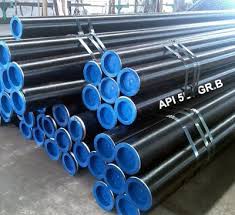
**1. What is API 5L material equivalent to?**
API 5L is a specification for line pipe used in the oil and gas industry for transporting gas, water, and oil. There is no single direct equivalent, as different international standards have similar grades. However, common comparable material specifications include:
* **European Standards (EN):** EN 10208-1 and EN 10208-2 have steel grades such as L245, L290, L360, etc., which are technically very similar to API 5L grades like GR B, X42, X52, etc.
* **German Standards (DIN):** DIN 17172 has grades like StE 240.7, StE 290.7, and StE 360.7, which are also comparable.
* **International Standards (ISO):** ISO 3183 is another international standard for pipeline transportation systems that aligns closely with API 5L.
It's crucial to note that while the mechanical properties (like yield and tensile strength) are often equivalent, the chemical composition and specific testing requirements can differ. They are not interchangeable without careful review of the project specifications.
**2. Is API 5L the same as A106?**
No, API 5L and ASTM A106 are not the same. They are designed for different purposes:
* **API 5L** is for **line pipe** used primarily for the conveyance of oil, gas, and water in transmission pipelines. Its focus is on weldability, toughness, and strength for high-pressure transportation over long distances.
* **ASTM A106** is for **seamless carbon steel pipe** used in **high-temperature service**, such as power plants, refineries, and process plants for conveying steam, water, and other fluids. Its focus is on strength and reliability at elevated temperatures.
While a pipe from one specification might occasionally be used for the other's purpose in non-critical applications, they are governed by different rules and are not considered direct substitutes.
**3. What is the difference between ASTM and DIN?**
ASTM and DIN are two different organizations that publish technical standards.
* **ASTM (American Society for Testing and Materials)**, now known as ASTM International, is a U.S.-based organization. Its standards (e.g., ASTM A53, A106) are developed through a consensus process and are widely used in the United States and many other countries around the world. They are often seen as more generalized and performance-oriented.
* **DIN (Deutsches Institut für Normung - German Institute for Standardization)** is a German national organization. DIN standards (e.g., DIN 2448, DIN 1629) were traditionally used primarily in Germany and continental Europe. They are often known for being very detailed and prescriptive, specifying exact dimensions, materials, and processes.
A key modern difference is that many older DIN standards have been replaced by **EN (European Norm)** standards, which are harmonized across the European Union. So, while DIN is a national standard, ASTM is an international standard with a U.S. origin.
**4. What is the difference between API 5L and ASTM A53?**
Both API 5L and ASTM A53 cover carbon steel pipe used for piping systems, but they have key differences:
* **Governing Body and Purpose:** API 5L is from the American Petroleum Institute and is specifically for **high-pressure pipeline transportation systems**. ASTM A53 is from ASTM International and is for **general purpose** structural and low-pressure plumbing applications.
* **Grades:** API 5L has grades like A, B, X42, X52, X60, etc., with higher strengths available. ASTM A53 has only Grade A and Grade B.
* **Testing:** API 5L has much more stringent requirements for testing, including more rigorous non-destructive testing (NDT), tougher impact testing requirements (for certain grades), and hydrostatic testing on every length of pipe. ASTM A53 has less strict testing requirements.
* **End Use:** API 5L is the standard choice for oil and gas transmission lines. ASTM A53 is common in water lines, plumbing, and structural applications (like fencing and scaffolding).
In simple terms, you can think of **API 5L as the "heavy-duty" version** for critical energy transport, while **ASTM A53 is the "general-duty" version** for common industrial use.
**5. What are ASTM pipe grades?**
ASTM pipe grades are classifications within an ASTM specification that denote different levels of mechanical properties (primarily yield strength and tensile strength) and sometimes chemical composition. Here are some common ASTM pipe specifications and their grades:
* **ASTM A53:** Covers seamless and welded black and hot-dipped galvanized pipe. Grades are **Grade A** (lower strength) and **Grade B** (higher strength).
* **ASTM A106:** Covers seamless carbon steel pipe for high-temperature service. Grades are **Grade A, Grade B, and Grade C** (with Grade C having the highest strength).
* **ASTM A333:** Covers seamless and welded steel pipe for low-temperature service. Grades are numbered (e.g., **Grade 1, Grade 3, Grade 6, Grade 9, Grade 11**), each designed for a specific minimum temperature impact toughness.
* **ASTM A335:** Covers seamless ferritic alloy-steel pipe for high-temperature service. Grades are named with a "P" number (e.g., **P5, P9, P11, P22, P91**), which correspond to specific alloy compositions.
* **ASTM A312:** Covers seamless and welded stainless steel pipe. Grades are designated by the ASTM standard stainless steel grade number (e.g., **TP304, TP316, TP321**).