


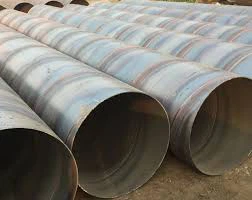
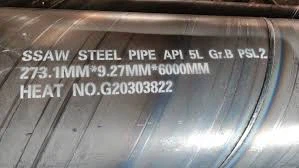
API 5L PSL2 Grade B is a standard, widely available, and commonly specified product for manufacturing Spiral Submerged Arc Welded (SSAW) steel pipes [citation:1, citation:3, citation:4, citation:5, citation:8]. This combination represents the most frequently used specification for large-diameter line pipe in oil, gas, and water transmission systems where enhanced quality and guaranteed toughness are required [citation:3, citation:4, citation:5].
The designation "API 5L PSL2 Grade B Spiral Submerged Arc Pipe" combines the most common material grade (Grade B) with the enhanced PSL2 quality level, produced using the economical spiral welding process for large-diameter applications [citation:3, citation:4].
📋 Key Specifications for API 5L PSL2 Grade B SSAW Pipe
The table below summarizes the primary specifications for this product, based on industry practice and manufacturer data [citation:1, citation:3, citation:4, citation:5, citation:7, citation:8, citation:10].
| Attribute | Description |
|---|---|
| Standard | API 5L: "Specification for Line Pipe" (46th Edition, aligned with ISO 3183) [citation:4, citation:5, citation:7]. |
| Product Specification Level | PSL2: The enhanced quality level for line pipe, with stricter requirements than PSL1 including tighter chemistry controls, maximum strength limits, mandatory Charpy impact testing, and more stringent NDT [citation:3, citation:4, citation:5, citation:8]. |
| Steel Grade | Grade B (L245) : The most common grade in the API 5L specification, with minimum yield strength of 35,000 psi (241 MPa) [citation:3, citation:4, citation:5, citation:7]. |
| ISO Designation | L245 [citation:4, citation:5, citation:7]. |
| Manufacturing Process | Spiral (Helical) Submerged Arc Welding (SSAW/HSAW) : Formed from hot-rolled steel coil, with the weld seam running continuously in a spiral along the pipe's length. Welded using double-sided automatic submerged arc welding [citation:1, citation:3, citation:5, citation:7]. |
| Chemical Composition (max %) [citation:3, citation:8] | Carbon (C): 0.22% max (PSL2 requirement) Manganese (Mn): 1.20% max Phosphorus (P): 0.025% max (tighter than PSL1's 0.030%) Sulfur (S): 0.015% max (significantly tighter than PSL1's 0.030%) Silicon (Si): 0.45% max |
| Mechanical Properties [citation:3, citation:4, citation:5, citation:8] | Yield Strength: 241-448 MPa (35,000-65,000 psi) range – both minimum and maximum specified Tensile Strength: 414-655 MPa (60,000-95,000 psi) range Yield-to-Tensile Ratio: ≤ 0.93 maximum Charpy Impact: Mandatory at specified temperature (≥27J @ 0°C standard) [citation:3, citation:5] |
| Typical Size Range [citation:1, citation:3, citation:5, citation:7, citation:10] | Outside Diameter: 219 mm to 4064 mm (approx. 8" to 160") Wall Thickness: 3.2 mm to 25.4 mm (common range 5-25 mm) Length: 3 m to 18 m standard; up to 50 m available for specific applications |
| Key Testing Requirements [citation:3, citation:5, citation:8] | Mandatory Charpy Impact Testing at specified temperature (typically 0°C) Tensile Testing verifying both minimum and maximum limits Chemical Analysis with tighter PSL2 limits (especially S ≤0.015%) Flattening and Bend Tests for weld integrity 100% Non-Destructive Testing of weld seam (UT/RT) Hydrostatic Test each pipe |
| Common Applications [citation:3, citation:4, citation:5, citation:7] | High-pressure oil and gas transmission pipelines; natural gas distribution networks; water transmission mains requiring guaranteed toughness; offshore pipelines; gathering lines in cold climates; critical infrastructure projects; applications where PSL2 quality is mandated by regulation. |
| Certification | Mill Test Certificate to EN 10204 Type 3.1 with full test results and traceability records [citation:5, citation:7]. API monogram available from licensed mills . |
📊 PSL1 vs. PSL2 Comparison for Grade B SSAW Pipe
The table below highlights the critical differences between PSL1 and PSL2 for Grade B, demonstrating why PSL2 is the premium choice [citation:3, citation:4, citation:5, citation:8]:
| Requirement | PSL1 Grade B | PSL2 Grade B | Significance |
|---|---|---|---|
| Carbon (C) max | 0.26-0.28% [citation:4, citation:8] | 0.22-0.24% [citation:3, citation:8] | Better weldability, lower HAZ hardness |
| Sulfur (S) max | 0.030% [citation:4, citation:8] | 0.015% [citation:3, citation:8] | 50% reduction - critical for toughness and HIC resistance |
| Phosphorus (P) max | 0.030% [citation:4, citation:8] | 0.025% [citation:3, citation:8] | Improved toughness and weldability |
| Yield Strength | Minimum only (245 MPa) [citation:4, citation:8] | Min (245 MPa) AND Max (448 MPa) [citation:3, citation:8] | Prevents over-strength materials that could cause welding issues |
| Tensile Strength | Minimum only (415 MPa) [citation:4, citation:8] | Range specified (415-655 MPa) [citation:3, citation:8] | Ensures consistent mechanical properties |
| Yield Ratio (Y/T) | Not specified | ≤ 0.93 [citation:3, citation:5] | Ensures adequate ductility |
| Impact Testing | Not required | Mandatory (≥27J @ 0°C) [citation:3, citation:5] | Guarantees low-temperature toughness |
| Carbon Equivalent | Not required | Calculated and controlled | Ensures good field weldability |
| Traceability | Batch level | Pipe-by-pipe full traceability | Complete quality documentation |
🔍 Key Points to Understand
What "PSL2 Grade B" Means: This specification combines the most common strength grade (Grade B/L245) with the enhanced quality requirements of PSL2. The result is a pipe with 241 MPa minimum yield strength that also features guaranteed impact toughness, tighter chemistry controls, maximum strength limits, and full traceability [citation:3, citation:4, citation:5, citation:8].
Why Choose PSL2 Grade B? PSL2 Grade B is specified when [citation:3, citation:4, citation:5, citation:7]:
Low-temperature service requires guaranteed impact properties (≥27J at 0°C)
Project specifications mandate PSL2 quality (common for regulated pipelines)
Enhanced documentation and traceability are required by code
Maximum strength limits need control to prevent field welding issues
Sour service requires low sulfur content (≤0.015%)
Regulatory compliance (FERC, DOT, FEMSA lines) is required
The "Workhorse" Grade: Grade B is the most commonly produced and stocked grade in the API 5L specification, with PSL2 availability through major manufacturers worldwide [citation:4, citation:5, citation:7]. This makes PSL2 Grade B SSAW pipe readily available with competitive lead times.
Industry Acceptance: PSL2 Grade B SSAW pipes are widely used in oil and gas transmission, water supply systems, and structural applications where enhanced quality is required but higher-strength grades (X42-X70) are not necessary [citation:3, citation:5, citation:7].
📏 Dimensional Tolerances (API 5L PSL2)
API 5L specifies the following tolerances for SSAW pipes, with PSL2 having the same dimensional requirements as PSL1 [citation:5, citation:10]:
| Parameter | Size Range | Tolerance |
|---|---|---|
| Outside Diameter | ≤ 60.3 mm | -0.8 to +0.4 mm |
| 60.3 mm < OD ≤ 168.3 mm | ±0.0075D | |
| 168.3 mm < OD ≤ 610 mm | ±0.0075D (max ±3.2 mm) | |
| 610 mm < OD ≤ 1422 mm | ±0.005D (max ±4.0 mm) | |
| Wall Thickness | ≤ 5 mm | ±0.5 mm |
| 5 mm < t < 15 mm | ±0.1t | |
| ≥ 15 mm | ±1.5 mm | |
| Straightness | All sizes | ≤ 0.1% of total length |
🏭 Applications and Selection Rationale
PSL2 Grade B SSAW pipes are used in a wide range of applications where enhanced quality is required [citation:3, citation:4, citation:5, citation:7]:
| Application | Why PSL2 Grade B is Specified |
|---|---|
| High-Pressure Gas Transmission | Mandatory Charpy impact testing guarantees toughness at operating temperatures |
| Cold Climate Pipelines | Guaranteed 27J at 0°C ensures ductile behavior in winter conditions |
| Offshore and Marine Applications | Tight sulfur control (≤0.015%) provides HIC resistance; full traceability required |
| Regulated Pipelines | FERC/DOT jurisdictions often require PSL2 quality for all pipeline materials |
| Critical Water Transmission | Enhanced testing and documentation for municipal infrastructure |
| Sour Service (with supplementary req.) | Low sulfur content meets NACE MR0175/ISO 15156 requirements |
| International Projects | Many global specifications default to PSL2 for all pipeline materials |
🔧 Manufacturing Process for PSL2 Grade B SSAW Pipe
The manufacturing process follows enhanced PSL2 quality controls [citation:3, citation:5, citation:7]:
Raw Material Preparation: Hot-rolled steel coils meeting PSL2 Grade B chemistry requirements (especially low sulfur ≤0.015%) are leveled, inspected, and edge-milled [citation:3, citation:5].
Spiral Forming: The steel strip is continuously formed into a cylindrical shape at a specific helix angle at room temperature [citation:3, citation:5].
Submerged Arc Welding: Double-sided automatic submerged arc welding (inside and outside) creates the spiral seam with full penetration. Welding procedures are qualified per PSL2 requirements [citation:3, citation:5].
Non-Destructive Testing: 100% ultrasonic (UT) or radiographic (RT) inspection of the entire weld length with PSL2 acceptance criteria [citation:3, citation:5, citation:8].
Hydrostatic Testing: Each pipe individually tested to verify pressure integrity [citation:3, citation:5].
Mechanical Testing: Tensile tests (verifying both min and max limits), flattening tests, bend tests, and mandatory Charpy impact testing on base metal, weld, and HAZ [citation:3, citation:5].
End Finishing: Ends prepared (plain or beveled per ASME B16.25) for field welding [citation:5, citation:7].
Coating: Optional external coatings (3LPE, FBE, etc.) and internal linings available [citation:5, citation:7].
📝 Important Considerations
Cost Premium: PSL2 Grade B costs more than PSL1 due to additional testing, tighter chemistry controls, and enhanced documentation requirements. The premium is justified for applications requiring guaranteed performance .
Availability: PSL2 Grade B is readily available from major manufacturers, as it is one of the most commonly produced PSL2 grades [citation:1, citation:3, citation:5, citation:7, citation:8].
Complete Specification: When ordering, specify [citation:3, citation:5]:
API 5L PSL2, Grade B, SSAW (spiral welded), Size (OD x WT), Length, End Finish
Impact Test Temperature: 0°C (standard) or lower if required
Any supplementary requirements (sour service, additional NDT)
Coating requirements (3LPE, FBE, etc.)
Sour Service Option: For H₂S-containing environments, specify API 5L PSL2 Grade B with supplementary requirement SR16 (SSC testing) and verify sulfur content ≤0.002% .
Dual Certification: Many mills offer pipes dual-certified to API 5L PSL2 Grade B, ASTM A53 Gr B, and ASTM A106 Gr B, providing flexibility for projects with multiple standard requirements .
📝 Summary
API 5L PSL2 Grade B Spiral Submerged Arc Welded pipes are the standard, most common choice for large-diameter pipeline applications requiring enhanced quality [citation:3, citation:4, citation:5, citation:7]. With minimum yield strength of 241 MPa (35,000 psi) , these pipes combine the reliable mechanical properties of Grade B with the premium features of PSL2: guaranteed Charpy impact toughness (≥27J at 0°C), tighter chemistry controls (especially sulfur ≤0.015%), maximum strength limits, full traceability, and more stringent testing [citation:3, citation:5, citation:8].
Available in diameters from 219mm to over 4000mm with wall thicknesses to 25.4mm and lengths up to 50m, these pipes are produced using the cost-effective SSAW manufacturing process while meeting the stringent quality requirements of PSL2 [citation:1, citation:3, citation:5, citation:7].
PSL2 Grade B is the preferred specification for [citation:3, citation:4, citation:5, citation:7]:
High-pressure gas transmission requiring guaranteed toughness
Cold climate and offshore applications
Regulated pipelines (FERC, DOT, FEMSA)
Critical infrastructure projects
Applications where enhanced documentation is mandatory
When ordering, ensure you clearly indicate API 5L PSL2 Grade B, SSAW, along with required dimensions, impact test temperature, and any coating or supplementary requirements based on your specific application [citation:3, citation:5, citation:7].


