



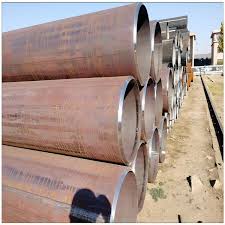
API 5L PSL1 Longitudinal Submerged Arc Welded (LSAW) Pipe
API 5L PSL1 LSAW pipe is a fundamental and widely used product for onshore and offshore oil and gas transportation pipelines. It is manufactured by shaping steel plates into a cylinder and welding the seam along its length using the Submerged Arc Welding (SAW) process. This method is preferred for large-diameter, high-pressure transmission lines.
1. Terminology Breakdown
| Term | Full Name | Meaning & Importance |
|---|---|---|
| API 5L | Specification for Line Pipe | The governing international standard by the American Petroleum Institute. It defines the requirements for seamless and welded steel pipe used in pipeline transportation systems. |
| PSL1 | Product Specification Level 1 | The standard level of requirements. PSL1 pipes have standard chemical, mechanical, and testing requirements suitable for most common pipeline applications. |
| Longitudinal | - | The seam weld runs parallel to the pipe's longitudinal axis. This is the most common orientation for LSAW pipe. |
| Submerged Arc Welding (SAW) | - | A high-quality, automated welding process where the arc is "submerged" under a layer of fusible flux. It produces deep penetration, high-strength welds with excellent quality and consistency. |
| LSAW | Longitudinally Submerged Arc Welded | The complete designation for the pipe's manufacturing method. |
2. Key Characteristics & Technical Data (PSL1)
| Feature | Description / Specification (Typical for PSL1) |
|---|---|
| Primary Manufacturing Process | Plate → Uing & Oing (UOE) or J-ing & C-ing (JCOE) forming → Submerged Arc Welding (inside & outside) → Expansion → Testing. |
| Common Sizes | Outside Diameter (OD): Typically from 18 inches (457 mm) up to 60 inches (1524 mm) and larger. Wall Thickness (WT): Medium to Heavy, commonly from 6 mm to 40+ mm. |
| Steel Grades (Common) | B, X42, X46, X52, X56, X60, X65, X70. (The number indicates the minimum yield strength in ksi, e.g., X65 = 65,000 psi min yield). |
| Key Application | Long-distance, high-pressure transmission pipelines for oil, natural gas, and other fluids. |
| Weld Seam | One longitudinal seam. The weld is visually prominent and is a key area for non-destructive testing (NDT). |
| Advantages | • Large Diameter & Thick Wall Capability • High Dimensional Accuracy (especially UOE process) • High Weld Quality & Strength from SAW process • Good Economics for large-diameter projects. |
| Limitations | • Generally not economical for small diameters (<~16 inches). • The single longitudinal weld is a potential line of weakness compared to seamless pipe, requiring rigorous inspection. |
3. Comparison with Other Common Line Pipe Types
| Pipe Type | Manufacturing Method | Typical Size Range (OD) | Key Features | Common Use Case |
|---|---|---|---|---|
| API 5L PSL1 LSAW | Plate formed & longitudinally welded via SAW. | Large: ~18" to 60"+ | One straight seam, strong, cost-effective for large sizes. | Main transmission lines, cross-country pipelines. |
| API 5L Seamless (SMLS) | Solid steel billet pierced and rolled. | Small to Large: ~1/2" to 26" | No weld seam, uniform strength, best pressure integrity. | High-pressure, critical sections, gathering lines, small-diameter projects. |
| API 5L ERW | Coil formed & welded via electric resistance. | Small to Medium: ~2-3/8" to 24" | One straight seam, efficient, smooth weld. | Lower-pressure flow lines, gathering lines, distribution networks. |
| API 5L SSAW/HSAW | Coil formed & spirally/helically welded via SAW. | Medium to Large: ~20" to 100"+ | Long spiral seam, flexible on diameter/wall combinations. | Large-diameter water, piling, or lower-pressure transmission. |
4. Quality Assurance & Testing (PSL1 Requirements)
Testing is less extensive than for PSL2 but still rigorous. Key tests include:
Non-Destructive Testing (NDT): 100% radiographic (X-ray) or ultrasonic inspection of the entire weld seam is mandatory.
Mechanical Tests: Tensile test, flattening test, or guided bend test on weld samples.
Hydrostatic Test: Every pipe is pressure tested to a level above its specified minimum yield strength (SMYS).
5. Important Considerations
PSL1 vs. PSL2: For more demanding applications (e.g., offshore, arctic, high-fatigue areas), PSL2 specifies stricter chemistry (lower carbon equivalent for better weldability), tougher impact testing (Charpy V-Notch), and higher testing frequency. PSL1 is the default for most standard onshore pipelines.
End Finishing: Can be supplied as plain end (PE) or with beveled ends for field welding.
Coating: Externally coated with Fusion-Bonded Epoxy (FBE), 3-Layer Polyethylene (3LPE), or other systems for corrosion protection. Internally may be lined for flow efficiency or corrosion resistance.
Summary
API 5L PSL1 LSAW pipe is the workhorse for large-diameter, high-pressure oil and gas transmission pipelines. Its combination of the robust SAW welding process, ability to handle large dimensions, and compliance with the well-established API 5L PSL1 standard makes it a reliable and cost-effective choice for constructing the backbone of energy transportation infrastructure worldwide.


