


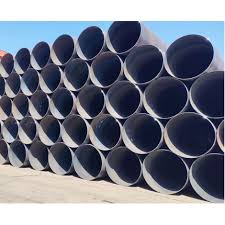
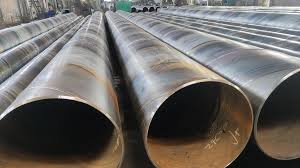
API 5L PSL1 Grade A is a standard and commonly available material specification for manufacturing Spiral Submerged Arc Welded (SSAW) steel pipes [citation:1, citation:2, citation:3, citation:5, citation:8, citation:9]. This combination is a well-established product offered by numerous global manufacturers for general pipeline and fluid transmission applications where the baseline strength grade is sufficient [citation:4, citation:8].
The designation "API 5L PSL1 Grade A Spiral Submerged Arc Pipe" combines the most basic material grade of the API 5L line pipe specification with the cost-effective spiral welding process to produce large-diameter pipes for less demanding service conditions [citation:4, citation:8].
📋 Key Specifications for API 5L PSL1 Grade A SSAW Pipe
The table below summarizes the primary specifications for this product, based on industry practice and manufacturer data [citation:1, citation:2, citation:3, citation:5, citation:7, citation:8, citation:9].
| Attribute | Description |
|---|---|
| Standard | API 5L: "Specification for Line Pipe" (46th Edition, aligned with ISO 3183) [citation:1, citation:4, citation:7]. |
| Product Specification Level | PSL1: The standard quality level for line pipe, with less stringent requirements compared to PSL2 (no mandatory impact testing, standard chemistry limits, minimum strength only specified) [citation:1, citation:4, citation:9]. |
| Steel Grade | Grade A (L210) : The entry-level strength grade in the API 5L specification. The "A" designation indicates a minimum yield strength of 30,000 psi (207 MPa) [citation:4, citation:8]. |
| ISO Designation | L210 [citation:3, citation:4, citation:8]. |
| Manufacturing Process | Spiral (Helical) Submerged Arc Welding (SSAW/HSAW) : Formed from hot-rolled steel coil, with the weld seam running continuously in a spiral along the pipe's length. Welded using double-sided automatic submerged arc welding [citation:1, citation:4, citation:5, citation:7]. |
| Chemical Composition (max %) [citation:1, citation:2, citation:3, citation:5, citation:7, citation:9] | Carbon (C): 0.22% max Manganese (Mn): 0.90% max Phosphorus (P): 0.030% max Sulfur (S): 0.030% max |
| Mechanical Properties (min) [citation:1, citation:2, citation:3, citation:4, citation:5, citation:7, citation:8, citation:9] | Yield Strength: 210 MPa (30,500 psi) Tensile Strength: 335 MPa (48,600 psi) |
| Typical Size Range [citation:1, citation:2, citation:3, citation:4, citation:5, citation:7, citation:8, citation:10] | Outside Diameter: 219 mm to 4064 mm (approx. 8" to 160") Wall Thickness: 3.2 mm to 40 mm (common range 5-25.4 mm) Length: 3 m to 18 m standard; up to 50 m available for specific applications |
| Key Testing Requirements [citation:1, citation:2, citation:4, citation:5, citation:7, citation:8] | Chemical analysis; tensile test; flattening test; bend test; hydrostatic test (each pipe); non-destructive testing (ultrasonic or X-ray of weld seam - standard practice). Impact testing is not required for PSL1 . |
| Common Applications [citation:1, citation:2, citation:4, citation:5, citation:7, citation:8, citation:9, citation:10] | Low-pressure water transmission; irrigation systems; drainage lines; structural applications (piling, foundation supports); general utility piping; low-pressure gas gathering; non-critical fluid service where higher strength grades are not required. |
| Certification | Mill Test Certificate typically to EN 10204 Type 3.1 or equivalent, with API monogram when required [citation:1, citation:2, citation:5]. |
📊 API 5L PSL1 Grade Comparison
The table below compares Grade A with adjacent grades in the API 5L PSL1 family [citation:1, citation:2, citation:3, citation:4, citation:5, citation:7]:
| Grade | ISO | Yield Strength (min) | Tensile Strength (min) | Relative Strength | Typical Application |
|---|---|---|---|---|---|
| A | L210 | 210 MPa (30 ksi) | 335 MPa (48 ksi) | Baseline | Low-pressure water, drainage, non-critical structural, irrigation |
| B | L245 | 245 MPa (35 ksi) | 415 MPa (60 ksi) | +17% yield | General pipeline service, most common grade |
| X42 | L290 | 290 MPa (42 ksi) | 415 MPa (60 ksi) | +38% yield | Medium-pressure transmission |
| X46 | L320 | 320 MPa (46 ksi) | 435 MPa (63 ksi) | +52% yield | Higher-pressure lines |
Percentage Increase: Grade A is the baseline strength grade, with Grade B offering approximately 17% higher yield strength .
🔍 Key Points to Understand
What "Grade A" Means: Within API 5L, Grade A (also designated as L210 in ISO notation) has a minimum yield strength of 210 MPa (30,000 psi) and a minimum tensile strength of 335 MPa (48,600 psi) [citation:4, citation:8]. It is the entry-level strength grade, suitable for applications where higher-strength grades (B, X42, etc.) are not required.
PSL1 Quality Level: The choice of PSL1 is significant. Key characteristics of PSL1 include [citation:1, citation:4, citation:9]:
Chemistry: Standard limits as shown above.
Strength: Only minimum yield and tensile strengths are specified; no maximum limits.
Impact Testing: Not required by the standard .
Typical Use: Suitable for general pipeline service, water lines, and non-critical applications where enhanced toughness and tighter controls are not necessary.
PSL2 Comparison: PSL2 would require tighter chemistry controls (e.g., C ≤ 0.24% for welded pipe), maximum strength limits, and mandatory Charpy impact testing [citation:4, citation:9]. PSL2 is typically required for critical service, sour service, low-temperature applications, and pipelines regulated by bodies like FERC or DOT .
SSAW Advantages for Grade A: The spiral welding process is well-suited for producing large-diameter, thick-wall pipes in Grade A [citation:1, citation:4, citation:5]:
Large Diameter Capability: Can economically produce pipes up to 160" diameter
Cost Efficiency: More economical than LSAW or seamless for very large diameters
Long Lengths: Up to 50m lengths reduce field welding requirements
Diameter Flexibility: Same steel coil can produce various diameters by adjusting the spiral angle
📏 Dimensional Tolerances
API 5L specifies the following tolerances for SSAW pipes [citation:5, citation:9, citation:10]:
| Parameter | Size Range | Tolerance |
|---|---|---|
| Outside Diameter | ≤ 60.3 mm | -0.8 to +0.4 mm |
| 60.3 mm < OD ≤ 168.3 mm | ±0.0075D | |
| 168.3 mm < OD ≤ 610 mm | ±0.0075D (max ±3.2 mm) | |
| 610 mm < OD ≤ 1422 mm | ±0.005D (max ±4.0 mm) | |
| Wall Thickness | ≤ 5 mm | ±0.5 mm |
| 5 mm < t < 15 mm | ±0.1t | |
| ≥ 15 mm | ±1.5 mm | |
| Straightness | All sizes | ≤ 0.1% of total length |
🏭 Applications and Grade Selection
API 5L PSL1 Grade A SSAW pipes are used in applications where the baseline strength is adequate [citation:1, citation:2, citation:4, citation:5, citation:7, citation:8]:
| Application | Description | Why Grade A is Suitable |
|---|---|---|
| Water Transmission Lines | Large-diameter water mains, irrigation systems, drainage pipelines | Low pressure requirements; cost-effective solution |
| Structural Applications | Piling foundations, bridge supports, construction projects | Adequate yield strength for many structural designs |
| Low-Pressure Gas Gathering | Non-critical gas collection lines where pressures are minimal | Basic strength sufficient; PSL2 not required |
| General Utility Piping | Industrial water lines, cooling water systems, fire water mains | Economical choice for non-critical service |
| Dredging and Slurry Lines | Transport of water and solids in mining/dredging operations | Good weldability; large diameters available |
| Temporary Pipelines | Construction site water supply, dewatering lines | Cost-effective for temporary installations |
🔧 Manufacturing Process
The manufacturing process for API 5L PSL1 Grade A SSAW pipe follows standard SSAW production methods [citation:1, citation:4, citation:5, citation:7]:
Raw Material Preparation: Hot-rolled steel coils meeting API 5L Grade A chemistry requirements are leveled, inspected, and edge-milled [citation:1, citation:4].
Spiral Forming: The steel strip is continuously formed into a cylindrical shape at a specific helix angle at room temperature [citation:1, citation:4, citation:5].
Submerged Arc Welding: Double-sided automatic submerged arc welding (inside and outside) creates the spiral seam with full penetration [citation:1, citation:4, citation:5].
Non-Destructive Testing: 100% ultrasonic or X-ray inspection of the weld seam is standard practice [citation:1, citation:4, citation:5, citation:7].
Hydrostatic Testing: Each pipe individually tested to verify pressure integrity [citation:1, citation:4, citation:5, citation:7].
Mechanical Testing: Tensile tests, flattening tests, and bend tests to verify properties [citation:1, citation:2, citation:7].
End Finishing: Ends prepared (plain or beveled) for field welding [citation:1, citation:4].
Coating: Optional external coatings (3LPE, FBE, etc.) as required [citation:1, citation:7].
📝 Important Considerations
PSL1 vs. PSL2: PSL1 is the standard quality level suitable for general service. For applications requiring enhanced toughness or tighter controls, specify API 5L PSL2 instead .
Grade Selection Rationale: Grade A is selected when [citation:4, citation:8]:
Design pressures are low (typically ≤ 2.5 MPa depending on wall thickness)
Cost optimization is critical
Higher-strength grades (B, X42, etc.) would be over-specified
The application is non-critical and does not require PSL2 features
Impact Testing: PSL1 does not require Charpy impact testing. If low-temperature service is anticipated, consider specifying supplementary requirements or upgrading to PSL2 .
Coating Options: Pipes can be supplied with various corrosion protection systems [citation:1, citation:7]:
3LPE (3-layer polyethylene)
FBE (Fusion Bonded Epoxy)
Coal Tar Epoxy
Black oil or varnish coating (temporary)
Complete Specification: When ordering, specify [citation:1, citation:4, citation:5]:
API 5L PSL1, Grade A, SSAW (spiral welded), Size (OD x WT), Length, End Finish, and any supplementary requirements
📝 Summary
API 5L PSL1 Grade A Spiral Submerged Arc Welded pipes are the entry-level, standard product for large-diameter line pipe applications [citation:1, citation:4, citation:8]. With minimum yield strength of 30,000 psi (210 MPa) , these pipes offer an economical solution for low-pressure water transmission, irrigation systems, drainage lines, and non-critical structural applications where higher-strength grades (B, X42, etc.) are not required [citation:4, citation:8].
The PSL1 quality level provides standard requirements suitable for general service, with the spiral welding process enabling production of pipes with large diameters (219mm to 4000mm+), thick walls (up to 40mm), and long lengths (up to 50m) at competitive costs [citation:1, citation:2, citation:4, citation:5, citation:7].
For more demanding applications requiring guaranteed low-temperature toughness or tighter controls, specify API 5L PSL2 with appropriate supplementary requirements . When ordering, ensure you clearly indicate the complete standard, grade, dimensions, and any coating or testing requirements based on your specific application [citation:1, citation:4, citation:5].


