



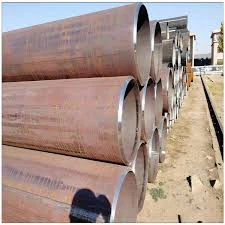
API 5L PSL1 Grade A is a recognized and standard material specification for manufacturing Longitudinal Submerged Arc Welded (LSAW) pipes [citation:1, citation:2, citation:6, citation:8, citation:9]. This combination is a common product offered by numerous global manufacturers for pipeline transportation systems, particularly for applications where the enhanced requirements of PSL2 are not necessary [citation:1, citation:4].
Here is the detailed specification for an API 5L PSL1 Grade A LSAW pipe:
Key Specifications
| Attribute | Description |
|---|---|
| Product Type | LSAW (Longitudinally Submerged Arc Welded) Steel Pipe. Manufactured using processes like UOE, JCOE, or RBE forming, with double-sided submerged arc welding (DSAW) [citation:2, citation:3, citation:8]. |
| Standard | API 5L: Specification for Line Pipe (current edition aligned with ISO 3183) [citation:1, citation:9]. |
| Product Specification Level | PSL1: The standard quality level for line pipe, with less stringent requirements compared to PSL2 (e.g., no mandatory impact testing, chemistry limits are not as tight, and maximum strength is not specified) [citation:1, citation:4, citation:9]. |
| Steel Grade | Grade A (L210) : A carbon steel grade representing the entry-level strength within the API 5L specification [citation:1, citation:6, citation:9]. |
| Process | LSAW (Longitudinal Submerged Arc Welding) : Pipes are manufactured by forming steel plates into a cylinder and welding the longitudinal seam both internally and externally using a submerged arc process, which ensures deep penetration and high weld quality [citation:1, citation:8]. |
| Chemical Composition (max %) [citation:6, citation:9] | |
| Carbon (C): 0.22 | |
| Manganese (Mn): 0.90 | |
| Phosphorus (P): 0.030 | |
| Sulfur (S): 0.030 | |
| Mechanical Properties (min) [citation:1, citation:6, citation:9] | |
| Yield Strength: 210 MPa (30,000 psi) | |
| Tensile Strength: 335 MPa (48,600 psi) | |
| Typical Size Range [citation:2, citation:3, citation:5, citation:8, citation:10] | |
| Outside Diameter: 323.9 mm to 2134 mm (approx. 12" to 84") | |
| Wall Thickness: 5 mm to 60 mm (up to 120 mm available from some manufacturers) [citation:3, citation:8] | |
| Length: 3 m to 18.3 m (customizable, up to 32 m available for specific applications) [citation:5, citation:8] | |
| Manufacturing Steps [citation:2, citation:8] | 1. Steel plate selection and edge milling. 2. Edge crimping and forming using JCOE or UOE processes. 3. Internal and external submerged arc welding. 4. Mechanical expanding (for UOE/JCOE). 5. Non-destructive testing (Ultrasonic, X-ray). 6. Hydrostatic testing. 7. End facing and beveling. |
| Common Applications [citation:1, citation:4, citation:9] | General pipeline transportation of oil, gas, and water at lower pressures; gathering and flow lines in upstream operations; water transmission mains; structural applications; engineering and offshore projects where the enhanced properties of PSL2 are not required. PSL1 pipes are typically used for distribution lines . |
| Certification | Mill Test Certificate typically provided as per API 5L requirements . |
🔍 Key Points to Understand
What "Grade A" Means: Within API 5L, Grade A (also designated as L210 in ISO notation) has a minimum yield strength of 210 MPa (30,000 psi) and a minimum tensile strength of 335 MPa (48,600 psi) [citation:1, citation:6, citation:9]. It is the baseline strength grade, suitable for lower-pressure applications where higher-strength grades (like B, X42, etc.) are not required.
PSL1 vs. PSL2: The choice between PSL1 and PSL2 is critical. PSL1 is the standard quality level with basic requirements. Key differences for PSL1 [citation:1, citation:4, citation:9]:
Chemistry: Standard limits (as shown above).
Strength: Only minimum yield and tensile strengths are specified.
Impact Testing: Not required.
Non-Destructive Testing (NDT) : Standard requirements apply.
Typical Use: Suitable for general pipeline service, gathering lines, and distribution systems .
PSL2: Requires tighter chemistry controls, specifies maximum as well as minimum strength limits, mandates Charpy V-notch impact testing, and has more stringent NDT requirements. PSL2 is typically required for critical service, sour service, low-temperature applications, and pipelines regulated by bodies like FERC or DOT [citation:1, citation:4].
LSAW Manufacturing for Grade A: While Grade A is commonly manufactured as seamless pipe for smaller diameters, the LSAW process is well-suited for producing large-diameter, thick-wall pipes in Grade A for applications such as water transmission or structural components [citation:2, citation:3, citation:8]. The robust welding process ensures high-quality seams even with this lower-strength material.
Grade Nomenclature: In API 5L, the grade can be referred to as either Grade A (using the legacy designation) or L210 (using the more modern ISO 3183-compliant designation) .
Summary
In conclusion, API 5L PSL1 Grade A LSAW pipe is a well-established, standard product that combines the entry-level strength of Grade A steel with the robust LSAW manufacturing process [citation:1, citation:2]. It is a cost-effective choice for large-diameter pipeline and structural applications where the higher strength and more stringent testing requirements of PSL2 (e.g., for Grades B, X42, etc.) are not necessary [citation:1, citation:4]. The LSAW process enables the production of pipes with large diameters (up to 84"+), thick walls (up to 60-120 mm), and excellent weld integrity, making it suitable for various infrastructure projects [citation:2, citation:3, citation:5, citation:8]. When specifying, ensure you clearly indicate API 5L PSL1 Grade A LSAW pipe along with required dimensions (OD, wall thickness, length) and any supplementary requirements.


