



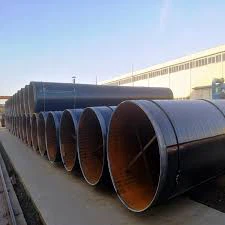
API 5L PSL1 Grade A Double-Sided Submerged Arc Welding (DSAW) Steel Pipe
Basic Overview
API 5L PSL1 Grade A DSAW (Double-Sided Submerged Arc Welding) steel pipe is the entry-level carbon steel line pipe manufactured to the American Petroleum Institute specification for pipeline transportation systems . The "Grade A" designation indicates a minimum yield strength of 30,000 psi (207 MPa), representing the lowest strength grade in the API 5L family .
Important Note: Grade A is available only in PSL1 quality level. PSL2 grades are offered from Grade B through X80 only . For applications requiring enhanced quality (tighter chemistry controls, mandatory impact testing, maximum strength limits), specify Grade B PSL2 or higher.
The DSAW manufacturing process-also known as LSAW (Longitudinal Submerged Arc Welding)-is a high-integrity welding method where both inside and outside welds are applied, forming a single high-quality weld nugget. This process is specifically designed for large-diameter, thick-wall pipes used in low-pressure fluid transmission, structural, and piling applications .
Name Explanation
| Part | Meaning |
|---|---|
| API | American Petroleum Institute |
| 5L | Specification for line pipe used in pipeline transportation systems |
| PSL1 | Product Specification Level 1 – standard quality level with basic requirements (no mandatory impact testing) |
| Grade A | Entry-level carbon steel grade with minimum yield strength of 30,000 psi (207 MPa) |
| DSAW | Double-Sided Submerged Arc Welding – both inside and outside welds are applied; the welding arc is submerged in granular flux during welding |
| Also Known As | LSAW (Longitudinal Submerged Arc Welding) – when the weld seam runs longitudinally along the pipe |
Key Specifications
| Attribute | Description |
|---|---|
| Standard | API 5L (46th Edition, aligned with ISO 3183) |
| Product Specification Level | PSL1 – standard quality level |
| Grade | A (L210 in ISO notation) |
| Minimum Yield Strength | 207 MPa (30,000 psi) |
| Minimum Tensile Strength | 331 MPa (48,000 psi) |
| Manufacturing Process | DSAW (Double-Sided Submerged Arc Welding) / LSAW (Longitudinal Submerged Arc Welding) |
| Forming Methods | JCOE (progressive J-C-O forming) or UOE (U-ing, O-ing, Expanding) |
| Size Range (DSAW) | 406 mm to 1829 mm (16" to 72") OD – typical for DSAW |
| Wall Thickness | 6.0 mm to 50 mm (up to 75 mm for special applications) |
| Length | 6 m to 12 m standard; up to 18 m available |
| End Finishes | Plain ends, beveled ends (30° bevel angle), threaded |
| Coating Options | Black paint, varnish, anti-rust oil, FBE, 3LPE, coal tar epoxy |
Chemical Composition (API 5L PSL1 Grade A Welded Pipe)
| Element | Maximum % | Notes |
|---|---|---|
| Carbon (C) | 0.22% | Lowest carbon among API 5L grades for maximum formability |
| Manganese (Mn) | 0.90% | Provides basic strength |
| Phosphorus (P) | 0.030% | Controlled for weldability |
| Sulfur (S) | 0.030% | Controlled for toughness |
| Silicon (Si) | Not specified for PSL1 | Typically ≤ 0.40% |
Note: PSL1 has no requirement for maximum yield strength, carbon equivalent, or mandatory impact testing .
Mechanical Properties (API 5L PSL1 Grade A)
| Property | Requirement |
|---|---|
| Yield Strength (min) | 207 MPa (30,000 psi) |
| Yield Strength (max) | Not specified for PSL1 |
| Tensile Strength (min) | 331 MPa (48,000 psi) |
| Tensile Strength (max) | Not specified for PSL1 |
| Elongation | Per API 5L formula (varies by wall thickness) |
| Charpy Impact | Not required for PSL1 – only PSL2 requires mandatory impact testing |
Grade A vs. Grade B Comparison
| Property | Grade A | Grade B | Difference |
|---|---|---|---|
| Yield Strength (min) | 207 MPa (30 ksi) | 241 MPa (35 ksi) | Grade B is 16% stronger |
| Tensile Strength (min) | 331 MPa (48 ksi) | 414 MPa (60 ksi) | Grade B is 25% stronger |
| Carbon (C) max | 0.22% | 0.26% | Grade A has lower carbon |
| Manganese (Mn) max | 0.90% | 1.20% | Grade B has higher Mn for strength |
| Typical Application | Low-pressure water, drainage, non-critical | General pipeline service, most common | Grade B is the standard choice |
Dimensional Specifications
| Parameter | Range / Tolerance |
|---|---|
| Outside Diameter | 406 mm to 1829 mm (16" to 72") – typical DSAW range |
| Wall Thickness | 6.0 mm to 50 mm (up to 75 mm for special applications) |
| Diameter Tolerance | ±0.75% of specified OD (typical) |
| Wall Thickness Tolerance | +15% / -12.5% of nominal (typical) |
| Length | 6 m to 12 m standard; up to 18 m available |
| Out-of-Roundness | ≤ 1% of specified OD |
Typical Size Availability (API 5L Grade A DSAW):
| OD (inch) | OD (mm) | Wall Thickness Range (mm) |
|---|---|---|
| 16" | 406 | 6.0 - 14.0 |
| 20" | 508 | 6.0 - 16.0 |
| 24" | 610 | 6.0 - 18.0 |
| 30" | 762 | 7.0 - 21.0 |
| 36" | 914 | 8.0 - 24.0 |
| 40" | 1016 | 8.0 - 26.0 |
| 48" | 1219 | 9.0 - 28.0 |
| 56" | 1422 | 10.0 - 29.0 |
| 60" | 1524 | 10.0 - 29.0 |
| 64" | 1626 | 10.0 - 30.0 |
| 72" | 1829 | 10.0 - 30.0 |
DSAW/LSAW Manufacturing Process
Double-Sided Submerged Arc Welding (DSAW), also known as Longitudinal Submerged Arc Welding (LSAW), is a high-efficiency process used primarily for large-diameter steel pipes .
Process Description
Welding arc is submerged in granular flux during welding, protecting the weld from atmospheric contamination
Both inside and outside welds are required, usually accomplished in separate processes
The separate welds consume a portion of the other, resulting in a single high-quality weld nugget
Forming Methods
| Method | Description | Typical Diameters |
|---|---|---|
| JCOE | Progressive J-C-O forming steps (J-shape → C-shape → O-shape), expanded after welding | 406-1626 mm (16"-64") |
| UOE | Plate pressed into U-shape, then O-shape, expanded after welding | 508-1118 mm (20"-44") |
Process Steps
Plate Selection – Steel plates meeting API 5L PSL1 Grade A requirements
Edge Preparation – Edges are beveled to create a V-shaped groove
Forming – Steel plates are formed into cylindrical shapes using JCOE or UOE presses
Tack Welding – Formed plates are tack-welded to maintain shape
Double Submerged Arc Welding – Pipe seam welded on both interior and exterior surfaces
Cold Expansion – Pipe may be expanded up to 1.5% to achieve final OD dimension
Ultrasonic Inspection – Seam inspected by continuous ultrasonic automatic flaw detection
Hydrostatic Pressure Test – Each pipe undergoes hydrostatic pressure testing (when specified)
Finishing – End processing, beveling, coating, and marking according to specifications
Testing & Inspection Requirements (PSL1)
| Test Type | Requirement | Notes |
|---|---|---|
| Chemical Analysis | Per heat lot | Verifies composition limits per API 5L PSL1 |
| Tensile Test | Per lot | Verifies yield and tensile strength |
| Flattening Test | Required | Checks ductility and weld integrity |
| Bend Test | Required | Verifies weld integrity |
| Charpy Impact Test | Not required for PSL1 | Only PSL2 requires mandatory impact testing |
| Hydrostatic Test | Each pipe (when specified) | Pressure integrity verification |
| Ultrasonic Inspection | 100% of weld seam | Standard practice for DSAW |
| X-ray Inspection | For "T" joints | Where strip butt welds intersect spiral seams |
| Dimensional Inspection | 100% | Per standard tolerances |
| Mill Test Certificate | EN 10204 Type 3.1B | Provided with full test results |
PSL1 vs. PSL2 Comparison for Grade A
| Feature | PSL1 Grade A | PSL2 Grade A | Significance |
|---|---|---|---|
| Availability | Available | Not available (PSL2 starts at Grade B) | PSL2 Grade A is not offered |
| Carbon (C) max | 0.22% | - | - |
| Sulfur (S) max | 0.030% | - | - |
| Yield Strength | 207 MPa min only | - | - |
| Impact Testing | Not required | - | - |
| Typical Use | Low-pressure, non-critical | - | - |
PSL2 Grade A is not available. According to API 5L specifications, PSL2 grades cover B through X80 . Grade A is only available in PSL1.
Common Applications
| Application | Description |
|---|---|
| Low-Pressure Water Lines | Municipal water supply, irrigation systems, drainage lines |
| Low-Pressure Gas Gathering | Non-critical natural gas collection |
| General Utility Piping | Industrial water lines, cooling water systems |
| Structural Applications | Piling, fencing, handrails, scaffolding |
| Mechanical Manufacturing | Machinery components, equipment frames |
| Temporary Pipelines | Construction site water supply, dewatering lines |
Key Advantages
| Advantage | Description |
|---|---|
| Most Economical | Lowest cost among API 5L grades |
| Excellent Formability | Low carbon content (0.22% max) allows bending, flanging, and shaping without cracking |
| Good Weldability | Low carbon equivalent ensures easy field welding |
| Large Diameter Capability | DSAW produces pipes from 16" to 72" OD – ideal for large-diameter applications |
| High Weld Integrity | Double-sided welding creates a single high-quality weld nugget with 100% UT inspection |
| Wide Availability | Commonly stocked by manufacturers |
| Ductility | Higher elongation than higher grades, suitable for cold forming |
International Approximations
| Standard | Equivalent Grade | Notes |
|---|---|---|
| ASTM A53 | Grade A | Similar yield strength (205 MPa vs. 207 MPa) |
| EN 10217-1 | P195TR1 / P195TR2 | Similar strength (195 MPa yield) |
| GB/T 9711 | L210 | Chinese equivalent |
| ISO 3183 | L210 | International standard equivalent |
| JIS G3454 | STPG370 | Japanese equivalent |
Coating Options
API 5L PSL1 Grade A DSAW pipe can be supplied with various coatings for corrosion protection :
| Coating Type | Best For | Key Features |
|---|---|---|
| 3LPE (3-layer polyethylene) | Buried pipelines | Most common; excellent corrosion protection, high impact resistance |
| FBE (Fusion Bonded Epoxy) | Oil & gas pipelines | Strong adhesion, chemical resistance |
| Coal Tar Epoxy | Marine environments | Heavy-duty protection |
| Varnish / Anti-rust oil | Temporary protection | Short-term corrosion protection during transport |
| Bitumen Coating | Buried service | Cost-effective protection |
| Black Oil Coating | Standard mill finish | Temporary protection |
End Finishes
Available end treatments include :
Plain ends (PE) – standard for most applications
Beveled ends (BE) – for field welding (30° bevel angle)
Threaded ends – for mechanical connections
Important Considerations
1. PSL1 Grade A vs. Grade B Selection
Grade A: Choose for low-pressure, non-critical applications where cost is the primary driver
Grade B: Most common grade for general service; offers 16% higher yield strength
2. PSL2 Not Available for Grade A
PSL2 Grade A is not offered in API 5L specifications
PSL2 starts at Grade B and goes through X80
If PSL2 quality is required, specify Grade B PSL2 or higher
3. DSAW Size Limitations
DSAW manufacturing for Grade A is typically available from 16" to 72" OD
Smaller diameters (under 16") are typically produced by ERW or seamless methods
4. Impact Testing
PSL1 does not require Charpy impact testing by the standard . If low-temperature service is anticipated, consider:
Specifying impact testing as a supplementary requirement
Upgrading to PSL2 (Grade B or higher)
5. Pressure Limitations
Grade A is suitable for low-pressure applications only
For higher pressure requirements, consider Grade B or higher grades
6. Temperature Limitations
Maximum recommended service temperature: 350°C (662°F)
No guaranteed low-temperature toughness – not suitable for sub-zero applications without evaluation
7. Third-Party Inspection
Available inspection services include SGS, BV, Lloyds
8. Mill Test Certificate
Typically provided as EN 10204 Type 3.1B with full test results
Third-party inspection available upon request
Summary
API 5L PSL1 Grade A Double-Sided Submerged Arc Welded (DSAW/LSAW) steel pipe is the entry-level line pipe specification for large-diameter, low-pressure applications. With minimum yield strength of 30,000 psi (207 MPa) and tensile strength of 48,000 psi (331 MPa), this material offers the most economical solution for non-critical fluid transmission, structural, and piling applications where higher strength grades are not required .
Key features:
Material standard: API 5L PSL1 Grade A – entry-level strength grade
Yield strength: 207 MPa (30,000 psi) minimum – lowest in API 5L family
PSL1 quality level: No mandatory impact testing; standard requirements for general service
PSL2 not available for Grade A – PSL2 starts at Grade B
Lowest carbon content (0.22% max) among API 5L grades for maximum formability
DSAW manufacturing produces pipes from 16" to 72" OD with wall thickness up to 50 mm
Double-sided welding creates a single high-quality weld nugget
JCOE or UOE forming methods ensure precise dimensional accuracy
100% ultrasonic inspection of weld seam ensures quality
Excellent weldability and good formability
Most economical choice among API 5L grades
Common applications include:
Low-pressure water lines and irrigation systems
Low-pressure gas gathering and drainage lines
General utility piping and industrial water lines
Structural applications (piling, fencing, handrails)
Mechanical manufacturing components
Temporary pipelines and construction applications
When ordering, specify: API 5L PSL1 Grade A, DSAW/LSAW (Double-Sided/Longitudinal Submerged Arc Welded), Size (OD x WT), Length, End Finish (plain/beveled), Coating Requirements, and Mill Test Certificate to EN 10204 Type 3.1B .
For applications requiring guaranteed low-temperature toughness, tighter chemistry controls, or sour service capability, specify API 5L PSL2 Grade B instead (Grade A is not available in PSL2) . For most general-purpose applications, Grade B is the more common and recommended choice due to its higher strength .


