



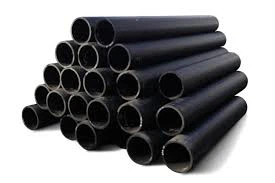
High-Level Summary
API 5L Grade B PSL1 is a standard specification for seamless and welded steel pipe used in pipeline transportation systems in the petroleum and natural gas industries. It represents a good balance of strength, weldability, and cost-effectiveness for low-to-medium pressure applications.
Detailed Breakdown
1. API 5L
This stands for "American Petroleum Institute Specification 5L". This is the governing standard that defines the manufacturing, chemical, and mechanical requirements for line pipe used in the energy sector. It ensures consistency, safety, and reliability across the global supply chain.
2. Grade B
This refers to the minimum yield strength of the steel.
Minimum Yield Strength: 35,000 psi (241 MPa)
Minimum Tensile Strength: 60,000 psi (414 MPa)
"Grade B" is the most common grade for general-purpose, low-pressure pipelines. It offers a good combination of strength and formability.
3. PSL1 (Product Specification Level 1)
PSL defines a set of mandatory, supplementary requirements. PSL1 is the standard, base level of requirements. Pipes with a PSL2 designation have more stringent requirements for chemistry, toughness, and testing.
Key Characteristics of PSL1:
Chemistry: Has broader limits for elements like Carbon (C), Manganese (Mn), and others. It also allows for a higher Phosphorus (P) and Sulfur (S) content, which can slightly reduce weldability and toughness compared to PSL2.
Toughness: No mandatory impact toughness testing (Charpy Test). The pipe is not guaranteed to perform in low-temperature environments where brittle fracture is a concern.
Testing: Requires standard hydrostatic testing and non-destructive electric testing.
Dimensional Tolerances: Standard tolerances for dimensions like outside diameter and wall thickness.
Key Specifications & Properties
| Property | Specification for API 5L Grade B PSL1 |
|---|---|
| Standard | API 5L (Latest edition is API 5L 46th Edition) |
| Grade | B |
| PSL | 1 |
| Min. Yield Strength | 35,000 psi (241 MPa) |
| Min. Tensile Strength | 60,000 psi (414 MPa) |
| Carbon Content (Max) | 0.22% (for seamless), 0.24% (for welded) |
| Toughness Testing | Not Required |
| Common Sizes | Widely available in a full range of sizes, from NPS 1/2" to 48" and larger. |
| Common Wall Thickness | Available in standard (STD), extra-strong (XS), and double-extra-strong (XXS) schedules, among others. |
Manufacturing Processes
API 5L Grade B PSL1 pipe can be manufactured in two main ways:
Seamless (S): Made by piercing a solid steel billet to create a hollow shell. It has no welded seam and is generally used for higher-pressure applications or where the risk of seam failure is a critical concern.
Welded (W): Formed from steel plate or coil (skelp) and then welded along its length. Common types include:
ERW (Electric Resistance Welded): Common for smaller diameters.
SAW (Submerged Arc Welded): Used for larger diameter pipes (e.g., over 16 inches).
The pipe type will be marked on the pipe as either "S" or "W".
Common Applications
This pipe is the workhorse for numerous industries due to its cost-effectiveness and reliability for standard duties.
Onshore and Offshore Oil & Gas Gathering Lines: Transporting crude oil and natural gas from the wellhead.
Low-Pressure Transmission Pipelines: Moving gas over long distances.
Water Injection Lines: In oil fields for secondary recovery.
Piping for other Industrial Fluids: Such as slurry, steam, and water.
Structural Applications: Sometimes used for piling, scaffolding, and structural supports (though not its primary intended use).
PSL1 vs. PSL2: A Quick Comparison
| Feature | PSL1 | PSL2 |
|---|---|---|
| Impact Toughness Test | Not Required | Mandatory |
| Max. Carbon Equivalent | Not Specified | Limited (for better weldability) |
| Max. Sulfur & Phosphorus | Higher Limits | Lower Limits (cleaner steel) |
| Tensile Test | On Pipe, or on Plate for Welded | Always on the Pipe Body |
| Hydrostatic Test Pressure | Lower | Higher |
| Cost | Lower | Higher |
| Application | General Purpose, Low-Risk | Higher Pressure, Colder Climates, Critical |
Conclusion
API 5L Grade B PSL1 is a versatile, economical, and widely available carbon steel pipe suitable for a vast range of low-to-medium pressure fluid transport applications. Its main limitation is the lack of a guaranteed toughness, making it unsuitable for services where low temperatures could cause brittle fracture. For such critical applications, PSL2 or higher grades like X42, X52, etc., would be specified.


