


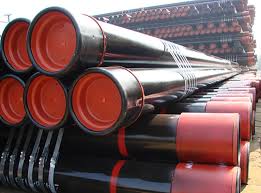

This is a commercially available but highly specialized product. Unlike the H40 grade we discussed previously, API 5CT J55 Spiral Submerged Arc Welded (SSAW) pipe is produced by some manufacturers for a very specific niche market [citation:1, citation:4]. However, it is critical to understand that this combination comes with significant technical trade-offs and is not a substitute for standard OCTG casing in most downhole applications .
Here is a detailed analysis of this specification and its implications.
1. Core Specification Breakdown
This product is a hybrid, combining a material standard for downhole use with a manufacturing process designed for pipelines.
| Component | Meaning | Implication |
|---|---|---|
| API 5CT | The specification for Casing and Tubing for use in oil or gas wells . | The pipe is intended to meet the mechanical and chemical requirements of this standard for well construction materials. |
| J55 | A common, economical casing grade. Minimum yield strength of 55,000 psi (379 MPa) . | It is used for shallow-to-medium depth wells and is one of the most widely produced OCTG grades. |
| Spiral SAW | A pipeline manufacturing process (Spiral Submerged Arc Welding) using a hot-rolled coil to create a helical weld . | This process is ideal for large diameters (24" to 100"+). It is fundamentally different from the seamless or ERW processes typically used for API 5CT products . |
2. Primary Application & Market Niche
This product does not compete with standard J55 casing. Instead, it fills a specific gap: very large-diameter, low-pressure surface strings where traditional methods are impractical or too expensive .
Table 1: Typical Use Case vs. Standard Pipe
| Application | Standard Choice | Why J55 Spiral SAW Might Be Used |
|---|---|---|
| Conductor Pipe | API 5L Gr. B SSAW or LSAW . | Cost and availability. J55 Spiral SAW can be cheaper than large-diameter LSAW pipe. Some suppliers market it as a "casing-grade" alternative . |
| Surface Casing (Shallow) | API 5CT J55 ERW or Seamless . | Diameter Availability. For diameters > 24", ERW/Seamless may have long lead times or be prohibitively expensive. |
| Large-Dia. Water Wells | API 5L or ASTM A139. | Perceived Quality. Buyers may specify "API 5CT J55" assuming it denotes higher quality than line pipe for large-diameter water well projects . |
Critical Limitation: This product is almost never used as production casing, intermediate casing, or in any downhole string that will see significant pressure, corrosive environments, or complex loading .
3. Technical Challenges & Manufacturing Adaptations
To be sold as "API 5CT J55," manufacturers must adapt the spiral welding process to meet the standard's key requirements.
Table 2: Key API 5CT J55 Requirements & Manufacturing Adaptations
| Requirement | API 5CT J55 Spec | Adaptation for Spiral SAW Pipe |
|---|---|---|
| Yield & Tensile Strength | YS ≥ 55,000 psi; TS ≥ 75,000 psi . | Use of low-C, high-Mn steel plate. Transverse weld tensile tests are mandatory and must meet these minimums. The weld is often the weakest point . |
| Hydrostatic Test | Mandatory per formula . | Standard practice for all pressure pipe. Easily performed. |
| Drift Test | Mandatory. A specified mandrel must pass through the pipe . | Major Challenge. Internal weld reinforcement must be meticulously ground flush to allow the mandrel to pass. This is a key quality differentiator between good and poor manufacturers . |
| Hardness | No maximum limit for J55 . | This is a major simplification versus higher grades like L80 or P110. No need for strict HAZ hardness control, which makes welding and heat treatment feasible for spiral pipe. |
| Marking & Traceability | Mandatory stenciling per API. | Standard practice. Pipe will be stenciled with "API 5CT J55" and heat numbers . |
| Threading | Typically API Buttress, ST&C, or LC. | The Biggest Hurdle. For this product, ends are often beveled for field welding only, not threaded . If threading is required, it demands extreme precision to avoid the weld seam in the thread root, which creates a major stress concentration point. |
4. Comparative Analysis
To help you decide, here is a comparison of J55 Spiral SAW against its main alternatives.
Table 3: Decision Matrix for Large-Diameter Surface String
| Parameter | API 5CT J55 Spiral SAW | API 5CT J55 ERW/Seamless | API 5L Gr. B / X42 Spiral SAW |
|---|---|---|---|
| Cost | Lowest for large diameters | Highest | Comparable to J55 SAW |
| Diameter Range | Very Large (e.g., 24" - 100"+) | Limited (typically up to 24") | Very Large (20" - 100"+) |
| Weld Integrity | Single helical seam (potential weak line) | No seam or single longitudinal seam (industry standard) | Single helical seam (industry-accepted for pipelines) |
| Downhole Compliance | Marginal. Meets material spec only; not full product spec for downhole . | Full. Standard, widely accepted product for downhole use . | None. Not designed for downhole loads . |
| Connection | Usually beveled for weld-on shoe or special order threading . | Full range of API/ Premium threads available . | Typically plain end for field girth welding . |
| Best For | Cost-driven, large-diameter conductor/surface casing for simple, shallow, low-pressure wells . | Any well where string integrity and regulatory compliance are critical. | Pipeline transport. A functional, cheaper alternative for conductor pipe . |
5. Critical Questions for Buyers & Specifiers
If you are considering this product, you must ask the supplier these questions to ensure it meets your project's needs:
"Is this pipe intended for downhole casing service, or for piling/structural use?" This will clarify their intended market and application limits .
"Are the pipe ends threaded? If so, please provide the threading procedure and connection test reports per API 5C5." Threading a spiral-weld pipe is a major deviation and requires extensive validation .
"Please provide the Welding Procedure Qualification (WPQ) records and mill test certificates showing transverse weld tensile and flattening test results." This proves the weld itself can meet API 5CT's mechanical requirements .
"How is internal weld reinforcement controlled to guarantee drift compliance?" Request certification of a drift test on every single joint .
"Do you have collapse pressure rating data for this spiral-weld product?" Be aware that the standard API collapse formulas do not apply. The actual collapse strength will be lower and unpredictable .
6. Risks and Final Recommendations
Substantial Risks:
Collapse Rating Unknown: The API bulletin formulas for collapse do not apply to spiral weld pipe. The actual collapse strength is lower and unpredictable .
Threading & Connection Integrity: If threaded, the spiral weld creates a major stress concentrator in the thread root, making it highly prone to leakage or failure .
Limited Regulatory Acceptance: Many operating companies and drilling regulations explicitly forbid spiral weld pipe for downhole use beyond conductor pipe .
Recommendations:
For True Well Casing (Surface or Intermediate): Use API 5CT J55 ERW or seamless pipe. The marginally higher cost is justified by guaranteed performance, known properties, and full regulatory compliance .
For Large-Diameter Conductor Pipe: J55 Spiral SAW can be an option, but only if: (a) it is not threaded (use a weld-on conductor shoe), (b) it is explicitly approved by the drilling engineer, and (c) full traceability and mill certs are provided .
The Pragmatic Alternative: For conductor pipe, consider API 5L Gr. B Spiral SAW pipe . It is functionally identical for this non-critical application, often cheaper, and does not misuse the API 5CT moniker. Its yield strength (≥ 42,000 psi) is sufficient for most conductor designs.
In conclusion, API 5CT J55 Spiral SAW Pipe is a cost-optimized, niche product for specific low-risk surface applications. It trades off guaranteed downhole performance for lower cost and large-diameter availability. It should be selected only with a full awareness of its limitations and should never be used in any well-critical, pressure-containing role without extensive, project-specific engineering review and testing .
Given the significant risks involved with this product, could you specify your exact application (e.g., conductor pipe diameter, setting depth, if it will be threaded) so I can provide more targeted guidance?


