


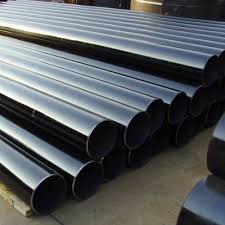

Overview and Key Application
A335 P2 is a seamless ferritic alloy-steel pipe intended for high-temperature service. It is most commonly known as "Chrome-Moly" pipe due to its key alloying elements: Chromium and Molybdenum.
Its primary application is in boiler systems, superheaters, and heat exchangers in power plants, refineries, and other industrial settings where pipes must withstand high internal pressures and temperatures.
A335 P2 Chemical Composition (According to ASTM A335/A335M Standard)
The composition is critical for achieving the desired high-temperature strength and corrosion resistance.
| Element | Composition (%) |
|---|---|
| Carbon (C) | 0.10 - 0.20 |
| Manganese (Mn) | 0.30 - 0.61 |
| Phosphorus (P) | 0.025 max |
| Sulfur (S) | 0.025 max |
| Silicon (Si) | 0.10 - 0.30 |
| Chromium (Cr) | 0.50 - 0.81 |
| Molybdenum (Mo) | 0.44 - 0.65 |
Why these elements matter:
Chromium (Cr): Enhances resistance to oxidation (scaling) and corrosion, especially at high temperatures. It also increases strength.
Molybdenum (Mo): Significantly increases strength at elevated temperatures and improves resistance to creep (the tendency of a material to deform slowly under constant stress at high temperatures).
A335 P2 Mechanical Properties
The pipes are supplied in the annealed or normalized and tempered heat-treated condition to achieve optimal microstructure and mechanical properties.
| Property | Value |
|---|---|
| Tensile Strength | 415 MPa (60,000 psi) min |
| Yield Strength | 205 MPa (30,000 psi) min |
| Elongation | Varies with wall thickness, but typically a minimum of 30% in 2 inches. |
Key Characteristics and Advantages
Excellent High-Temperature Strength: The key reason for its use. It maintains its structural integrity and strength at temperatures where carbon steel would rapidly weaken.
Good Creep Resistance: The molybdenum content is crucial for resisting long-term deformation under stress at high temperatures, which is a primary failure mode in boiler tubes.
Improved Oxidation Resistance: The chromium content provides a protective oxide layer, reducing material loss due to scaling in steam and flue gas environments.
Weldability: P2 steel has good weldability, but it requires pre-heating and post-weld heat treatment (PWHT) following strict procedures to prevent cracking and restore the mechanical properties in the heat-affected zone (HAZ).
Common Specifications and Forms
Governing Standard: ASTM A335 / A335M - Standard Specification for Seamless Ferritic Alloy-Steel Pipe for High-Temperature Service.
Pipe Manufacturing Process: Seamless (mandatory for this specification).
Common Sizes: Available in a wide range of outside diameters and wall thicknesses (schedules), typically from NPS 1/4 to NPS 24.
Comparison with Other Grades
It's helpful to see where P2 fits in the broader A335 family:
| Grade | Common Name | Key Alloying Elements | Typical Use Case |
|---|---|---|---|
| A335 P1 | Carbon-Moly | ~0.50% Mo | Moderate temperatures, better than carbon steel. |
| A335 P2 | 1/2 Chrome-Moly | 0.5-0.8% Cr, 0.5% Mo | This grade. Good balance of cost and performance for many boiler applications. |
| A335 P11 | 1-1/4 Chrome-Moly | ~1.00% Cr, 0.5% Mo | Higher temperature and pressure than P2. |
| A335 P22 | 2-1/4 Chrome-Moly | ~2.25% Cr, 1.00% Mo | Very common for high-pressure steam lines and headers. |
| A335 P5/P9 | 5Cr/9Cr-Moly | 5% or 9% Cr, ~1% Mo | Superior oxidation resistance for very high-temperature sections like superheaters. |
Important Considerations for Use
Heat Treatment: Always verify the pipe has been supplied in the proper heat-treated condition (annealed or normalized and tempered).
Welding Procedures: Strict adherence to qualified welding procedures, including the correct filler metal (often ER80S-B2 or E8018-B2), pre-heat, and post-weld heat treatment (PWHT), is absolutely critical to avoid service failures.
Code Compliance: Its use is governed by construction and operating codes like the ASME Boiler and Pressure Vessel Code (BPVC).
In summary, ASTM A335 P2 is a workhorse alloy steel pipe that provides a cost-effective solution for high-temperature, high-pressure piping systems in boilers and other power generation equipment, offering a significant performance upgrade over plain carbon steel.


