


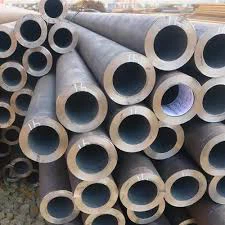

Summary Overview
12CrMoG is a chromium-molybdenum (Cr-Mo) alloy steel specifically designed for high-temperature service, primarily in power plant boilers and pressure vessels. The "G" in its name stands for "Boiler" (from the Chinese standard "Guolu"), indicating its dedicated use.
It offers a excellent combination of strength, weldability, and resistance to creep (deformation under stress at high temperatures) compared to plain carbon steels.
1. Key Characteristics & Properties
High-Temperature Strength: Maintains good mechanical strength and structural integrity at temperatures up to about 580°C (1076°F).
Creep Resistance: Its primary advantage. It resists the slow, continuous deformation that can occur in metals under constant stress at high temperatures, which is critical for boiler tubes.
Good Oxidation Resistance: The chromium content provides improved resistance to scaling (oxidation) in steam environments compared to carbon steels.
Good Weldability: It can be readily welded using common techniques, though pre-heating and post-weld heat treatment (PWHT) are often required to prevent cracking and restore the microstructure.
Toughness and Ductility: Offers a good balance of strength and the ability to deform without fracturing.
2. Chemical Composition (Typical % by weight)
The composition is tightly controlled by standards. Here is a typical range based on the Chinese standard GB 5310:
| Element | Content (%) | Role of the Element |
|---|---|---|
| Carbon (C) | 0.08 - 0.15 | Provides basic strength and hardness. |
| Silicon (Si) | 0.17 - 0.37 | Deoxidizer during steelmaking, improves strength. |
| Manganese (Mn) | 0.40 - 0.70 | Increases strength and hardenability. |
| Chromium (Cr) | 0.40 - 0.70 | Improves high-temperature strength, creep resistance, and oxidation resistance. |
| Molybdenum (Mo) | 0.40 - 0.55 | Significantly enhances strength at high temperatures and creep resistance. |
| Phosphorus (P) | ≤ 0.025 | Impurity; kept low to prevent embrittlement. |
| Sulfur (S) | ≤ 0.015 | Impurity; kept low to improve ductility and weldability. |
3. Mechanical Properties
Mechanical properties are specified at room temperature. The minimum requirements per GB 5310 are typically:
| Property | Value |
|---|---|
| Yield Strength (Rp0.2) | ≥ 205 MPa (≥ 30,000 psi) |
| Tensile Strength (Rm) | 415 - 560 MPa (60,000 - 81,000 psi) |
| Elongation (A) | ≥ 21% |
Note: At elevated temperatures, the strength values (e.g., allowable stress) are provided by material codes and are significantly lower than room temperature values.
4. Common Applications
12CrMoG pipes are exclusively used in high-temperature and high-pressure environments:
Superheater Tubes: Where saturated steam is further heated to become superheated steam.
Reheater Tubes: Where steam from a high-pressure turbine is sent back to the boiler to be reheated before entering intermediate/low-pressure turbines.
High-Temperature Headers and Steam Pipes: Main pipes that carry superheated steam.
Boiler Pressure Parts: Various other components within a power station boiler that operate at elevated temperatures.
5. Relevant Standards
GB 5310: "Seamless steel tubes for high pressure boiler" (The primary Chinese standard that specifies 12CrMoG).
ASTM A335 / ASME SA335: This is the equivalent U.S. standard, where the comparable grade is P2.
DIN 17175: The German standard, where a similar grade is 13CrMo44.
EN 10216-2: The European standard, where a similar grade is 13CrMo4-5.
6. Manufacturing and Processing
Manufacturing Process: Typically manufactured as seamless pipes through processes like hot extrusion or piercing to ensure homogeneity and strength under pressure.
Heat Treatment: Supplied in the normalized and tempered (N&T) condition. This heat treatment optimizes the microstructure (typically a fine bainite) to achieve the best combination of strength, toughness, and creep resistance.
Welding: Requires careful procedure.
Pre-heat: ~150-250°C (300-480°F) is recommended.
Post-Weld Heat Treatment (PWHT): Mandatory. Performed at ~650-680°C (1200-1250°F) to relieve residual stresses and temper the heat-affected zone (HAZ).
Comparison with Other Common Boiler Steels
| Steel Grade | Type | Key Feature | Typical Max Use Temp |
|---|---|---|---|
| 20G | Carbon Steel | Economical, good strength | ~450°C (842°F) |
| 12CrMoG | Low Cr-Mo | Good creep strength | ~580°C (1076°F) |
| 15CrMoG | Low Cr-Mo | Higher Cr for better oxidation resistance | ~550°C (1022°F) |
| 12Cr1MoVG | Cr-Mo-V | Vanadium adds superior creep strength | ~590°C (1094°F) |
| T/P91, T/P92 | High Cr-Mo | Advanced high-strength creep-resistant steels | ~650°C (1202°F) |
Conclusion
12CrMoG is a fundamental and reliable workhorse material in the thermal power industry. It represents a critical step up from carbon steel, offering the necessary creep resistance and high-temperature strength for many sections of a boiler operating at medium to high steam parameters. Its well-understood properties and established welding and fabrication guidelines make it a trusted choice for engineers.


