


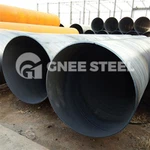


ST37 Structural Steel Pipe
Certification: SGS ISO
Size: OD (4-190mm) x WT (0.5-15mm)
ST37 Structural Pipe Description
ST37 steel pipe is a low-temperature pressure vessel carbon structural steel pipe suitable for low-temperature environments ranging from -45°C to -195°C. The designation "ST37" consists of the German abbreviation "St" (for Stahl, meaning steel) followed by the minimum tensile strength value (in N/mm²). The tensile strength of ST37 steel pipe is not less than 370 N/mm² (370 MPa).
As a manufacturer and supplier of ST37 steel pipes, GNEE Group provides ST37 steel pipes to global customers, including ST37.2 carbon structural steel pipes, St37-3U structural pipes, St37-3n low-temperature pipes, RSt-2 rectangular pipes, and USt37-2 welded pipes. If you have any needs, feel free to contact us at any time.
ST37 Structural Steel Tubes Specification
Standard: ST37
Size: OD (4-190mm) x WT (0.5-15mm)
Length: max 6000mm
Tolerance: ±1%
Payment terms: T/T ,L/C.
Terms of trade: FOB, CFR, CIF, DDP, EXW.
Inspection: Chemical Component Analysis, Flattening Test, Bending Test, Hardness Test, etc..
Packing: Waterproof Paper wrapped, Steel Strips bundled, two tags on each bundle
Chemical Composition of ST37 Hollow Section Steel Tube for Structure
| Grade | C | Si | Mn | Pmax | Smax |
| St37 | ≤0.17 | ≤0.35 | ≥0.35 | 0.04 | 0.04 |
ST37 Hollow Steel Square And Rectangular Welded Steel Pipe


GNEE ST37 Hollow Section Surface Defect Detection Test
-
Eddy Current Testing
Eddy current testing comes in various forms, commonly including conventional eddy current testing, remote field eddy current testing, multi-frequency eddy current testing, and pulsed eddy current testing. It utilizes eddy current sensors to induce currents in metals. Different types and shapes of defects on the surface of square and rectangular tubes will produce different types of signals. Its advantages include high detection accuracy, high detection sensitivity, fast detection speed, the ability to detect the surface and subsurface of the test tube, and being unaffected by impurities such as oil stains on the surface of the test tube. The disadvantage is that it is prone to misjudge non-defective structures as defects, leading to a high false alarm rate, and the detection resolution is not easy to adjust.
-
Ultrasonic Testing
When ultrasonic waves encounter defects in an object, a portion of the waves will be reflected. By analyzing the reflected waves, the transmitter and receiver can accurately detect defects. Ultrasonic testing is commonly used in the inspection of forgings. It has high sensitivity for flaw detection but is not suitable for inspecting complex-shaped tubes. It requires the surface of the square and rectangular tubes to be inspected to have a certain degree of cleanliness, and coupling agent is needed to fill the gap between the probe and the inspected surface.
-
Magnetic Particle Testing
The principle of magnetic particle testing is to establish a magnetic field in the material of the square and rectangular tubes. Based on the interaction between the leakage magnetic field at the defect and the magnetic particles, when there are discontinuities or defects on or near the surface, local magnetic distortion occurs at the discontinuities or defects, generating magnetic poles. Its advantages include low equipment investment, high reliability, and intuitiveness. However, the disadvantages are high operating costs, inability to accurately classify defects, and relatively low detection speed.
-
Infrared Testing
By using high-frequency induction coils, an induction current is generated on the surface of the square and rectangular tubes. This induction current will cause the defective area to consume more electrical energy, leading to a local temperature rise. The local temperature is then detected using infrared rays to determine the depth of the defect. Infrared testing is generally used for detecting defects on flat surfaces and is not suitable for detecting irregularities on metal surfaces.
-
Magnetic Flux Leakage Testing
The magnetic flux leakage testing method for square and rectangular tubes is very similar to the magnetic particle testing method. It has a stronger applicability, sensitivity, and reliability compared to magnetic particle testing.
GNEE Group adheres to providing customers with high-quality steel pipes. If you have any needs, feel free to give us a call.
Hot Tags: st37 structural steel pipe, China st37 structural steel pipe manufacturers, suppliers, A691 Welded Steel Pipe, Low alloy steel pipes, SPRIAL STEEL PIPE, Longitudinal Electric Resistance Weld, Carbon and Alloy Steel Pipe, straight seam resistance welded steel pipe
Previous
ST37.2 Welded TubeYou Might Also Like


Send Inquiry