


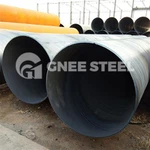


A252 GR2 LSAW Pipe
What ASTM A252 Actually Covers
ASTM A252 (also published as ASME SA252) is the specification for welded and seamless steel pipe piles used in construction. It is a piling standard, not a line-pipe or pressure-pipe standard - the pipe is bought for its ability to bear axial and lateral load as a foundation element, not to hold internal pressure.
The standard splits pipe into three strength grades:
| Grade | Minimum yield | Minimum tensile | Typical use |
|---|---|---|---|
| Grade 1 | 205 MPa / 30,000 psi | 345 MPa / 50,000 psi | Light foundation and casing work |
| Grade 2 | 240 MPa / 35,000 psi | 415 MPa / 60,000 psi | Most building, bridge and marine piling |
| Grade 3 | 310 MPa / 45,000 psi | 455 MPa / 66,000 psi | Heavy piers, large bridges, deep loads |
Grade 2 is the workhorse. Grade 3 is reserved for the heavy stuff - big bridge piers and deep, high-load foundations - while Grade 1 handles lighter duty. For a typical project, Grade 2 is what gets driven into the ground.
Why Pick LSAW for Piling
LSAW means the seam runs straight down the length of the pipe and is welded by submerged arc - usually from both sides, with multiple wires. That gives a clean, fully consolidated seam with predictable ductility, which matters when a pile is hammered or vibrated into place.
The real reason engineers specify LSAW over ERW or spiral (SSAW) is size. Straight-seam mills form the pipe from plate, so they are not tied to coil width. That opens up diameters and walls other processes cannot make:
Large diameter. LSAW piling commonly runs from around 14 in (355.6 mm) up to 72 in (1828.8 mm) on JCOE/UOE lines, and rolled-plate routes push the ceiling to 120 in (3000 mm) for bespoke foundations.
Heavy wall. Wall thickness from roughly 8 mm up to 50 mm on standard lines, and beyond 80 mm on rolled-plate double-seam products.
Long lengths. Single lengths of 6, 12 or 18 m are normal; sections can be welded end-to-end under full UT to make piles up to 60 m, cutting the number of field splices.
Accuracy. After welding, the pipe is expanded and straightened, which tightens roundness and straightness - both count when piles have to line up in a cap or sleeve.
It costs more than ERW or spiral per tonne, but it is still well below seamless, and for large-diameter piles there is often no seamless alternative anyway.
Not sure whether LSAW or spiral fits your pile?
Diameter, wall and driving method decide it. Tell us the foundation type and we will recommend a process and a schedule that keeps your splice count and freight down. Talk to our piling team.
Chemical Composition
One thing buyers miss: ASTM A252 does not set fixed chemical composition limits the way line-pipe specs do. It only requires that the steel contain no more than 0.050% phosphorus, and it leaves the rest of the analysis to the mill, reported as heat and product analysis on the mill certificate.
In practice, A252 Grade 2 is a carbon-manganese steel, and most mills hold a typical range like this:
| Element | Typical, % (max unless noted) |
|---|---|
| C | 0.20 – 0.26 |
| Mn | 0.80 – 1.20 |
| Si | 0.15 – 0.35 |
| P | 0.030 (standard ceiling 0.050) |
| S | 0.030 |
| Carbon equivalent (CEV) | ≤ 0.44 |
That low phosphorus and controlled carbon equivalent are what keep the seam weldable and give the pile enough toughness to survive driving without cracking.
Mechanical Properties
| Property | ASTM A252 Grade 2 |
|---|---|
| Yield strength, min | 240 MPa (35,000 psi) |
| Tensile strength, min | 415 MPa (60,000 psi) |
| Elongation, min | By wall thickness per A252; ≈ 18% in 2 in. at standard wall, ranging 16.75%–25% as wall thins |
The elongation requirement is tied to wall thickness rather than fixed - thicker walls get a lower minimum because the gauge length effect works in their favour. Either way, the ductility is there to absorb the shock of pile driving and the bending a pile sees in soft or layered ground.
Yield-to-tensile ratio and impact testing are not called out by A252 the way they are in line-pipe specs. If your project needs CVN impacts or a ratio cap, that has to go in the purchase order as a supplementary requirement.
Dimensions, Wall Thickness and Length
For LSAW Grade 2 piling, the practical envelope is:
Outside diameter: ~355.6 mm to 1828.8 mm on JCOE/UOE (14–72 in); up to 3000 mm (120 in) on rolled-plate routes.
Wall thickness: ~7.92 mm to 50 mm on standard lines; heavier walls to 80 mm available.
Length: 6 m, 12 m, 18 m as singles; spliced lengths to 60 m.
Ends: plain (square cut) or beveled for welding; threaded-and-coupled only on smaller sizes.
Tolerances Per ASTM A252
| Dimension | Allowance |
|---|---|
| Weight per length | +15% / −5% of theoretical |
| Outside diameter | ±1% (mills often work to ±0.75% / ±3.2 mm) |
| Wall thickness | Not less than 12.5% under nominal (heavy-wall LSAW often quoted −0% / +15%) |
| Straightness | ≤ 0.2% of length |
These are looser than line-pipe tolerances on purpose - a pile is a structural member, not a pressure boundary, so the spec trades tight wall control for drivability and cost.
How It's Made: JCOE and UOE
Two forming routes dominate LSAW piling. JCOE presses the plate step-by-step into a near-round "J-C-O-E" shape before welding; UOE draws the plate into a U then an O in dies. Both feed the seam to a multi-wire submerged arc welder that lays the root and fill passes from inside and outside.
After welding, the pipe goes through expansion and straightening. That step settles the diameter, pulls out camber, and proves the seam by stressing it slightly - a cheap way to shake out a bad weld before it reaches the jobsite. For piling, you do not want surprises once the hammer is running.
Coatings and Surface Finish
Most A252 piles ship bare and oiled or with black varnish, but corrosive sites call for more:
Coal-tar epoxy / bitumen - classic marine and buried protection.
FBE, 3LPE / 3PE, 3PP - fused and multi-layer coatings for aggressive soil and seawater.
Galvanized (zinc) - for fender piles and splash-zone members.
For a wharf or an offshore wind foundation, the coating choice usually tracks the design life, not the pipe grade. Tell us the environment and we will match the system.
Testing and Certification
A252 welding and tensile checks are mandatory; hydrostatic testing is not required by the standard and is normally optional. A typical test set for Grade 2 LSAW piling:
Tension test (longitudinal or transverse strip, 2 in. gauge)
Flattening test - required for welded piles, proves seam ductility
Guided-bend test on the weld
Ultrasonic testing on the seam (spot or 100% on request)
Magnetic particle inspection, optional
Heat analysis with phosphorus reported on the MTC
We supply EN 10204 3.1 mill certificates as standard and 3.2 with a notified body when the project demands it.
Where A252 Grade 2 LSAW Pipe Gets Used
Building deep foundations - high-rise and industrial piles where load per column is high.
Bridge piers and abutments - the classic Grade 2 application.
Ports, wharves and quay walls - marine piles and fender systems.
Retaining walls and cofferdams - permanent and temporary earth retention.
Highway sign and lighting foundations - smaller-diameter piles.
Offshore wind monopiles - large-diameter, heavy-wall versions.
Soil stabilization and temporary works - where a tough, reusable member helps.
In short, anywhere a structure needs a cylindrical member driven or drilled into the ground to carry load, Grade 2 LSAW is on the table.
packaging and shipping

Ready to specify your A252 Gr.2 LSAW piles?
Send your foundation schedule - diameters, walls, lengths, grade and any coating or inspection requirement - to pipe@gneetube.com. We will return a quote with mill certificates and, where needed, a JCOE/UOE production plan that fits your delivery window. For ongoing bridge, port or wind-farm packages, ask about project stock and mill-direct pricing.
FAQ
Is ASTM A252 Grade 2 a pressure pipe?
No. A252 is a piling specification. The pipe is rated for structural load as a foundation element, not for holding internal pressure. If you need a pressure pipe, look at API 5L or ASTM A53 instead.
Does A252 fix the chemical composition?
No. The standard only limits phosphorus to 0.050% and leaves the rest to the mill, reported on the certificate. Grade 2 is supplied as a carbon-manganese steel with controlled carbon equivalent for weldability.
LSAW vs SSAW - which for piling?
LSAW has a straight seam and is the choice for large diameter, heavy wall and high axial capacity. SSAW (spiral) is cheaper for smaller diameters and long runs but is less common for the heaviest foundation piles. The driving method and diameter usually decide it.
What is the biggest diameter and wall you can supply?
Standard JCOE/UOE lines cover up to about 72 in (1828.8 mm) and 50 mm wall. Rolled-plate routes extend to 120 in (3000 mm) and 80 mm wall, with spliced lengths to 60 m. Send your drawing and we will confirm feasibility.
Is hydrostatic testing required?
Not by ASTM A252. Tension and flattening tests are mandatory; hydrotesting is optional and added only when the purchase order calls for it.
Hot Tags: a252 gr2 lsaw pipe, China a252 gr2 lsaw pipe manufacturers, suppliers, Straight Welded Seam Carbon Steel Pipeline, GB T 13793 LSAW Steel Pipe, DIN 17100, A335 P11 P12 alloy steel welded pipes, A335 Alloy Steel ERW Pipe, P12 Alloy Steel Pipe
Previous
A252 GR3 LSAW Steel PipeYou Might Also Like


Send Inquiry