


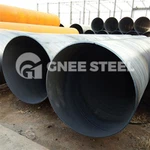


P460NH Steel Welded Pipe
P460NH Steel Welded Pipe - Normalized Fine-Grain Pressure Tube with Elevated-Temperature Strength
P460NH steel welded pipe - engineers also specify it as a P460NH pressure pipe or an EN 10217-3 P460NH tube - is a normalized, weldable P460NH fine grain steel tube covered by EN 10217-3:2019 under material number 1.8935 (often ordered as 1.8935 welded pipe). Its defining feature is not higher strength but a published elevated-temperature yield (Rp0.2) table that runs to 400 °C, so the same 460 MPa room-temperature yield can be designed into steam and boiler service where ordinary carbon steels would need far thicker walls.
P460NH is a high-strength normalized pressure vessel steel grade that is commonly used in applications such as chemical and petrochemical industries, as well as in power generation and offshore engineering. It is a weld able, fine-grain steel grade that offers good mechanical properties and excellent toughness, making it ideal for use in demanding environments.
Our P460NH steel tubes are manufactured using advanced technologies and equipment, ensuring that they meet the highest quality standards. The tubes undergo rigorous testing and quality control processes, including non-destructive testing, to ensure that they meet the required specifications and standards, such as EN 10216-3, ASTM A333, and ASME SA333.
In addition to our standard product range, we also offer customized solutions to meet our customers' specific project requirements. Our technical experts can provide advice on the optimal steel grade, dimensions, and testing requirements for your project.
We are committed to providing our customers with high-quality products and services, which is why we have established a strict quality management system that covers all aspects of our operations, from raw material selection to final product inspection and testing.
If you need P460NH steel tubes for your high-strength normalized pressure vessel applications, we have the expertise and experience to meet your needs. Contact us today to learn more about our products and services and how we can help you achieve your project goals.
P460NH ( 1.8935 ) Specification
| Parameter | Capability |
|---|---|
| Standard | EN 10217-3:2019 (welded); EN 10216-3:2014 (seamless available) |
| Material number | 1.8935 |
| Outside diameter | 21.3–2191 mm (0.84–86.3 in), HFW up to ~610 mm, SAW up to 2191 mm |
| Wall thickness | 2.0–120 mm (0.08–4.72 in), per order and diameter |
| Length | 6–12 m (19.7–39.4 ft) single random, up to 18 m double random on request |
| Welding route | HFW (ERW/HFW) for smaller diameters; SAW (SAWL / SAWH) for large diameters |
| Ends | Plain, bevelled (30°–37°), or square cut; protective end caps available |
| Surface | As-rolled / normalized, varnished or light oil; external coatings on request |
| Delivery condition | Normalized (+N) |
| Certification | EN 10204 3.1; third-party inspection (SGS, TÜV, BV, ABS) available |
Chemical composition % of steel P460NH (1.8935): EN 10028-3-2009
| According EN 10216-3:2014: 1.0=< Mn=<1.7; S=<0.01; N=<0.02; Ti=<0.04; |
| C | Si | Mn | Ni | P | S | Cr | Mo | V | N | Nb | Ti | Al | Cu | - |
| max 0.2 | max 0.6 | 1.1 - 1.7 | max 0.8 | max 0.025 | max 0.015 | max 0.3 | max 0.1 | max 0.2 | max 0.025 | max 0.05 | max 0.03 | max 0.02 | max 0.7 | Nb+Ti+V < 0.22 |
Mechanical properties of steel P460NH (1.8935)
| Nominal thickness (mm): | to 16 | 16 - 60 | 60 - 100 |
| Rm - Tensile strength (MPa) (+N) | 560-730 | 570-720 | 540-710 |
| Nominal thickness (mm): | to 16 | 16 - 40 | 40 - 60 | 60 - 100 |
| ReH - Minimum yield strength (MPa) (+N) | 460 | 445 | 430 | 400 |
| KV - Impact energy (J) longitud., (+N) | -20° 40-45 |
0° 47-65 |
+20° 55-75 |
| KV - Impact energy (J) transverse, (+N) | -20° 27-30 |
0° 35-40 |
+20° 39-50 |
| A - Min. elongation at fracture (%) (+N) | 16-19 |
Equivalent grades of steel P460NH (1.8935)
Warning! Only for reference
| EU EN |
Germany DIN,WNr |
France AFNOR |
Russia GOST |
|||
| P460NH |
|
|
|
Elevated-Temperature Yield - The "H" Property
| Temperature | ≤ 12 mm | > 12–20 mm | > 20–40 mm |
|---|---|---|---|
| 100 °C | 402 | 392 | 382 |
| 150 °C | 373 | 363 | 353 |
| 200 °C | 343 | 343 | 333 |
| 250 °C | 314 | 314 | 304 |
| 300 °C | 294 | 294 | 284 |
| 350 °C | 265 | 265 | 255 |
| 400 °C | 235 | 235 | 226 |
These P460NH high temperature properties are what separate NH from P460N. They define the P460NH maximum temperature for yield-based design at 400 °C - so a wall sized at the ambient 460 MPa would be roughly 56 % too thin. At 300 °C the usable yield has fallen to about 294 MPa; at 400 °C the design yield is 235 MPa, nearly half the room-temperature value. Designing to the correct temperature-specific number, not the headline 460 MPa, is the single most important step in specifying P460NH for hot service. Above 400 °C the design switches to creep / stress-rupture data, which keep the grade usable to about 500 °C.
P460 Family Comparison
| Grade | Material no. | Room yield (≤16 mm) | Impact test temp | Elevated-temp Rp0.2 | Typical service |
|---|---|---|---|---|---|
| P460N | 1.8905 | 460 MPa | 0 °C | No (room-temp only) | Ambient-pressure vessels |
| P460NH | 1.8935 | 460 MPa | −20 °C | Yes, to 400 °C | High-temp steam / boilers |
| P460NL1 | 1.8915 | 460 MPa | −40 °C | No | Low-temp, −40 °C |
| P460NL2 | 1.8918 | 460 MPa | −50 °C | No | Cryogenic / LNG, −50 °C |
All four share the same room-temperature yield of 460 MPa (≤16 mm). The suffix changes only the impact test temperature and - for NH - the addition of the elevated-temperature yield table. Mislabeling NH as a "stronger" grade, or as a low-temperature grade, is the most common specification error in this family.
HFW vs SAW - matching the route to the diameter
| Route | Size suitability | Strength of the route |
|---|---|---|
| HFW / ERW | Smaller diameters, typically up to ~610 mm (24 in) | High-speed, consistent seam, tight tolerances |
| SAW (SAWL / SAWH) | Large diameters up to 2191 mm (86 in) | Heavy walls and large diameters, full weld-seam NDT |
Both routes deliver the same EN 10217-3:2019 grade; the choice is set by diameter and wall thickness, and both require 100 % seam NDT and a leak test before dispatch.
Advantages
The commercial value of P460NH is measurable, not decorative:
Thinner walls at high temperature. Against P355NH at the same pressure and temperature, P460NH runs roughly 15 % thinner - less material, less weight, easier welding.
Designable to 400 °C by yield. The standard publishes Rp0.2 at temperature, so engineers can size directly rather than guessing a derating factor.
Good weldability. A carbon equivalent around 0.45 and low impurity levels (P ≤ 0.025 %, S ≤ 0.015 %) keep preheat and PWHT requirements modest versus low-alloy steels.
High integrity as-welded. 100 % weld-seam NDT and a mandatory leak test mean the tube arrives ready for pressure service without re-inspection.
Cost balance. It fills the gap between plain carbon steel (inadequate strength) and 16Mo3 / 13CrMo4-5 (over-specified and more expensive) for intermediate-temperature duty.
Applications
P460NH is selected where the line operates above ambient temperature and where its higher room-temperature yield reduces wall thickness and weight compared with P355NH or carbon-manganese grades. Typical uses:
Power-plant boiler and steam systems
Superheater and reheater headers, main steam lines and boiler drums run hot and benefit directly from the 400 °C elevated-temperature yield table; a thinner wall also eases fabrication and lifting.
Heat exchangers and pressure vessels
Shells, channels and high-temperature process vessels in petrochemical and chemical plants where design temperatures sit in the 200–400 °C band.
High-temperature process piping
Plant piping carrying steam or hot process fluids at pressures where P235GH/P265GH would require impractically thick walls.
District heating mains
High-temperature district-heating supply lines where the 400 °C design capability and good weldability suit long, welded field runs.
Waste-to-energy and biomass plants
High-temperature flue-gas and steam paths where normalized fine-grain steel gives a cost-effective middle ground between carbon steel and low-alloy Cr-Mo grades.
Quality Control and Testing
Weld seam integrity. Every weld seam is non-destructively tested along its full length (HFW by electromagnetic/UT, SAW by UT/radiography per EN 10217-3 clause 11.12).
Leak tightness. Each tube passes a hydrostatic test or, at the purchaser's option, an electromagnetic leak test; SAW tubes cannot use the electromagnetic method.
Mechanical verification. Tensile, yield, elongation and Charpy impact at −20 °C are confirmed on test pieces from the heat.
Surface and dimensional check. Surface imperfections deeper than 5 % of wall or 3 mm (whichever is smaller) are dressed; wall thickness is verified at the dressed area.
Certification. EN 10204 3.1 material certificate with full chemical, mechanical and heat-traceability data; third-party inspection on request.
Why Source P460NH Steel Welded Pipe from GNEE
As a P460NH welded pipe supplier and manufacturer, GNEE combines mill-direct pricing with the certificate and inspection discipline this grade demands.
Mill-direct supply with certificate. Tubes are sourced against EN 10217-3:2019 with EN 10204 3.1 certification and full heat-number traceability.
Diameter and wall coverage. HFW and SAW routes cover 21.3–2191 mm outside diameter and walls up to 120 mm, so one supplier handles both plant small-bore and large main-line requirements.
Inspection and logistics. Third-party inspection (SGS, TÜV, BV, ABS) is available, with export packing, VCI protection and port-level shipment from Tianjin.
Test and inspection


Packaging and shipping

Send your outside diameter × wall thickness, quantity, design temperature and destination port - our technical team will confirm the specification against EN 10217-3:2019 and return a quotation with lead time within 24 hours.
Request a P460NH Steel Welded Pipe Quote
FAQ
What is P460NH steel?
P stands for pressure-purpose steel, 460 is the minimum room-temperature yield strength of 460 MPa (66,700 psi) for thicknesses up to 16 mm (0.63 in), N means normalized, and H means the grade carries specified elevated-temperature yield values (Rp0.2) up to 400 °C. The material number is 1.8935 and the governing welded-tube standard is EN 10217-3:2019.
What is the difference between P460NH and P460N?
At room temperature they are identical: both have a 460 MPa minimum yield for thicknesses up to 16 mm. The difference is that P460NH (tested at −20 °C) carries a published elevated-temperature yield table to 400 °C, while P460N is characterized at room temperature only and is impact-tested at 0 °C. Choose NH when the design temperature rises above ambient; choose N for ambient-pressure service.
What is the maximum service temperature for P460NH?
The standardized yield-at-temperature (Rp0.2) values are given up to 400 °C in EN 10217-3:2019. Above 400 °C the design is governed by creep / stress-rupture data, which keeps P460NH usable to roughly 500 °C. Beyond about 500 °C, low-alloy chromium-molybdenum steels such as 16Mo3 or 13CrMo4-5 become more economical.
Is P460NH suitable for low-temperature or cryogenic service?
No. P460NH is impact-tested at −20 °C (minimum 40 J longitudinal / 27 J transverse, Charpy V-notch). It is not a low-temperature grade. For −40 °C service use P460NL1 (1.8915) and for −50 °C / LNG-grade service use P460NL2 (1.8918).
What are the chemical composition limits for P460NH welded pipe?
Cast-analysis maximums per EN 10217-3:2019 are C 0.20 %, Si 0.60 %, Mn 1.10–1.70 %, P 0.025 %, S 0.015 %, Cr 0.30 %, Cu 0.70 %, Mo 0.10 %, Ni 0.80 %, Nb 0.05 %, Ti 0.03 %, V 0.20 %, Al 0.020 % min, N 0.025 % max, with Nb+Ti+V below 0.22 %. Carbon equivalent CEV is limited to about 0.45.
Which standards apply to P460NH welded pipe?
The welded tube is covered by EN 10217-3:2019 (superseding EN 10217-3:2002). The seamless companion is EN 10216-3:2014, the plate is EN 10028-3:2017, and the bars are EN 10273:2007. Material number is 1.8935 and the products fall under PED 2014/68/EU.
What is the P460NH equivalent grade?
The P460NH equivalent grade most buyers ask about is the Chinese Q460R in GB/T 713.2-2023 for pressure-vessel plates - in other words, Q460R equivalent to P460NH is the closest national-standard match. Legacy or regional equivalents also include WStE460 (DIN), E460FP (NF/AFNOR) and 18G2 (GOST). Note that none of these is a drop-in ASTM grade - projects usually procure P460NH directly to the EN designation.
How is P460NH welded pipe produced and tested?
Tubes are made by HFW (high-frequency welded) for smaller diameters or SAW (submerged-arc welded, longitudinal SAWL or helical SAWH) for larger diameters, from normalized fine-grain plate, then normalized. Every weld seam is 100 % non-destructively tested, the tube passes a hydrostatic or electromagnetic leak test, and it is supplied with an EN 10204 3.1 certificate and full traceability to the heat number.
Hot Tags: p460nh steel welded pipe, China p460nh steel welded pipe manufacturers, suppliers, Polyethylene Pipe For Water Supply, SAW Pipe, alloy steel mechanical tubing, High Pressure Water Pipe, Alloy Mechanical Tube, Pipe Fusion Welding
You Might Also Like


Send Inquiry