


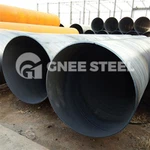


API X52 PSL2 ERW Line Pipe
In X52 electric resistance welded (ERW) line pipe, the designation "X52" signifies a minimum yield strength of 52,000 psi (approximately 358 MPa), classifying it as a medium-strength line pipe steel. Its chemical composition typically features carbon and manganese as the primary alloying elements, along with trace amounts of silicon, phosphorus, sulfur, and other elements. Through controlled rolling and controlled cooling processes, X52 ERW pipe achieves a balance of high strength combined with excellent toughness and weldability.
X52 line pipe is typically required to meet specific low-temperature impact toughness standards to ensure its suitability for use across a diverse range of environmental conditions.
Get a Real-Time Quote: API 5L X52 PSL2 ERW Pipe Prices per Meter/Ton – Updated for now
API 5L X52 PSL1 vs. PSL2 pipeline
| Feature | PSL1 | PSL2 |
| Impact Testing | Not Required | Mandatory (CVN Test) |
| Chemical Composition | Basic Limits | Stricter (Lower Carbon, Phosphorus, & Sulfur) |
| Carbon Equivalent (CEq) | Not Required | Mandatory (Max 0.43% for X52) |
| Traceability | Basic | Full Traceability (from heat to final pipe) |
| Weldability | Standard | Superior (due to controlled chemistry) |
Technical Specifications of X52 PSL2 oil and gas pipelines
Chemical Composition (Max %)
Carbon (C): 0.22%
Manganese (Mn): 1.40%
Phosphorus (P): 0.025%
Sulfur (S): 0.015%
Mechanical Properties
Yield Strength: 360 - 510 MPa (52,200 - 74,000 psi)
Tensile Strength: 460 - 760 MPa (66,700 - 110,200 psi)
Elongation: Based on the cross-sectional area.
Comparison Table: API 5L X52 PSL2 ERW vs. LSAW vs. SSAW Pipes
| Feature | ERW | LSAW | SSAW |
| Full Name | Electric Resistance Welded | Longitudinal Submerged Arc Welded | Spiral Submerged Arc Welded |
| Raw Material | Hot Rolled Steel Coil (HR Coil) | Heavy Steel Plate | Hot Rolled Steel Coil (HR Coil) |
| Forming Process | High-Frequency Induction (HFI) welding via extrusion | JCOE or UOE press forming | Spiral winding and forming |
| Outside Diameter (OD) | 2" - 24" (60.3mm - 610mm) | 16" - 60" (406mm - 1524mm) | 8" - 100" (219mm - 2540mm) |
| Max Wall Thickness (WT) | Thinner (usually < 20mm) | Ultra-thick (up to 60mm+) | Moderate (usually < 25.4mm) |
| Weld Seam Type | One longitudinal seam (nearly invisible) | One longitudinal seam | One continuous spiral seam |
| Weld Seam Length | Equal to pipe length | Equal to pipe length | Much longer (approx. 1.5–2x pipe length) |
| Residual Stress | Relatively low | Lowest (due to Cold Expansion) | Higher |
| Dimensional Accuracy | High (uniform OD and WT) | Highest (calibrated by Cold Expansion) | Fair/Standard |
| PSL2 Compliance | Requires strict Weld Seam Heat Treatment (HT) | Excellent performance in all mechanical/impact tests | Requires strict control of forming stability |
| Cost / Price | Lowest (High production efficiency) | Highest (Complex process & equipment) | Moderate (Economical for large diameters) |
| Common Uses in S. America | Gathering lines, city gas, midstream oil & gas | High-pressure gas mainlines (Long-distance) | Water transport, mining slurry, low-pressure oil/gas |
Coating process of API 5L X52 PSL2 High Yield Line Pipes
3LPE Coating Process (3-Layer Polyethylene)
Detailed Breakdown of the Three-Layer Structure:
- First Layer: Primer - FBE (Fusion Bonded Epoxy; Thickness: >170μm)
Function: Adheres directly to the surface of the steel pipe following sandblasting, providing excellent chemical corrosion resistance and superior resistance to cathodic disbondment.
- Second Layer: Intermediate Layer - Adhesive (Thickness: 170–250μm)
Function: Acts as a "bonding agent," firmly fusing the underlying epoxy layer with the top polyethylene layer.
- Third Layer: Top Layer - High-Density Polyethylene (HDPE; Thickness: 1.5–3.5mm)
Function: Provides robust mechanical protection, guarding against scratches during handling, soil pressure, moisture ingress, and chemical erosion.
Advantages:
Exceptional Service Life: Typically designed for a service life of 30 to 50 years.
Excellent Impermeability: Water vapor is virtually unable to penetrate the HDPE layer.
High Mechanical Strength: Effectively prevents damage to the pipe body caused by backfill soil-particularly in complex environments characterized by rocky terrain, such as the Andes Mountains in South America.
Good Electrical Insulation Properties.
Disadvantages:
Temperature Limitations: Typically restricted to operating temperatures not exceeding 70°C to 80°C.
Cost: More expensive than single-layer FBE coatings.
FBE Coating Process (Fusion Bonded Epoxy)
FBE is a single-layer, thermosetting epoxy powder coating widely used for station piping networks, subsea pipelines, and in environments where extremely robust mechanical protection is not required.
- Process Principle:
Epoxy powder is applied via electrostatic spraying onto the surface of steel pipes that have been preheated to between 190°C and 230°C. The powder melts and cures, forming a dense, cross-linked film structure.
- Advantages:
Exceptional Adhesion: It virtually "fuses" with the steel pipe surface, offering superior resistance to cathodic disbondment.
High Temperature Resistance: Certain specialized FBE coatings can withstand media temperatures ranging from 110°C to 150°C.
Rapid Application: The process is relatively simple, resulting in high production efficiency.
Environmentally Friendly: It is solvent-free.
- Disadvantages:
Brittleness: The coating is relatively thin (typically 300–600 μm); consequently, it is highly susceptible to damage-potentially rendering the pipe unusable-during long-distance transport (e.g., sea freight to Chile or Brazil) or when backfill soil contains rocks.
Water Absorption: When subjected to prolonged immersion in water, its resistance to moisture permeation is slightly inferior to that of 3LPE coatings.
Selection Guide: 3LPE vs. FBE (Choosing for X52 PSL2 Pipelines)
| Selection Criteria | Recommended: 3LPE | Recommended: FBE |
| Installation Environment | Onshore Buried pipelines, complex terrains (mountains, jungles, highly corrosive soils). | Above-ground stations, offshore pipelines (as a layer under concrete weight coating), dry desert areas. |
| Medium Temperature | Ambient / Normal temperature (< 70°C). | High-temperature transport (80°C - 120°C). |
| Transport Distance | Long-distance ocean or land freight (requires extreme abrasion & impact resistance). | Short-haul, intra-plant, or transport with specialized protective packaging. |
| Installation Complexity | High (Field joints require Heat Shrinkable Sleeves (HSS); requires high technical precision). | Moderate (Mature field joint coating processes; easier to repair or touch-up). |
| Project Budget | Higher initial cost; ideal for projects targeting 30+ years of maintenance-free service. | Lower initial cost; suitable for limited budgets or non-severe corrosive environments. |
| Typical Applications | Cross-border gas trunklines (e.g., South America), mining slurry pipelines, high-pressure oil mains. | Refinery piping networks, oil export terminals, station pipe bends, and fittings. |
GNEE 3LPE and FBE coated pipeline for sale

GNEE API 5L Pipeline test and inspection equipment

GNEE API 5L X52 PSL2 oil and gas pipeline packaging and shipping

Looking for Fast Delivery? API 5L X52 PSL2 ERW Pipe Manufacturing Timeline and Global Shipping Options.
FAQ
What is API 5L X52 yield strength
API 5L X52 (also known as L360) steel pipe has a minimum yield strength of 52200psi(360 MPa).
What is api 5l x52 equivalent material
API 5L X52 (L360) is a commonly used oil and gas pipeline grade with a minimum yield strength of 360MPa(52200psi). The primary equivalent material is ISO 3183 L360. Other common equivalents include ASTM A106 Gr. B or ASTM A53 Gr. B (for lower pressure) and structural steel S355.
Hot Tags: api x52 psl2 erw line pipe, China api x52 psl2 erw line pipe manufacturers, suppliers, A530M SSAW Pipe, oil and gas pipes, SY T 5037 2000 SSAW Pipe, EN 10219 S235JRH S275J0H S275J2H Spiral Welded Pipe, Spiral Welded Steel Pipe, ASTM A252 steel pipe
You Might Also Like


Send Inquiry