


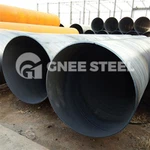


API 5L X120 DSAW Pipe
What is API 5L X120 DSAW Pipe?
API 5L X120 is an ultra-high-strength carbon steel grade under the API 5L specification.
X120: Denotes a minimum yield strength of 120,000 psi (827 MPa).
DSAW (Double Submerged Arc Welded): Refers to the welding process where the pipe is welded both internally and externally using a submerged arc process. For X120, this is typically LSAW (Longitudinal) using high-quality steel plates.
Purpose: It allows for significantly higher operating pressures or reduced wall thicknesses compared to X70 or X80, drastically reducing the total weight of steel required for mega-projects.
Reduce project steel weight by 30%+! API 5L X120 ultra-high strength allows for thinner walls, slashing material and logistics costs. Get your optimization plan now.
Chemical Composition and Mechanical Properties (PSL2)
Chemical Composition (Typical for X120)
X120 requires a complex micro-alloying design and TMCP (Thermomechanical Control Process) to achieve strength without becoming brittle.
| Element | C (Max) | Mn (Max) | P (Max) | S (Max) | Ni | Mo | Cr | Nb/V/Ti |
| X120 (%) | 0.04 - 0.10 | 1.60 - 2.10 | 0.015 | 0.005 |
≤≤ 1.0 |
≤≤ 0.50 |
≤≤ 0.50 |
Trace |
Mechanical Properties
| Grade | Yield Strength (MPa) | Tensile Strength (MPa) | Yield-to-Tensile Ratio |
| X120 PSL2 | 827 - 1000 | 915 - 1145 |
≤≤ 0.93 (approx) |
API 5L X120 DSAW Pipe Specification
| Feature | Description |
| Standard | API Spec 5L (PSL2 Mandatory) |
| Welding Process | DSAW / LSAW (Longitudinal Submerged Arc Weld) |
| Outside Diameter | 16" (406mm) to 60" (1524mm) |
| Wall Thickness | Up to 50mm (typically 12mm to 25mm for X120) |
| Length | 6m to 12.5m (Single or Double Random Length) |
| Coating | FBE, 2LPE, 3LPE, 3LPP, Internal Epoxy Lining |
Dimensional Control
X120 pipes have extremely tight tolerances to ensure perfect alignment during field welding:
Diameter Tolerance: ± 0.5% of OD.
Wall Thickness: ± 5% to 10% depending on WT.
Out-of-roundness: Within 1% of OD.
Straightness: ≤ 0.2% of the total length.
Manufacturing Process (LSAW/DSAW)
Plate Ultrasonic: 100% UT inspection of the high-strength plate.
Edge Milling: Bevelling the plate edges for welding.
Forming: Using JCOE (J-shape, C-shape, O-shape, Expansion) or UOE process.
Tack Welding: Temporary CO2 shielded welding.
Internal DSAW: Submerged arc welding from the inside.
External DSAW: Submerged arc welding from the outside.
Expansion: Cold mechanical expansion to improve dimensional accuracy and relieve internal stress.
Surface of API 5L X120 DSAW Pipe
Internal Surface: Must be smooth, free from scale, and often coated with an epoxy to reduce friction (drag reduction).
External Surface: Must be free from injurious defects like slivers, cracks, or deep scratches.
Surface Preparation: Often sandblasted to Sa 2.5 grade before anti-corrosion coating (3LPE/FBE) is applied.
Delivery Condition of API X120
M (Thermomechanical Rolled/Formed): The strength is derived from the TMCP process of the plate plus controlled cooling.
Delivery: Usually in "M" condition (e.g., API 5L X120M). Note that X120 cannot be normalized or traditionally heat-treated after welding without losing its strength.
Impact Test of API 5L X120 Pipeline
Since X120 is ultra-high strength, toughness is critical to prevent brittle fracture.
Test Type: Charpy V-Notch (CVN) Impact Test.
Temperature: Usually tested at 0°C, -10°C, or -20°C depending on project requirements.
Energy Requirements: Significantly higher than X70, often requiring >150J to 250J (longitudinal) to ensure crack arrest capabilities.
DWTT (Drop Weight Tear Test): Mandatory for PSL2 to ensure shear area percentage at operating temperatures.
NDT (Non-Destructive Testing)
UT (Ultrasonic Testing): 100% of the weld seam and the pipe body.
X-Ray (Radiographic): Used for the weld ends and to verify UT results.
Magnetic Particle (MPI): For detecting surface cracks on pipe ends.
Hydrostatic Test: 100% testing at pressures often exceeding 90% of yield strength.
Pipe Ends
Type: Bevelled ends are standard.
Bevel Angle: 30° (+5°, -0°) with a root face of 1.6mm (± 0.8mm).
Protection: High-strength pipes must have beveled ends protected by heavy-duty caps to prevent nicks that could act as stress concentrators.
Packaging and Marking
Marking: Each pipe must be stenciled with: Manufacturer Name, API 5L Grade X120 PSL2, OD, WT, Length, Heat Number, and Pipe Number.
Packaging:
Pipes are usually shipped bare with a protective varnish or coated (e.g., 3LPE).
Ends are protected with plastic or metal caps.
Hexagonal bundles (for smaller diameters) or loose for larger diameters.
Lifting is done using wide nylon slings to prevent damage to the high-strength steel.
FAQ
What grade pipe is API 5L?
API 5L is a specification for line pipe steel rather than a single specific grade; it encompasses a wide range of grades, ranging from the foundational Grade B to the high-strength "X" series (such as X42, X52, X65, X70, and extending up to the ultra-high-strength X120). In this context, the number following the "X" denotes the pipe's minimum yield strength (measured in thousands of pounds per square inch-for instance, X70 signifies 70,000 psi); a higher number indicates greater strength and the capacity to withstand higher pressures. Furthermore, these grades are further categorized into two Product Specification Levels-PSL1 and PSL2-based on the stringency of their technical requirements, thereby meeting diverse needs ranging from standard transportation applications to demanding, high-pressure environments.
What is the difference between API pipe and ASTM pipe?
The difference between API pipe and ASTM pipe lies primarily in their intended application, industry focus, and technical strictness.
While they often look identical and sometimes overlap, they are governed by different organizations and designed for different environments.
Hot Tags: api 5l x120 dsaw pipe, China api 5l x120 dsaw pipe manufacturers, suppliers, API 5L Spiral Welded Carbon Steel Pipe, GB T 14291 Welded Steel Pipe, SSAW Carbon Steel Tube, LSAW Pipe, JIS A5525 SSAW Pipe, EN 10217 Welded Steel Pipe
You Might Also Like


Send Inquiry