


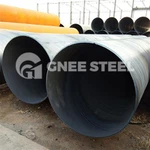


En10219 Electric Resistance Welded Pipes
En10219, the European Standard for structural hollow sections in steel, specifically addresses the design, manufacturing, and quality control of electric resistance welded (ERW) pipes. These pipes are widely utilized in various industries due to their exceptional strength, versatility, and cost-effectiveness. Here's a brief overview of En10219 ERW pipes, encompassing their key features, applications, and manufacturing process within a 300-word limit.
En10219 ERW pipes are characterized by their seamless or spirally welded construction, with electric resistance welding being the preferred method for joining the steel strip edges to form a continuous tube. This welding process ensures a strong, uniform bond, capable of withstanding high pressures and external loads. The standard covers a wide range of pipe dimensions, from small-diameter tubing to large-scale structural elements, catering to diverse application requirements.
The material used in En10219 pipes typically conforms to steel grades such as S235, S275, S355, and their low-temperature variants, ensuring structural integrity even in harsh environmental conditions. The pipes undergo rigorous quality control tests, including non-destructive examinations and mechanical testing, to verify their compliance with the standard's stringent specifications.
The versatility of En10219 ERW pipes makes them indispensable in infrastructure projects worldwide. They are extensively used in the construction of bridges, buildings, stadiums, and other large-scale structures, where their strength and durability are paramount. In the oil and gas industry, these pipes serve as transmission lines, carrying fluids and gases over long distances with minimal leakage risks. Additionally, they find applications in water supply systems, where their corrosion resistance and long service life contribute to efficient and reliable water distribution networks.
The manufacturing process of En10219 ERW pipes involves precision engineering and state-of-the-art technology. The steel strip is first uncoiled and fed into a forming mill, where it's shaped into a tubular form. The edges of the strip are then brought together and welded using high-frequency electric current, forming a continuous seam. Post-welding, the pipe undergoes sizing and straightening operations to ensure dimensional accuracy and straightness. Finally, it's inspected for quality and tested for strength, before being coated or painted for protection against corrosion and the elements.
| Grade: | 300 Series |
|---|---|
| Certification: | ISO, RoHS, IBR, AISI, ASTM, GB, EN, DIN, JIS |
| Shape: | Round |
| Technique: | Cold-Drawing |

FAQ
Q1. How can I request a product sample?
A. The samples are free. We are also responsible for the freight of samples. Please send your adress and your telephone namber by email.
Q2. How can I request a product catalog?
A The hard copies of cataloges are free but freight should be collected. Please send courier account number by email. You are suggested to request a PDF catalog.
Q3. What's your payment terms?
A One is T/T 30% before production and 70% against copy of B/L; the other is irrevocable L/C 100% at sight.
Q4. What's your trade terms?
A FOB, CNF (CFR), CIF, EXW
Hot Tags: en10219 electric resistance welded pipes, China en10219 electric resistance welded pipes manufacturers, suppliers, JIS G3445 ERW CS Pipe, Alloy Steel Pipe, API 5L X52 X56 ERW Pipe, Carbon Steel Tubes, ERW Pipe A178, S355JR square pipe
You Might Also Like


Send Inquiry