


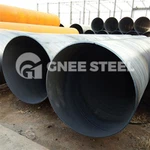


API 5L X100 Carbon Steel Pipes For Oil Pipelines
API 5L X100 carbon steel pipeline is a high-strength pipeline designed for high-pressure and long-distance oil and gas transportation, suitable for extreme working conditions such as deep sea, extreme cold, and high internal pressure. It has a minimum yield strength of 690 MPa and is widely used in international large-scale energy projects.
Specification Chart for API 5L X100 Oil and gas transmission pipe
| Parameter | Value |
|---|---|
| Standard | API 5L / ISO 3183, 46th Edition |
| Grade | X100 |
| Product Specification Level | PSL1 or PSL2 (PSL2 recommended for critical applications) |
| Manufacturing Types | Seamless, LSAW (Longitudinal Submerged Arc Welded), SSAW (Spiral Submerged Arc Welded), ERW (Electric Resistance Welded) |
| Outside Diameter Range | 21.3 mm – 1524 mm |
| Wall Thickness Range | 2.0 mm – 50 mm |
| Length | Single Random Length (SRL), Double Random Length (DRL), Cut-to-Length |
| Delivery Condition | M (Thermo-Mechanical Rolling), Q (Quenched & Tempered) |
Chemical Composition of API 5L X100 Carbon Steel Line Pipe
| Element | Maximum Content (%) | Notes |
|---|---|---|
| Carbon (C) | ≤0.16 | Controlled carbon equivalent for weldability |
| Silicon (Si) | ≤0.45 | Deoxidizer, enhances strength |
| Manganese (Mn) | ≤1.90 | Improves strength and toughness |
| Phosphorus (P) | ≤0.020 | Harmful element, strictly limited |
| Sulfur (S) | ≤0.010 | Prevents hot brittleness, stricter in PSL2 |
| Copper (Cu) | ≤0.50 | Not intentionally added |
| Nickel (Ni) | ≤0.50 | Not intentionally added |
| Chromium (Cr) | ≤0.50 | Not intentionally added |
| Molybdenum (Mo) | ≤0.50 | Not intentionally added |
| Vanadium (V), Niobium (Nb), Titanium (Ti) | Total ≤0.15% | Microalloying elements for grain refinement |
Mechanical Requirements for API 5L X100 oil and gas pipelines
| Property | Requirement |
|---|---|
| Minimum Yield Strength | 690 MPa (100,000 psi) |
| Tensile Strength | 760–990 MPa |
| Yield-to-Tensile Ratio | ≤0.97 |
| Elongation A50mm | ≥18% |
| Charpy V-Notch Impact Energy (0°C) | Avg ≥41J (longitudinal), ≥27J (transverse) |
| DWTT (Drop Weight Tear Test) | Shear Area ≥75% (required for PSL2) |
Size and Weight Chart for API 5L X100 pipeline for oil and gas
| Outside Diameter (mm) | Wall Thickness (mm) | Weight per Meter (kg/m) | Application |
|---|---|---|---|
| 457 | 12.7 | 138.5 | Onshore trunk lines |
| 610 | 14.3 | 210.2 | High-pressure gas transmission |
| 813 | 17.5 | 342.1 | Deep-sea pipelines |
| 1016 | 22.2 | 542.8 | Ultra-high-pressure long-distance transport |
Dimensional Tolerances for API 5L X100 pipelines for combustible fluids
| Parameter | Allowable Deviation |
|---|---|
| Outside Diameter | ±1% of OD |
| Wall Thickness | +12.5% / -10% |
| Length | +2% / -0% |
| Straightness | ≤2 mm/m |
| Bevel Angle | 30°–35° |
| Root Face | 1.6 ± 0.8 mm |
Differences Between PSL1 and PSL2
| Feature | PSL1 | PSL2 |
|---|---|---|
| Chemical Composition | General control | Stricter limits on C, P, S |
| Mechanical Properties | Basic requirements | Higher strength and toughness thresholds |
| Impact Testing | Not mandatory | Required at 0°C (Charpy V-notch) |
| Non-Destructive Testing | Sampling | 100% Ultrasonic + Radiographic Testing |
| Traceability | Standard | Full process traceability |
| Application | General onshore pipelines | Offshore, high-pressure, sour service |
Testing Methods for API 5L X100 Seamless Steel Pipes
Tensile Test: Verifies yield strength, tensile strength, and elongation.
Charpy V-Notch Impact Test: Evaluates low-temperature toughness; minimum 41J at 0°C (longitudinal).
DWTT (Drop Weight Tear Test): Assesses crack propagation resistance; shear area ≥75%.
Hydrostatic Test: Conducted on every pipe; pressure ≥2× design pressure, held for 5 seconds.
Non-Destructive Testing (NDT):
Ultrasonic Testing (UT): 100% longitudinal and transverse flaw detection.
Radiographic Testing (RT): 100% weld inspection (for welded pipes).
HIC/SSC Corrosion Resistance Test: For sour service environments (per NACE MR0175/ISO 15156).
Metallographic Analysis: Confirms microstructure (e.g., bainite, martensite ratio).

API LSAW Pipe Factory

FAQ
What are the grades of API 5L material?
The common steel grades of API 5L materials include Gr. B, X42, X46, X52, X56, X60, X65, X70, X80, X100, and X120, where the number after "X" represents the minimum yield strength of the steel grade (in kilopounds per square inch, ksi). For example, the minimum yield strength of X65 is 65 ksi (approximately 448 MPa)
What is the difference between API 5L and ASTM
The core difference between API 5L and ASTM lies in their usage and performance focus: API 5L is a standard designed specifically for oil and gas transmission pipelines, emphasizing the overall service performance of steel pipes under high pressure, long distance, and complex environments (such as low temperature and corrosion), with special emphasis on weldability, toughness, and crack propagation resistance. It is widely used in cross-border pipeline engineering.
ASTM is a universal material standard system that covers various industrial scenarios. For example, ASTM A106 is mainly used for fixed industrial pipelines with high temperature and high pressure (such as refineries and power plants), and focuses more on the chemical composition and mechanical properties of the material itself, without emphasizing the reliability verification of on-site construction and long-term operation.
Hot Tags: api 5l x100 carbon steel pipes for oil pipelines, China api 5l x100 carbon steel pipes for oil pipelines manufacturers, suppliers, 316 Stainless Steel Welded Pipe
You Might Also Like


Send Inquiry