


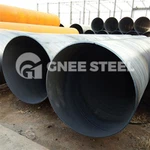


API 5CT L80-13Cr Casing Pipe
L80-13Cr uses chromium (Cr) as the main alloying element, and its mechanical properties can be adjusted through heat treatment processes to achieve L80 and Super 13Cr110 grades. In CO₂-containing oil and gas environments, its corrosion rate is only 1/30 to 1/300 that of ordinary N80Q steel, demonstrating excellent corrosion resistance. It also has seawater corrosion resistance, making it suitable for offshore oil and gas extraction.
API 5CT L80-13Cr Casing Steel Pipe Identification of Color Band Table
To distinguish this high-value alloy pipe in the field, API 5CT specifies a unique color coding system:
| Grade | Body Band Color | Coupling Color |
| L80-13Cr | 1 Red + 1 Brown band | Entire coupling Red with 1 Brown stripe |
API 5CT L80-13Cr Casing Tubing Chemical Composition (%)
The corrosion resistance of 13Cr is derived entirely from its high Chromium content.
| Element | C | Mn | P | S | Si | Cr | Ni | Cu |
| Content (%) | ≤ 0.22 | 0.25 - 1.00 | ≤ 0.020 | ≤ 0.010 | ≤ 1.00 | 12.0 - 14.0 | ≤ 0.50 | ≤ 0.25 |
API 5CT L80-13Cr Seamless Oil Pipe Mechanical Properties
| Property | Requirement |
| Yield Strength | 552 - 655 MPa (80 - 95 ksi) |
| Tensile Strength | ≥ 655 MPa (95 ksi) |
| Maximum Hardness | ≤ 23 HRC |
| Min. Elongation | Calculated based on API formula per specimen area |
API 5CT L80-13Cr Oil And Gas Casing Pipes Manufacturing Types
Due to the metallurgical characteristics of 13Cr, the manufacturing process is strictly controlled:
Seamless (SML): API 5CT mandates that L80-13Cr must be manufactured using a seamless process.
No Welding: Electric Resistance Welding (ERW) and other welding methods are strictly prohibited because the weld zone is highly susceptible to performance degradation in corrosive environments.
Heat Treatment Methods for L80-13Cr Pipes
Heat treatment is critical to achieving the required martensitic structure and corrosion resistance:
Quench & Temper (Q&T): The pipes must undergo full-length quenching and tempering.
Objective: To produce a uniform tempered martensite structure, ensuring the material achieves the 80 ksi yield strength while keeping the hardness within a specific range to prevent brittleness.
API 5CT L80-13Cr OCTG Casing Dimension and Tolerances Table
| Parameter | Tolerance Requirement |
| Outside Diameter (OD) |
≥≥ 4.5": +1.00% / -0.50%; < 4.5": ± 0.79mm |
| Wall Thickness (WT) | Minimum 87.5% of nominal (-12.5%) |
| Weight | Single Joint: +6.5% / -3.5%; Load: -1.75% |
| Straightness | Total deviation
≤≤ 0.2% of length |
| Drift | Must pass standard API drift mandrel |
API 5CT L80-13Cr Petroleum Casing Pipe Connection Type, Ends, and Couplings
Because 13Cr is often used in high-pressure gas wells, the connection choice is vital:
End Types: Plain End (PE), Threaded & Coupled (T&C).
Standard API Threads: BTC (Buttress Thread), LTC (Long Round Thread).
Premium Connections: Gas-tight Premium Connections are very common in 13Cr projects to ensure zero leakage in high-pressure CO2 environments.
Coupling Treatment: Often involves phosphating or special anti-friction coatings to prevent galling, which stainless steel is highly prone to during make-up.
Inspection for L80-13Cr Casing and Tubing
Since 13Cr is used in critical wells, the inspection requirements are more stringent than for carbon steel:
Full-length Ultrasonic Testing (UT): To detect internal and external flaws in the pipe body.
Electromagnetic Inspection (EMI): To assist in detecting surface cracks.
Hardness Testing: A mandatory requirement to ensure the hardness stays within API limits (preventing hydrogen-induced cracking).
Hydrostatic Test: To verify the pressure integrity and sealing capability.
Drift Test: To ensure the internal diameter is clear for downhole tools.
Metallographic Analysis: To verify the microstructure is fully tempered martensite.
API 5CT L80-13Cr Oil Well Drilling Casing Pipe test and inspection

API 5CT L80-13Cr Casing pipe factory

FAQ
What is 13cr L80 material?
API 5CT L80-13Cr is a martensitic stainless steel casing and tubing containing approximately 13% chromium, specifically engineered to resist Carbon Dioxide ( CO2 ) corrosion, commonly referred to as "sweet service." Processed as a quenched and tempered seamless pipe, it provides a yield strength of 80 ksi while maintaining a strict hardness limit of 23 HRC, offering the most cost-effective solution for replacing standard carbon steel in high- CO2 environments to extend well lifespan. However, it is primarily intended for sweet service and is not suitable for harsh sour service conditions with high concentrations of Hydrogen Sulfide ( H2S ).
What is the yield strength of L80-13Cr pipe?
The yield strength of API 5CT L80-13Cr pipe is defined as follows:
Minimum Yield Strength: 80,000 psi (552 MPa)
Maximum Yield Strength: 95,000 psi (655 MPa)
Hot Tags: api 5ct l80-13cr casing pipe, China api 5ct l80-13cr casing pipe manufacturers, suppliers, 316 Stainless Steel Welded Pipe
You Might Also Like



Send Inquiry