


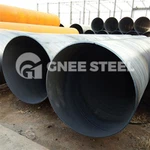


ASTM A312 TP309S Stainless Steel Welded Pipe
Depending on the external dimensions and wall thickness, welded pipes are produced by various methods: electric resistance welding (ERW), fusion welding (EFW), and double submerged arc welding (DSAW). In the ERW and EFW manufacturing processes, welded pipes are formed by hot or cold rolling the sheet and welding the seams. To keep the welded pipe's outer surface (O.D.) smooth and uniform, a cutting tool called a trimming blade is used to remove weld burrs. Trimming can also be done from the internal (I.D.) weld burrs. Heat treatment at the end of the manufacturing process can make the welded area of the steel pipe less noticeable. Due to the presence of the weld seam, welded pipes have lower working pressures than seamless pipes according to ASME regulations. In general, welded pipes have tighter dimensional tolerances than seamless pipes and are less expensive to produce in the same quantity.
ERW is pipe, that is, electric resistance welded pipe. The sheet is rolled into a pipe and then welded using the electric resistance welding process. Usually used for large diameters. (The cheapest process) ERW pipe refers to electric resistance welded pipe. ERW steel pipe is used for various engineering purposes, fencing, scaffolding, line pipe, etc. ERW steel pipe is available in various qualities, wall thicknesses, and finished pipe diameters.
Alloy 309 and Alloy 309S are austenitic chromium-nickel stainless steels that are commonly used in high-temperature applications. Due to the high chromium and nickel content, alloys 309 and 309S are highly corrosion resistant, have excellent oxidation resistance and excellent heat resistance, while having good strength at room temperature and elevated temperatures. The only significant difference between 309 and 309S is the carbon content. The 309S alloy has a much lower carbon component to minimize carbide precipitation and improve weldability.
Alloy 309 (UNS S30900) is an austenitic stainless steel developed for high-temperature corrosion-resistant applications. Under non-cycling conditions, the alloy resists oxidation to 1900°F (1038°C). Frequent thermal cycling reduces oxidation resistance to about 1850°F (1010°C).
Due to its high chromium content and low nickel content, 309 alloy can be used in sour environments up to 1832°F (1000°C). Since the alloy exhibits only moderate resistance to carbon absorption, it is not recommended for use in highly carburizing environments. 309 alloy can be used in mild oxidation, nitriding, bonding, and thermal cycling applications, but the maximum service temperature must be reduced.
Hot Tags: astm a312 tp309s stainless steel welded pipe, China astm a312 tp309s stainless steel welded pipe manufacturers, suppliers, stainless steel tube gaskets, gas permeability of stainless steel tube, stainless steel tube selection, quality inspection of stainless steel tube, stainless steel tube certification, painted stainless steel tube
You Might Also Like



Send Inquiry