


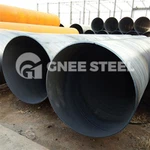


Tubular Steel Tower For Wind Turbine
The Tubular Steel Tower is the most widely utilized support structure in the global wind energy industry, commanding over 90% of the market share. It consists of multiple conical steel sections manufactured in a factory and bolted together at the project site.
Core Function: It supports the nacelle and rotor blades at the required hub height while absorbing and transferring dynamic loads-such as torque, bending moments, and axial pressure-to the foundation.
Key Material: High-strength, low-alloy structural steel (typically S355NL/ML) known for excellent impact toughness at low temperatures and superior weldability.
Data Highlights:
Height Range: Typically 80m–120m for onshore; 140m+ for offshore.
Weight Proportion: Accounts for 60%–70% of the total turbine weight (excluding foundation).
Cost Factor: Represents approximately 15%–20% of the total wind farm CAPEX.
Tubular Steel Tower Specifications
| Parameter | Technical Description |
| Steel Grades | S355J2+N, S355NL, S355ML (per EN 10025 standards) |
| Design Standards | IEC 61400-1, Eurocode 3, GL Guidelines |
| Height Capacity | 50m to 160m (customizable) |
| Max Diameter | Onshore: ~4.5m (logistics limited); Offshore: Up to 8m+ |
| Plate Thickness | 10mm (top) to 80mm+ (base) |
| Section Length | Typically 20m to 35m per section |
| Design Life | 25 to 30 years |
| Operating Temp | -40°C to +50°C |
Structural Components (Structural Design)
A wind tower is a highly engineered system comprising several critical elements:
Conical Shells: The tower body uses a tapered design (wider at the base) to optimize stress distribution and minimize material usage.
Flanges: Located at both ends of each section, these are made of high-strength forged steel. Common designs include L-type or T-type flanges connected via high-tension bolts.
Tower Internals:
Ladders/Service Lifts: Provides access for maintenance personnel.
Platforms: Resting platforms and cable support levels.
Cable Brackets: Secure the power cables descending from the generator.
Safety Systems: Fall arrest rails and aviation obstacle lighting.
Door Frame: A reinforced opening at the base for entry, designed to compensate for the structural strength lost by cutting the shell.
Manufacturing Process
The production of wind towers involves heavy-duty automated machinery and precision engineering:
Plate Cutting & Beveling: CNC plasma or flame cutting machines cut steel plates to size and prepare edges (beveling) for welding.
Rolling: Large 3-roll or 4-roll bending machines cold-form the flat plates into conical or cylindrical segments.
Longitudinal Welding: Submerged Arc Welding (SAW) is used to join the seams of a single shell.
Circumferential Welding: Multiple shells are welded together to form a complete tower section.
Flange Welding: The forged flanges are welded to the tower sections. This is the most critical welding stage requiring extreme precision.
Internal Component Welding: Brackets for platforms and ladders are welded inside the shell.
Surface Preparation: Steel grit blasting to reach Sa 2.5 cleanliness standard.
Coating Application: Multi-layer spray painting for long-term protection.
Quality Control & Test Equipment
Quality assurance is mandatory, with 100% inspection of critical welds:
Non-Destructive Testing (NDT):
UT (Ultrasonic Testing): To detect internal weld defects.
MT (Magnetic Particle Testing): To find surface or near-surface cracks.
PT (Dye Penetrant Testing): For auxiliary surface defect inspection.
RT (Radiographic Testing): X-ray imaging for critical joints.
Geometric Measurement:
Laser Tracker: Used for high-precision measurement of flange flatness, tower verticality, and diameter tolerances.
Total Station: For overall geometric positioning.
Coating Inspection:
DFT (Dry Film Thickness) Gauge: Ensures paint thickness meets specs.
Adhesion Tester: Ensures the coating will not peel under stress.
Holiday Detector: Detects pinholes or "holidays" in the coating.
Anti-Corrosion Coating System
Towers must survive 25+ years in harsh environments (especially C5-M offshore conditions):
Typical 3-Layer System (ISO 12944 - C5 Standard):
Primer: Zinc-rich Epoxy. Provides electrochemical (galvanic) protection against rust.
Intermediate Coat: High-build Epoxy with Micaceous Iron Oxide (MIO). Acts as a physical barrier against moisture and oxygen.
Top Coat: Aliphatic Polyurethane. Provides excellent UV resistance, color retention, and weathering protection.
Total Thickness Requirements:
Onshore: Approximately 320μm - 360μm.
Offshore (C5-M): Usually exceeds 400μm.
Standard Colors: RAL 7035 (Light Grey) or RAL 9010 (Pure White).
GNEE Tubular Steel Tower

FAQ
Q1: What international standards do your wind towers comply with?
A: Our towers are designed and manufactured in strict accordance with international standards, including IEC 61400 (Design requirements), EN 10025 (Hot rolled products of structural steels), Eurocode 3 (Design of steel structures), and AWS D1.1 or EN ISO 5817 for welding quality.
Q2: How are the tower sections protected during long-distance sea transit?
A: We use Heavy-duty Steel or Airtight Wooden End Covers to seal both ends of each section. This prevents salt spray and moisture from entering the tower and protects the precision-machined flange faces. The external coating is protected by rubber-padded shipping saddles.
Q3: What is the expected maintenance-free life of the coating?
A: Our coating systems are designed to be maintenance-free for 20 to 25 years under normal operating conditions, protecting the structural steel from corrosion and UV degradation.
Hot Tags: tubular steel tower for wind turbine, China tubular steel tower for wind turbine manufacturers, suppliers, A691 Welded Steel Pipe, chromium molybdenum welded pipe, EN10208, GB T1591 2009, Longitudinal Electric Resistance Weld, P12 Alloy Steel Pipe
You Might Also Like



Send Inquiry