


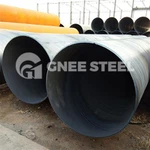


X60 Spiral Steel Pipe
X60 spiral steel pipe - also written x60 spiral welded pipe, and sold as x60 SSAW pipe or x60 SAWH pipe depending on the market - is a carbon steel line pipe in which the strip is wound at a fixed helix angle and welded inside and outside by submerged arc welding. The helical seam lets a single coil width produce a range of finished diameters, which is why spiral mills dominate the large-diameter end of the market. X60 sits one step above X52: the higher yield allows a thinner wall for the same design pressure, so the saving compounds quickly on a long line.
That saving is only real if the weldability and toughness requirements travel with the grade. X60 is normally reached by thermomechanical rolling with a low carbon content, not by adding carbon, and the purchase order has to carry the carbon equivalent, impact and inspection requirements that make the grade usable in the field. The sections below set out what to write, and where quotations usually diverge from the specification.
Standard and Grade: API 5L X60 / L415
X60 spiral pipe is manufactured to API Specification 5L, Specification for Line Pipe, with ISO 3183 as the technically equivalent international standard and GB/T 9711 as the Chinese equivalent. The grade carries two designations for the same property: X60 expresses the specified minimum yield strength as 60,000 psi, and L415 expresses the same value as 415 MPa. Neither is more authoritative; the X form dominates purchase orders and mill drawings, while the L form appears on ISO-flavoured documentation.
Two product specification levels apply. PSL1 covers a base set of requirements. PSL2 adds mandatory chemistry limits, carbon equivalent control, notch toughness and specified inspection. PSL2 is not a higher-strength grade: both levels share the same 415 MPa minimum yield. The difference is how tightly the result is controlled, and that difference is what most X60 orders actually turn on.
Delivery condition suffixes
In PSL2 the grade is written with a delivery-condition suffix, and the suffix is part of the designation rather than a mill preference.
| Suffix | Delivery condition | Available for X60 PSL2? | Practical note |
|---|---|---|---|
| M | Thermomechanically rolled (TMCP) | Yes | Most common route for spiral; combines strength with low carbon and low Pcm |
| N | Normalized | Yes | Available at X60; needs normalizing capacity, so fewer mills quote it |
| Q | Quenched and tempered | Yes | Used where strength uniformity matters; adds heat-treatment cost |
X60 is the last grade in the common ladder where all three conditions are available. From X65 upward, normalized delivery is not permitted under PSL2, so only Q or M apply - a supply constraint worth knowing before a project assumes X60 practice carries over to X65. Confirm availability with the mill against the ordered size.
Chemical Composition
The two levels differ less in the elements they list than in the ceilings they set. Carbon, phosphorus and sulfur all step down at PSL2, and only PSL2 controls carbon equivalent.
| Element (max, mass %) | X60 PSL1 (welded) | X60 PSL2 (welded) |
|---|---|---|
| Carbon (C) | ≤ 0.26 | ≤ 0.22 |
| Manganese (Mn) | ≤ 1.40 * | ≤ 1.40 * |
| Phosphorus (P) | ≤ 0.030 | ≤ 0.025 |
| Sulfur (S) | ≤ 0.030 | ≤ 0.015 |
| Silicon (Si) | - | ≤ 0.45 |
| Nb + V + Ti | per API 5L | ≤ 0.15 combined, subject to individual limits |
| Carbon equivalent | not required | CE_IIW ≤ 0.43; CE_Pcm ≤ 0.25 |
*Mn may be raised under the carbon–manganese interchange rule: for each 0.01 % of carbon below the maximum, the manganese maximum increases by 0.05 %, up to a higher ceiling set by the edition. A low-carbon TMCP heat therefore often reports manganese above 1.40 % and still complies. Values are indicative and must be verified against the applicable API 5L edition, PSL, delivery condition and purchase order.
One correction is worth stating plainly, because it circulates widely, including on supplier pages: 0.12 % is not the carbon limit for X60. That figure belongs to a low-carbon target some mills work to for heavy-wall or sour service, and to the threshold at which Pcm becomes the governing carbon equivalent formula. The specification limit for welded X60 PSL2 is 0.22 %.
Mechanical Properties
The tensile requirements are where PSL1 and PSL2 look least alike, because PSL2 adds ceilings to both yield and tensile strength.
| Property | X60 PSL1 | X60 PSL2 |
|---|---|---|
| Yield strength, Rt0.5 | ≥ 415 MPa (60,200 psi), no maximum | 415–565 MPa (60,200–81,900 psi) |
| Tensile strength, Rm | ≥ 520 MPa (75,400 psi), no maximum | 520–760 MPa (75,400–110,200 psi) |
| Yield-to-tensile ratio | no requirement | ≤ 0.93, for OD > 323.9 mm (12.750 in) |
| Elongation | Per the API 5L formula, which depends on the applicable cross-sectional area and the specified minimum tensile strength | |
| Charpy impact, pipe body | not required | 0 °C: average ≥ 27 J (20 ft·lbf), single ≥ 20 J (15 ft·lbf) |
| Charpy impact, weld and HAZ | not required | Required for PSL2 SAW pipe; test location and orientation per the standard |
| Hydrostatic test | Each pipe; hoop stress 60 % of SMYS | Each pipe; hoop stress up to 90 % of SMYS, per the standard and the order |
Impact values above are the standard PSL2 requirement. Project specifications commonly call for lower test temperatures or higher energy - for example −20 °C or −45 °C, or 40 J minimum - and those values must be stated in the purchase order, because they are additional requirements rather than standard ones. Confirm the elongation calculation and the hydrostatic test pressure against the edition in force.
Dimensions and Supply Range
| Parameter | Typical range | Note |
|---|---|---|
| Pipe type | SAWH / SSAW, helical seam, double-sided SAW | Longitudinal seam pipe (LSAW) is a different product |
| Outside diameter | 219–3048 mm (8–120 in) | Larger diameters evaluated per mill capability |
| Wall thickness | 5.0–25.4 mm | Heavier wall subject to D/t ratio and coil supply |
| Length | 6–12 m; up to about 18 m on some mills | SRL / DRL or fixed length per order |
| Grade and PSL | X60 / L415, PSL1 or PSL2 | PSL2 written with M, N or Q suffix |
| Pipe ends | Beveled end (BE) for field welding; plain end (PE) | Bevel angle and land per the welding procedure |
| Surface protection | 3LPE, 3LPP, FBE; internal epoxy or cement-mortar lining | Coating standard stated separately from the pipe standard |
Body outside diameter tolerance is typically ±0.75 % and wall thickness +15 % / −12.5 % under API 5L PSL2, but tolerances are set by the edition and the size range, and should be read from the standard rather than from a table on a website. Non-standard sizes are evaluated against the purchase order and mill capability; no supplier can promise every combination of diameter and wall.
Manufacturing and Inspection
Spiral pipe starts as hot-rolled coil. The strip is edge-trimmed and edge-prepared, then formed into a helix at a controlled forming angle - typically 30° to 50°, chosen so that the available coil width produces the ordered diameter. An internal welding head lays the root pass and an external head follows immediately, giving a double-sided submerged arc weld along the full helical seam. The pipe is cut to length, and both ends are faced and beveled.
Because the seam runs at an angle, the weld is longer than the pipe: at a 45° forming angle it is roughly 1.5 times the pipe length. That is more weld metal to inspect per metre, which is why 100 % weld NDT matters more on spiral pipe than the tonnage alone suggests.
| Inspection | Scope | Applies to |
|---|---|---|
| Spiral weld ultrasonic testing | 100 % of seam length | PSL1 and PSL2 |
| Hydrostatic test | Every pipe, to the calculated pressure | PSL1 and PSL2 |
| Dimensional and visual | OD, wall, ovality, straightness, end squareness, surface | PSL1 and PSL2 |
| Charpy impact | Pipe body, weld and HAZ | PSL2 |
| Chemistry and carbon equivalent | Heat and product analysis, CE calculation reported | PSL2 |
| Traceability | Heat number marked and carried through to the certificate | PSL1 and PSL2 |
Additional examination - radiographic testing of the seam, drop-weight tear testing, hardness surveys or full-body inspection - is available when the project specifies it. Third-party inspection (for example SGS, BV or DNV) is arranged against the purchase order.
Applications
Large-diameter onshore gas and oil transmission lines, particularly long trunk sections where tonnage and welding time dominate cost
Gathering and flow lines in medium-pressure service
Compressor and pump station piping where a higher grade permits a thinner wall at moderate diameter
Water transmission and raw-water mains at higher pressure than a utility line
Piling and structural tube where the pipe is specified to API 5L rather than a structural standard
Suitability depends on design pressure and temperature, diameter and wall, medium composition, design code, corrosion control and the welding procedure qualified for the project. X60 is not a universal rating, and sour or low-temperature service requires the additional order requirements described above.
Test and inspection


To receive a quotation for X60 spiral steel pipe, provide the grade and PSL, the applicable API 5L edition, the delivery condition suffix (M, N or Q), outside diameter and wall thickness, length and quantity, pipe-end and coating requirements, inspection and certification scope, any third-party inspection, the design pressure and medium, and the destination port with the required schedule.
FAQ
What is X60 spiral steel pipe?
It is line pipe formed from hot-rolled coil into a helix and joined by double-sided submerged arc welding, made to API 5L grade X60, also designated L415 under ISO 3183. The grade has a specified minimum yield strength of 415 MPa (60,200 psi). It is supplied in PSL1 and PSL2 and is used mainly for large-diameter oil, gas and water transmission where a higher strength than X52 allows a thinner wall.
Is X60 the same as L415?
Yes. X60 and L415 are two designations for the same grade. The X number is the specified minimum yield strength in thousands of pounds per square inch, and the L number is the same property in megapascals, so 60 ksi corresponds to 415 MPa. API 5L and ISO 3183 share the grade table, and PSL2 delivery conditions are written with a suffix, for example L415M or X60M.
Should I specify X60 PSL1 or PSL2?
For transmission pipelines, sour or low-temperature service, and any line under a regulated design code, specify PSL2. PSL2 does not make the pipe stronger; it caps yield at 565 MPa, limits the yield-to-tensile ratio, controls carbon equivalent, requires Charpy impact testing and full-length weld inspection. PSL1 remains workable for general low-pressure water and utility lines where the purchaser accepts looser chemistry and no mandatory impact test.
What do the M, N and Q suffixes mean on X60 pipe?
They state the delivery condition. M is thermomechanically rolled, N is normalized, and Q is quenched and tempered. X60 PSL2 can be supplied in all three conditions, which is one reason it is easier to source than X65, where normalized delivery is not permitted and only Q or M apply. The suffix is part of the grade designation and must appear on the purchase order and the certificate.
What is the carbon equivalent requirement for X60?
PSL2 controls carbon equivalent by two formulas: CE_IIW at 0.43 maximum and CE_Pcm at 0.25 maximum. The Pcm formula is the governing one when carbon is 0.12 % or below, which is the normal case for thermomechanically rolled X60; CE_IIW governs at higher carbon. PSL1 sets no carbon equivalent requirement at all, which is a common reason a PSL1 quotation cannot be substituted into a PSL2 specification.
Can X60 spiral pipe be supplied for sour service?
Yes, when it is ordered that way. Sour service under API 5L Annex H tightens sulfur and phosphorus limits, restricts hardness and requires hydrogen-induced cracking and sulfide stress cracking testing to NACE TM0284 and NACE TM0177, usually with a carbon equivalent below the standard PSL2 ceiling. The requirement has to be stated in the purchase order, because standard PSL2 pipe is not automatically suitable for wet H2S service.
What diameters and wall thicknesses are available in X60 spiral pipe?
Spiral welded X60 is typically supplied from 219 mm to 3048 mm outside diameter (8 to 120 in) with wall thickness from 5.0 mm to about 25.4 mm, in lengths of 6 to 12 m and up to about 18 m on some mills. Heavier wall and larger diameter are evaluated against the diameter-to-thickness ratio, coil capability and transport limits rather than quoted as a standing range.
What coating is used on buried X60 spiral steel pipe?
3LPE to ISO 21809-1 or DIN 30670 is the usual external coating for buried X60 spiral pipe, with 3LPP for higher temperatures and FBE where a thin film or a high-temperature section suits better. Coating is a separate specification from API 5L and is ordered with its own thickness class and test requirements. On spiral pipe the helical seam needs separate attention, because ISO 21809-1 allows up to 10 % reduction in total coating thickness over the SAW weld seam.
What does dual grade X60/X65 mean on a certificate?
Under PSL2 the yield ranges of X60, X65 and X70 overlap between 485 MPa and 565 MPa, so a pipe with an actual yield inside that band can satisfy more than one grade. Mills therefore sometimes mark and certify pipe against two or three grades. For the buyer this is a documentation convenience, not a strength upgrade: the design must still be based on the lowest grade marked, and the purchase order should state which grade governs.
Hot Tags: x60 spiral steel pipe, China x60 spiral steel pipe manufacturers, suppliers, SSAW Steel Pipe, API 5L Spiral Welded Carbon Steel Pipe, oil and gas pipes, EN10217 P195 P235 P265 SSAW Steel Pipe, Spiral Steel Pipe, EN 10219 S235JRH S275J0H S275J2H Spiral Welded Pipe
You Might Also Like


Send Inquiry