


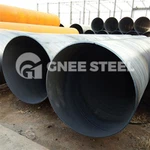


API 5L X46 / L320 ERW Pipe
API 5L X46 (also written L320) ERW pipe is a carbon-manganese line pipe with a minimum yield strength of 320 MPa (46,400 psi), made by high-frequency electric resistance welding (HFW/ERW) and supplied to PSL1 or PSL2. It sits one step above X42 and one below X52, giving a cost-effective strength band for medium-pressure oil, gas and water transmission. The three things your order must decide are the PSL level, the outside diameter and wall, and any sour-service or impact requirement - the grade name alone does none of that.
API 5L names the same steel two ways: X46 uses the ksi convention (46 × 1,000 psi ≈ 320 MPa), while L320 uses the SI convention (320 MPa). Both appear throughout this page and on the certificate. ERW is one of several routes for X46; seamless and LSAW/SSAW make the identical grade, and the route choice is about diameter, the longitudinal seam and economy - not about the steel's strength.
X46 ERW is produced from 21.3 mm to 609.6 mm (1/2–24 in) outside diameter, with walls from 1.8 mm to 22.2 mm. We stock common sizes and roll to order, with 3.1 mill certificates as standard and third-party inspection on request. Send your OD, wall, length and PSL for a quotation.
Technical Specifications
| Parameter | Capability |
|---|---|
| Standard | API Spec 5L (46th ed.) / ISO 3183 |
| Grade | X46 / L320 |
| Process | ERW / HFW (high-frequency induction welded) |
| Product specification level | PSL1 or PSL2 |
| Outside diameter | 21.3–609.6 mm (1/2–24 in) |
| Wall thickness | 1.8–22.2 mm (Schedule 10 to 160, STD/XS/XXS) |
| Length | 3–18 m; SRL 5–7 m, DRL 11–13 m, or fixed length |
| Ends | Plain end, beveled to ASME B16.25 (30° ± 5°), or threaded + coupling |
| Surface / coating | Bare, varnished, 3LPE, 3LPP, FBE, coal-tar epoxy |
| Certification | EN 10204 3.1 as standard; 3.2 with TÜV/SGS/BV on request |
Chemical Composition
| Element | PSL1 seamless | PSL1 welded | PSL2 L320N (normalized) | PSL2 L320Q (quenched) | PSL2 L320M (welded) |
|---|---|---|---|---|---|
| Carbon (C) | 0.28 | 0.26 | 0.24 | 0.18 | 0.22 |
| Silicon (Si) | - | - | 0.40 | 0.45 | 0.45 |
| Manganese (Mn) | 1.20 | 1.20 | 1.20 | 1.40 | 1.30 |
| Phosphorus (P) | 0.030 | 0.030 | 0.025 | 0.025 | 0.025 |
| Sulfur (S) | 0.030 | 0.030 | 0.015 | 0.015 | 0.015 |
| Niobium (Nb) | - | - | 0.05 | 0.05 | 0.05 |
| Vanadium (V) | - | - | 0.07 | 0.05 | 0.05 |
| Titanium (Ti) | - | - | 0.04 | 0.04 | 0.04 |
| Carbon equivalent | not specified | not specified | CE_IIW ≤0.43; CE_Pcm ≤0.25 | CE_IIW ≤0.43; CE_Pcm ≤0.25 | CE_IIW ≤0.43; CE_Pcm ≤0.25 |
PSL1 carries no carbon-equivalent requirement and no micro-alloy minima; PSL2 controls C, Si, the cleanliness elements P/S and the micro-alloying (Nb+V+Ti ≤ 0.15 %). Under the Mn–C interchange rule, lowering C below the maximum raises the permitted Mn (about +0.05 % Mn per −0.01 % C), up to 1.65 % for grades through L360 - a mill option, not a default.
Mechanical Properties
| Property | PSL1 | PSL2 |
|---|---|---|
| Yield strength | ≥ 320 MPa (no maximum) | 320–525 MPa (46,400–76,100 psi) |
| Tensile strength | ≥ 435 MPa (no maximum) | 435–655 MPa (63,100–95,000 psi) |
| Yield-to-tensile ratio | not specified | ≤ 0.93 (for OD > 323.9 mm) |
| Elongation | By API 5L formula from specimen area and specified min. tensile; not a single fixed % | |
| Charpy impact (PSL2) | not required | 0 °C, avg ≥ 27 J, single ≥ 20 J; project options for lower temp |
| Test standards | API Spec 5L / ISO 3183; certificates EN 10204 3.1 / 3.2 | |
Note the PSL2 ceiling: X46 is not "yield 320 and that is all." PSL2 caps yield at 525 MPa and tensile at 655 MPa to protect field weldability and strain capacity. Quoting a 320 MPa yield with no ceiling on a PSL2 pipe is a specification error.
PSL1 vs PSL2 - What Each Commits To
| Requirement | PSL1 | PSL2 |
|---|---|---|
| Charpy impact test | Not required | Required (0 °C, 27 J avg) |
| Carbon equivalent | None | CE_IIW ≤0.43, CE_Pcm ≤0.25 |
| Yield / tensile ceiling | None | Yield ≤525, tensile ≤655 MPa |
| NDE of weld | Per purchase agreement | Mandatory (full-length UT/ET) |
| Traceability | To end of tests only | Through completion (SR 15.2) |
| Sour service (H₂S) | Not qualified | Qualifiable with sour annex + NACE |
| Typical use | Non-critical, sweet, ambient | Toughness / sour / traced projects |
Choosing PSL1 or PSL2
| Condition | Recommended PSL |
|---|---|
| Sweet, ambient, non-critical utility line | PSL1 |
| Any toughness, traceability or HIC requirement | PSL2 |
| Wet H₂S (sour) environment | PSL2 + sour annex + NACE MR0175 / ISO 15156 |
| Low-temperature or cyclic offshore exposure | PSL2 with specified impact temperature |
What the Pipe Carries: Pressure Rating by Wall
Working pressure follows Barlow's formula, P = 2·S·t / D, where S is allowable hoop stress, t wall and D outside diameter. Below is a screening-level table at a 0.72 design factor (S ≈ 230 MPa), with no corrosion allowance or temperature derating. It shows why "high pressure" must always be stated with a wall thickness.
| Nominal | OD (mm) | Wall (mm) | MAOP (MPa) | MAOP (psi) | MAOP (bar) |
|---|---|---|---|---|---|
| NPS 6 | 168.3 | 7.11 (SCH 40) | 19.5 | 2,825 | 195 |
| NPS 8 | 219.1 | 8.18 (SCH 40) | 17.2 | 2,495 | 172 |
| NPS 12 | 323.9 | 8.38 (SCH 40) | 11.9 | 1,730 | 119 |
| NPS 12 | 323.9 | 10.31 (SCH XS) | 14.7 | 2,130 | 147 |
| NPS 16 | 406.4 | 9.53 (0.375 in) | 10.8 | 1,565 | 108 |
| NPS 20 | 508.0 | 9.53 (0.375 in) | 8.6 | 1,253 | 86 |
| NPS 24 | 609.6 | 9.53 (0.375 in) | 7.2 | 1,045 | 72 |
Screening calculation only - not a substitute for project design. Actual MAOP also depends on the design factor for your class location (ASME B31.4 / B31.8), temperature derating, corrosion allowance, and any pipe-body or weld seam factor. Send your duty to our team for a project-specific check.
Where X46 Sits in the Grade Ladder
X46 is a mid-strength rung. Stepping up or down changes wall thickness and cost for the same pressure.
| Grade | Min yield (MPa) | Relative to X46 | When to choose |
|---|---|---|---|
| B / L245 | 245 | −23 % | Low-pressure utility, lowest cost |
| X42 / L290 | 290 | −9 % | When X46 is slightly over-specified |
| X46 / L320 | 320 | base | Medium-pressure transmission |
| X52 / L360 | 360 | +12 % | Higher pressure or thinner wall needed |
| X60 / L415 | 415 | +30 % | High-pressure trunk lines |
| X70 / L485 | 485 | +52 % | High-pressure, long-haul, strain-based design |
For the same duty, choosing X52 over X46 lets you thin the wall (about 12 % more yield), but costs more per tonne and needs more welding care. X46 is the economical choice when X42 is under-strength but X52 is over-specified.
X46 and L320 Are the Same Steel
There is no "X46 vs L320" decision. X46 and L320 are one grade under two naming systems: X46 is the ksi name (46 × 1,000 psi), L320 is the SI name (320 MPa). A project specification written in MPa will say L320; one written in psi will say X46. Both must yield at least 320 MPa and are supplied to the identical API 5L requirements. State either on the order - and if the rest of the specification is in SI units, L320 is the consistent choice. See our line pipe index for the full grade list.
Carbon Equivalent and Weldability
Weldability is governed by carbon equivalent. PSL1 sets no CEV limit; for PSL2, API 5L requires CE_IIW ≤ 0.43 and CE_Pcm ≤ 0.25, where CE_IIW = C + Mn/6 + (Cr+Mo+V)/5 + (Ni+Cu)/15. Because X46 is a low-carbon, controlled-manganese steel, standard field welding procedures apply with modest, if any, preheat for normal wall thicknesses.
The certificate does not print the CEV automatically - it is calculated from the ladle analysis. Request the CEV explicitly if your WPS qualification or the project specification calls for it. For thicker sections or highly restrained joints, confirm the preheat with our welding engineer.
Standards and Editions in Force
| Standard | Subject | Current edition | Replaces |
|---|---|---|---|
| API Spec 5L | Line pipe (grade, PSL, test) | 46th ed. (2018); 47th ed. published 2 Jun 2026 | 45th ed. |
| ISO 3183 | Steel pipe for pipeline transportation | 2019 | 2007 / 2012 |
| ASME B36.10M | Welded & seamless wrought steel pipe dimensions | 2018 | 2004 |
| ASME B16.25 | Pipe weld end bevels | 2017 | 2003 |
| EN 10204 | Inspection documents (3.1 / 3.2) | 2004 | 1991 |
| NACE MR0175 / ISO 15156 | Sour-service material limits | current | - |
The 47th edition of API Spec 5L was published on 2 June 2026 and, per industry reporting, carries an API Monogram compliance date of 1 July 2027. Its changes most relevant to this product are tightened high-frequency-welded (HFW/ERW) pipe quality controls, updated sour-service and impact-toughness requirements, lamination ultrasonic testing, hydrotest gauge calibration and NDE personnel certification. The 46th edition still governs most orders placed today; because the editions differ, the purchase order should name the edition it is placed against.
Applications
X46 ERW serves medium-pressure transmission and gathering where a longitudinal welded seam is acceptable and diameters stay within the ERW mill envelope. Five applications cover most demand:
Onshore oil and gas gathering lines
Low-to-medium pressure collection from wells and separators to the mainline, where X46's yield is ample and ERW cost is favorable.
Medium-pressure transmission mains
Trunk lines and branch mains where X52 would be over-specified; the Barlow calculation (below) shows typical working pressures.
Water injection and distribution
Water flood and utility lines where corrosion control comes from coating rather than grade, making PSL1 ERW economic.
Marine and jetty piping
Shallow-water offshore and terminal lines; PSL2 with controlled toughness is usual for the cyclic and low-temperature exposure.
Structural and piling
ERW X46 is also supplied to dual standards (e.g. ASTM A53 Grade B) for structural and foundation use where the line-pipe certificate is a bonus.
Why Source X46 ERW Pipe from GNEE
ERW (HFW) and upstream seamless/SAW routes available, with common X46 sizes in stock.
EN 10204 3.1 certificates as standard; 3.2 with TÜV/SGS/BV witness on request.
Full heat-number traceability and in-house tensile, impact, UT and hydrostatic testing.
ISO 9001 quality system and 18+ years of steel-pipe export to 60+ countries.
Cut-to-length, beveling, coating coordination and third-party inspection before shipment.
L320 Steel Welded Pipe Supplier-GNEE Team

GNEE Customers

GNEE Exhibition

Quality Control and Testing
Hydrostatic test. Every pipe, at pressure from P = 2St/D with S at 60 % SMYS (PSL1) or up to 90 % SMYS (PSL2); minimum dwell 5 s (≥10 s above 508 mm).
Weld NDE. 100 % full-length ultrasonic or eddy-current examination of the seam; PSL2 adds full-body UT.
Tensile and flattening / bending. Per heat and lot, confirming yield, tensile and ductility.
Charpy impact (PSL2). 0 °C, average ≥ 27 J, single ≥ 20 J, on pipe body and weld as applicable.
Chemical verification. Heat and product analysis against the PSL chemistry limits above.
Third-party inspection. SGS, BV, TÜV or LR witness and EN 10204 3.2 certification on request.

Send your outside diameter, wall thickness, length, PSL level and any sour-service or impact requirement - plus whether you need ERW/HFW supply. Our technical team will confirm the specification, flag any conflict with the standard, and return a quotation with lead time and documentation scope, typically within 24 hours.
Packaging and Shipping

FAQ
What is the difference between API 5L X46 and L320?
X46 and L320 are the same grade under two naming systems. X46 uses the ksi convention, where 46 means a minimum yield strength of 46,000 psi (about 320 MPa). L320 uses the SI convention, where 320 is the minimum yield in MPa. So X46 and L320 are interchangeable designations; a purchase order can state either, and most international project specs write L320.
Is ERW pipe as strong as seamless pipe of the same grade?
At the same API 5L grade and PSL, ERW (HFW) and seamless pipe share the same minimum yield and tensile strength - 320 MPa minimum yield and 435 MPa minimum tensile for X46. The difference is the longitudinal weld seam, which is removed of flash, heat-treated and 100% non-destructively examined. ERW is not suitable where the specification forbids a longitudinal seam or where very large diameters are needed; those call for seamless or SAW routes.
When should I specify PSL2 instead of PSL1 for X46?
Specify PSL2 when the service needs Charpy impact toughness, a controlled carbon equivalent, mandatory traceability, or sour-service qualification (NACE MR0175 / ISO 15156). PSL1 has no impact requirement, no CEV limit, no yield ceiling and only batch-level traceability. For wet H2S (sour) service, PSL2 is mandatory - PSL1 sulfur of 0.030 % makes it unfit.
What is the yield and tensile strength of X46 pipe?
The minimum yield is 320 MPa (46,400 psi) for both PSL1 and PSL2. PSL1 has no upper bound on yield or tensile. PSL2 sets a ceiling: yield 320–525 MPa and tensile 435–655 MPa, with a yield-to-tensile ratio not above 0.93. A common error is quoting 245 MPa as the X46 yield - that is Grade B (L245), not X46.
What is the maximum diameter of ERW X46 pipe?
ERW (HFW) line pipe is normally produced up to 609.6 mm (24 in) outside diameter, with some mills reaching 26–30 in. Above roughly 610 mm, longitudinal (LSAW) or spiral (SSAW/HSAW) submerged-arc welding is the practical route because the coil width and mill geometry of ERW are exceeded. The grade (X46) does not change across these routes - only the diameter capacity does.
Can X46 ERW pipe be used for sour (H2S) service?
Only as PSL2 ordered with the sour-service annexes of API 5L plus NACE MR0175 / ISO 15156, HIC testing to NACE TM0284 and SSC testing to NACE TM0177, with hardness held to 22 HRC (about 250 HV10). Sulfur is typically tightened to 0.015 % and, on severe projects, to 0.002 % or lower. PSL1 X46 cannot be used in sour service because its 0.030 % sulfur promotes manganese-sulfide inclusion cracking.
How does the API 5L 47th edition affect X46 ERW orders?
The 47th edition was published on 2 June 2026 and, per industry reporting, carries an API Monogram compliance date of 1 July 2027. It tightens high-frequency-welded (HFW) pipe quality controls, sour-service and impact-toughness requirements, lamination UT, hydrotest gauge calibration and NDE personnel certification. The 46th edition still governs most orders today. Because the editions differ, name the edition on the purchase order; for pipe delivered in 2027–28, reference the 47th edition now.
How do I specify an X46 ERW pipe order?
State: (1) standard and grade - API 5L X46 / L320; (2) PSL level; (3) process - ERW/HFW; (4) outside diameter, wall thickness and length in mm and inch; (5) ends - plain or beveled to ASME B16.25; (6) coating if any (3LPE, FBE, etc.); (7) impact temperature and any sour-service requirement; (8) inspection and certificate type (EN 10204 3.1 / 3.2); (9) port of discharge and lead time. Send these to the mill for a confirmed quote.
Hot Tags: API 5L X46 / L320 ERW Pipe, China API 5L X46 / L320 ERW Pipe manufacturers, suppliers, ASTM A672 ERW Pipe, Seamless Mechanical Tubing, ERW welded pipe, ERW Carbon Steel Pipes, Electrofusion Welded Carbon Steel Pipe, A513 ERW Steel Pipe
Previous
ERW TubesYou Might Also Like



Send Inquiry