


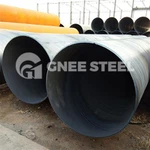


3 Layer PE Coated Anticorrosive Steel Pipe
3PE coated pipes Description
A 3 layer PE coated anticorrosive steel pipe - written 3LPE coated pipe or 3PE coated pipe in most specifications - is a steel line pipe whose outer surface carries a three-layer polyethylene coating: a fusion bonded epoxy primer, a copolymer adhesive and a polyethylene topcoat, applied to a minimum total thickness of 1.8–3.7 mm under DIN 30670-1:2024-01 or up to 4.7 mm under the ISO 21809-1:2018 heavy duty classes.
The pipe is supplied in outside diameters from 60 mm to 3,000 mm (2″–118″) on seamless, ERW, LSAW or HSAW substrates in API 5L grades from Gr.B to X70, in lengths up to 18 m, with the coating cut back at both ends for field welding. Three things decide whether the finished product behaves as the order intended: whether the coating standard and thickness class were actually named, whether the coating was treated as part of a cathodic protection system rather than a stand-alone barrier, and how the pipe was handled between the coating line and the trench.
GNEE supplies coated line pipe on seamless, ERW, LSAW and HSAW substrates with coating applied in-house to DIN 30670-1:2024-01, ISO 21809-1:2018, GB/T 23257 or CSA Z245.21 as ordered. Send the substrate specification and the coating class you need.
Product Name: 3LPE Coated Pipe, 3PE Coating Pipe, Anti Corrosion Steel Pipe
Coating Type: 3 Layer Polyethylene
OD: 25 mm to 3000 mm
WT: SCH5S to SCH160, XXS
Length: Up to 12m
Connection: Weld And Thread
Standard: ANSI, JIS, DIN, EN, ISO,DIN;CAN/CSA,NFA
3PE Anti Corrosion Oil Pipe Specification
| Item | Range |
|---|---|
| Substrate | Seamless, ERW / HFW, LSAW (JCOE, UOE), HSAW / SSAW |
| Outside diameter | 60–3,000 mm (2″–118″) |
| Wall thickness | 4.5–25.4 mm for line pipe; heavier on request for structural and piling service |
| Length | 6–18 m; random or fixed, as ordered |
| Pipe standard | API Spec 5L, ISO 3183, GB/T 9711 |
| Grade and level | API 5L Gr.B to X70, PSL1 or PSL2; X80 by agreement |
| Coating standard | DIN 30670-1:2024-01, DIN 30670-2:2024-01, ISO 21809-1:2018, GB/T 23257, CSA Z245.21 |
| Coating type | Type N (−20 to +60 °C) or Type S (−40 to +80 °C), extruded |
| Thickness class | Normal (n) or reinforced (v); ISO duty class 1, 2 or 3 |
| End preparation | Plain or bevelled to ASME B16.25; coating cut back 120–150 mm (+20/−0 mm) unless otherwise specified |
| Certificates | Pipe: EN 10204 3.1 or API 5L. Coating: EN 10204 2.2, with production test records and the system test report |
| Field joint material | Heat shrinkable sleeves and repair kits can be supplied with the pipe |
Coating Thickness: The Class Is a Decision, Not a Default
Two standards govern the thickness, and they select it by different logic. DIN 30670-1:2024-01 selects by nominal diameter and offers two grades, normal (n) and reinforced (v). ISO 21809-1:2018 selects by pipe mass in kg per metre combined with a duty class from 1 to 3. The same pipe can therefore land in different rows under the two documents, which is why a purchase order that says only "ISO 21809-1 coating" has not defined what acceptable looks like.
| Nominal size DN | Normal (n), mm | Reinforced (v), mm |
|---|---|---|
| ≤100 | 1.8 | 2.5 |
| >100 to 250 | 2.0 | 2.7 |
| >250 to <500 | 2.2 | 2.9 |
| 500 to <800 | 2.5 | 3.2 |
| ≥800 | 3.0 | 3.7 |
Special thicknesses may be agreed. For SAW pipe, ISO 21809-1:2018 Table 2, note a allows the required total thickness to be reduced by a maximum of 10 percent on the weld seam.
Which Duty Class Belongs on Which Ground
The thickness class is an answer to a ground condition and an installation method, not to a preference. On a long transmission route the class is frequently not uniform: the same line can carry a normal grade through farmland and a heavy grade through the rocky sections, the crossings and the directional drills. Specifying the highest class for the whole route is safe but expensive; specifying the lowest for the whole route is neither.
| Class | Ground and backfill | Installation method | Representative minimum total thickness (ISO 21809-1, class A family) |
Where the class comes from |
|---|---|---|---|---|
| 1 - light duty | Sandy soil, screened backfill, no rock | Open trench, standard padding | 1.8–3.2 mm | Handling and soil stress only |
| 2 - moderate duty | Clay soils, absence of imported backfill | Open trench with normal cover | 2.1–3.8 mm | Soil loading plus limited padding |
| 3 - heavy duty | Rocky soil, or offshore | Rock trench, HDD, auger bore, river crossing | 2.6–4.7 mm | Impact and abrasion during laying, plus the consequence of a defect in inaccessible ground |
The ISO thickness step depends on pipe mass in kg/m, so the values above are the range across mass bands, not a single figure per class. DIN classes run 1.8 to 3.7 mm and are selected by diameter instead. The selection logic of the two standards is covered in detail on our 3PE SSAW coated pipe page.
A unit trap worth checking before you compare quotations: DIN 30670-1:2024-01 states peel strength in newtons per centimetre, while ISO 21809-1:2018 states it in newtons per millimetre - a factor of ten apart. ISO class A requires ≥10 N/mm at 23 °C, which is numerically the same as 100 N/cm. A quotation that lists "peel strength 10" against a DIN reference is quoting a figure an order of magnitude below the DIN requirement, and one that lists "peel strength 180" without the unit has quoted an ISO class B figure as if it were a DIN one.
Advantages
Extremely long service life
The three-layer structure works together to block soil moisture, microorganisms and chemical media, and the pipeline life is increased to 30-50 years, which is more than 3 times longer than traditional anti-corrosion technology.
Excellent mechanical protection performance
The impact strength is more than 15 joules (traditional anti-corrosion pipes are about 11 joules), which can resist the collision of construction machinery and foundation settlement stress.
The pressure bearing capacity of the spiral welded pipe matrix (such as SSAW) reaches X70-X80 steel grade, which is suitable for high-pressure transmission environment.
Adaptability to harsh environments
Passing -40℃ low temperature shock and 60℃ high temperature tests, it maintains stability in complex geology such as deserts, wetlands, and seabeds.
3PE coated pipes


Test and inspection

Package & shipping

Send us the three blank fields and we will quote against them. Tell us the substrate (pipe standard, grade, OD × WT, length), the coating requirement (standard and edition, type, thickness class) and the delivery condition (cutback, bevel, packing, certificates). We will come back with a coated pipe quotation, the applicable coating class for your ground conditions and installation method, and the documentation package that goes with it.
Request a quote for 3LPE coated line pipe
Customers & Exhibition cooperation

GNEE has been engaged in the steel pipe trading industry for 18 years, with partners in more than 160 countries and regions around the world. Every year, it attends exhibitions in Vietnam, Guangzhou, Indonesia, and other countries and regions as an excellent trader, and has won the trust and recognition of customers with high-quality steel pipes and professional services.
FAQ
What is a 3 layer PE coated anticorrosive steel pipe?
It is a steel line pipe whose external surface carries a three-layer polyethylene coating: a fusion bonded epoxy primer, a copolymer adhesive and a polyethylene topcoat. It is the same product as 3LPE coated pipe and 3PE coated pipe - the L stands for layer. The epoxy layer bonds to the blast-cleaned steel and resists cathodic disbondment, the adhesive bonds the epoxy to the polyethylene, and the polyethylene topcoat provides the mechanical protection and the moisture barrier. Total coating thickness runs from 1.8 mm to 3.7 mm under DIN 30670-1:2024-01 and up to 4.7 mm under the ISO 21809-1:2018 heavy duty classes.
Does 3LPE coating make cathodic protection unnecessary?
No, and the pairing is deliberate rather than redundant. Every coating leaks to some degree after handling, laying and backfill; the coating reduces the bare steel area so that a cathodic protection system of practical size can protect what is exposed. The coating and the cathodic protection system are treated as two halves of one corrosion control system, which is why the cathodic disbondment test exists at all: it measures whether the coating stays bonded in a cathodically protected environment. A coating whose failure mode creates tight disbonded pockets that block cathodic current can defeat the protection system even though it looks intact.
What is cathodic disbondment, and is the acceptance limit 5 mm or 7 mm?
Cathodic disbondment is the loss of adhesion between coating and steel caused by the alkaline environment that forms at a coating defect when cathodic protection current flows. It is measured as a disbonded radius from an artificial holiday. The 7 mm figure comes from the 2012 edition of DIN 30670, tested at 23 °C for 28 days or 60 °C for 2 days. DIN 30670-1:2024-01 uses different conditions: 5.0 mm maximum after 24 hours at 65 °C at −3.38 V, and 15 mm maximum after 28 days at −1.38 V at the type-specific elevated temperature. Because the test conditions changed, a 7 mm result cannot be presented as conformity with the current edition.
How thick must the 3LPE coating be?
The thickness is not a single number because the two governing standards select it differently. DIN 30670-1:2024-01 selects by nominal diameter, giving a normal grade of 1.8 mm and a reinforced grade of 2.5 mm up to DN 100, rising to 3.0 mm and 3.7 mm from DN 800 upward. ISO 21809-1:2018 selects by pipe mass in kg per metre combined with a duty class from 1 to 3, so the same pipe can fall in a different row. The purchase order has to name the standard, the coating type and the thickness class; a coating described only as 3LPE has no defined thickness.
How is the field joint at a girth weld coated?
The coating is cut back at both pipe ends before shipment, leaving bare steel for welding. After the girth weld passes inspection, the joint is coated on site, most commonly with a heat shrinkable sleeve to ISO 21809-3:2016. The sequence is solvent cleaning, abrasive blasting or power tool cleaning to St3, an anchor profile of 40 to 100 microns, grinding the factory coating edge to a 30 to 45 degree feather edge, preheating the steel to 50 to 80 °C above dew point, shrinking the sleeve at 120 to 150 °C, and 100 percent holiday testing at 15 to 25 kV after cooling. Field joints account for roughly two percent of the pipeline surface but a disproportionate share of coating failures.
How much coating damage is acceptable before a pipe is rejected?
DIN 30670-1:2024-01 sets the boundary. Defects that do not expose steel may be repaired without limit. Defects that do expose steel are limited to a single area of 10 square centimetres or less, with no more than one such defect per metre of pipe; beyond that the pipe is recoated. Repairs are made with an approved material, normally a liquid epoxy or a heat shrinkable patch, and every repair is re-inspected with the same holiday test and thickness measurement used on the original coating.
Can 3LPE coated pipe be stored outdoors before installation?
Yes, with limits that belong in the supply contract. Stack height is restricted by diameter, from about twelve layers at DN 150 down to three layers above DN 700, and the bottom layer sits at least 300 mm clear of the ground on timber supports placed about 0.75 m from the pipe ends and crosswise at least every 4 m. Slings must be padded webbing at least 60 mm wide; bare wire rope and round-section slings are prohibited. Pipes are stacked with a slight slope so rain does not collect inside, and bevel protectors stay fitted throughout. Where a pipe will sit in an open yard for more than a few months, a UV stabilised polyethylene grade is specified.
What must the purchase order state to make anticorrosive verifiable?
Three groups of information. First, the substrate: pipe standard and edition, grade and product specification level, outside diameter, wall thickness, length and end preparation. Second, the coating: coating standard with edition, coating type N or S, thickness class normal or reinforced, the cutback length, and the test frequency and documentation package. Third, the delivery condition: bevel protection, marking and traceability, and whether field joint material and repair kits are to be supplied with the pipe. An order that reads only "API 5L 3LPE pipe" has defined none of these, which is why quotations for the same wording can differ by more than a millimetre of coating thickness.
Hot Tags: 3 Layer PE Coated Anticorrosive Steel Pipe, China 3 Layer PE Coated Anticorrosive Steel Pipe manufacturers, suppliers, industrial 3pe pipe, standard 3pe pipe, price list 3pe pipe, boxing 3pe pipe, industry analysis 3pe pipe, specification 3pe pipe
You Might Also Like


Send Inquiry